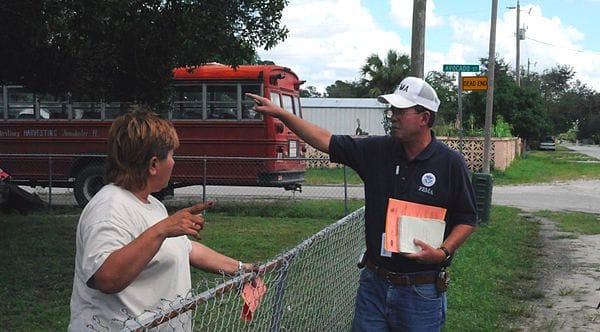
The Washington Post put it simply: “Obama has been aggressive about bolstering the federal government’s capability to respond to disasters, while his Republican challenger believes that states should be the primary responders in such situations and has suggested that disaster response could be privatized.” Thus, the two Presidential candidates have sharply different views – Obama supports FEMA while Romney would curtail the federal role and even transfer as much responsibility as possible from the states to the private sector. Although, as his campaign now insists, Romney might not abolish FEMA completely, he made it clear in a primary debate that its role should be sharply reduced. And even apart from his specific views about FEMA, the Romney-Paul budget plan simply might not leave much room for such non-defense purposes as disaster relief.
Romney’s approach would return the situation in the vicinity of where it was in the early twentieth century, before the federal government got seriously involved in disaster issues. The modern federal role dates from Herbert Hoover’s coordination of relief aid after the Mississippi River flooded 27,000 square miles of the South.
But it’s worth taking a second look at this long-standing practice to see if it’s truly justified. I write and teach about the legal issues relating to natural disasters, so this is a topic I’ve given a lot of thought.
The federal role in emergency relief is clearly justified in the case of major disasters like Hurricane Sandy. State and local authorities are always the first responders, for the simple reason that they are on the scene. But they may need all kinds of help: medical supplies and food, Coast Guard rescues, heavy equipment for clearing rubble, emergency power supplied from Naval ships, and air support to help assess the situation and identify harm. It’s unrealistic to think that states can supply all of these things, or that private charities will have the capacity to provide immediate help on this scale.
Rebuilding is the next phase of a disaster. The federal government provides flood insurance that landowners can purchase and some forms of financial assistance for rebuilding. Without a federal role, disaster recovery would be relatively easy for resident of larger, better-off states like California, Texas, and New York, but a lot harder for citizens in poorer, smaller states.
One argument for a federal role here is that a single state may not be able to handle the extraordinary financial burden without cutting back on key services like schools, prisons and police. Finally, many local resources have multistate significance – think of airports, seaports, interstate highways, and even key private infrastructure like pipelines and telecommunications. More generally, the national economy is sharply interconnected, so it’s a problem if there’s severe local harm. And if people can’t rebuild, they may just move to other states, overburdening those states with their needs.
The final federal role is risk mitigation, like building levees and seawalls to help prevent flooding. To some extent, the reasons for a federal role in risk mitigation mirror the reasons for a federal role in disaster recovery. But there’s an additional reason. Since people in other states are going to be helping to pay for disaster response and recovery, we all have an interest in ensuring that cost-effective precautions are taken in advance to minimize the harm. These might include discouraging residential development in flood zones and building levees, for example.
In short, there are good policy reasons for a substantial federal role in dealing with major disasters. I suspect, however, that for most people the reasons are simpler. And basically, it comes down to the same reason we’d respond if some country invaded a far-off state: a feeling that even distant states are part of our country and have a right to our help. Economists may debate the policy issues, but for most people it’s just a case of “united we stand, divided we fall.”