With Trump’s fresh policy announcements, the mainstream media continues to speculate, and create click-bait for the masses who are eager to read all about the latest decisions from the president-elect.
Wishful thinkers argue he’s reaching out by “softening rhetoric” on building a wall, the alt-right reports he’s betraying his supporters for the same thing. The media analyzes every new policy position as sort some of Machiavellian grand scheme to either shore up the base, or push forward a populist agenda.
https://www.youtube.com/watch?v=7xX_KaStFT8
As fun as these stories must be to write, and as many hits as they get, they’re mostly hyperbole.
All of the evidence leads to Donald Trump shifting priority toward policies that can be achieved via executive order.
Whether it’s prosecuting Hillary Clinton, building a wall along the U.S.-Mexico border, replacing and repealing Obamacare, and pulling the United States out of the Trans-Pacific Partnership, all of these were campaign promises. Now that the election is over, the media is all a tizzy with stories that Trump is hedging on some of these campaign promises.
So where does president-elect Trump actually stand on these central themes? What does he have the power to do using executive order? And what does he need congressional support for?
Prosecuting Hillary Clinton
Campaign
Donald Trump used the prosecution of Hillary Clinton as a rallying cry for his campaign. Crowds picked up the movement with the chant, “Lock her up.” His signature title for the Democratic candidate was “Crooked Hillary.”
Post-Election
Kellyanne Conway, the former Trump campaign manager and a senior adviser to his transition, said in a TV interview the president-elect wanted to “move beyond the issues of the campaign” and confirmed that Mr. Trump did not want his promised Clinton investigations to take place.
Legal Authority
The FBI still has an open investigation into the Clinton Foundation. President-elect Trump cannot authorize prosecution of Clinton; he can only make a suggestion to the F.B.I., the prosecuting agency. Indeed, the powers of the FBI are such that if, as president, Mr. Trump ordered the F.B.I. director, James B. Comey, to close the inquiry, Mr. Comey could choose to rebuff him. To insulate F.B.I. directors from political scrutiny and pressure, they are given a ten-year term. The president can fire a director for cause, as Bill Clinton did in 1993 after a DOJ investigation uncovered abuses by William S. Sessions.
Building the Wall/Mass Deportation of Immigrants
Campaign
Throughout his campaign, president-elect Trump vowed to build a “big, beautiful” wall along the southern border and to have Mexico pay for it. He also promised to deport the nation’s estimated 11 million undocumented immigrants.
Post-Election
In an interview with 60-Minutes, the president-elect said he intends to move forward with the construction of the wall. Some portions may include fencing, he indicated. In the same interview, the president-elect explained that he will begin by deporting illegal immigrants with criminal records and, once finished, will determine next steps. He said he will determine what to do with “everybody else” after the border is secured and after everything gets normalized.
Legal Authority
There are a number of obstacles president-elect Trump would have to overcome before beginning construction of the wall, and it will likely require congressional approval. Regardless of immigration status, all instances of deportation requires due process. As long as this is not violated, the removal of undocumented immigrants who have committed crimes does not require congressional approval.
The Trans-Pacific Partnership
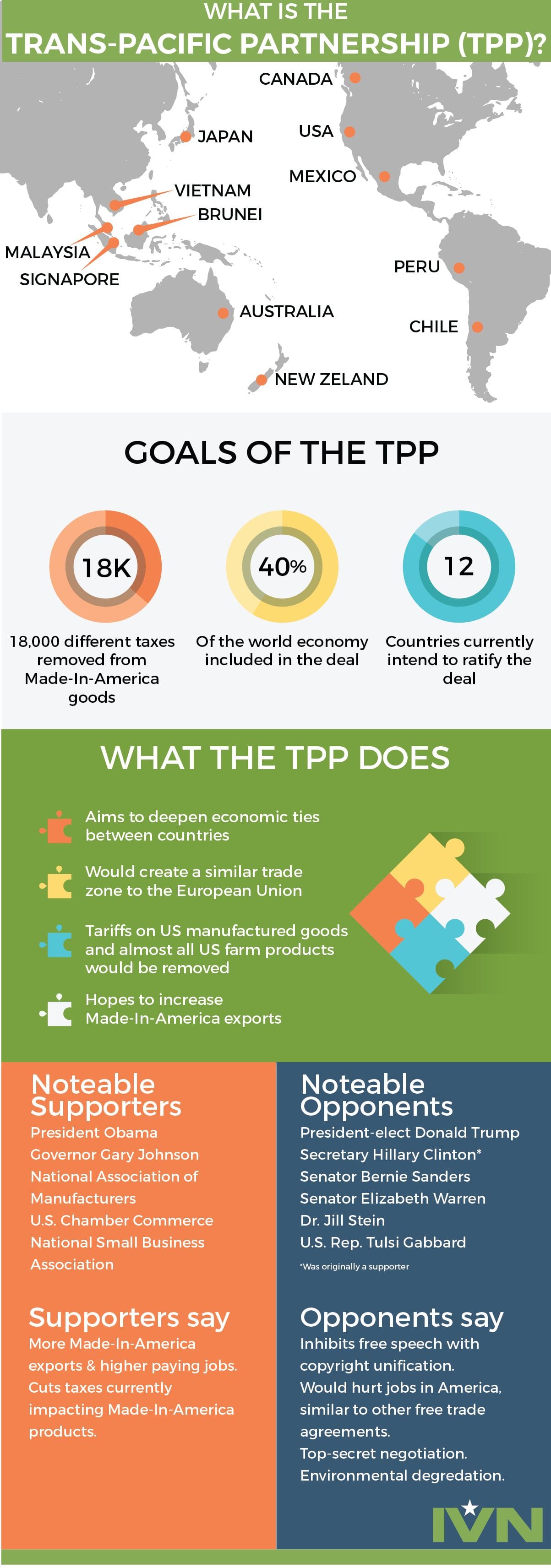
Summary: The massive trade deal that is the TPP, was signed in 2016 by nations including the US, Japan, Malaysia, Australia, New Zealand, Canada and Mexico. It has not been ratified by the individual countries. Its aim was to deepen economic ties, boost growth, and reduce tariffs. There were also measures to enforce labor and environmental standards, copyrights, patents and other legal protections. Opponents say it was negotiated in secret and favored big corporations.
Campaign
During the presidential campaign, Donald Trump was clearly not down with TPP. He called it one of the worst trade deals the United States has ever signed. President-elect Trump described it as "another disaster done and pushed by special interests who want to rape our country.” In another speech he referred to the TPP as "the greatest danger yet.” Announcing the plan to pull out of the TPP, Trump said that the US would "negotiate fair, bilateral trade deals that bring jobs and industry back onto American shores.”
Post-Election
In a video released yesterday, president-elect Trump said on the first day of his presidency he would remove the United States from the TPP. In the video Trump said, “I am going to issue a notification of intent to withdraw from the Trans-Pacific Partnership, a potential disaster for our country. Instead we will negotiate fair, bilateral trade deals that bring jobs and industry back onto American shores.”
Legal Authority
There are a pair of provisions that allow the president to slow-walk or even kill the TPP 12-nation pact using executive order. Trump can refuse to verify that other countries have implemented their early commitments under the pact. He can also simply delay sending the paperwork to inform other TPP members that the United States has completed its own implementation.
Of note: The same authority intended to give a president the power to push complicated trade deals forward can also be used to do the exact opposite, giving the president-elect more leeway than most people realize to indefinitely delay the pact regardless of what Congress does.
Obamacare
Summary: The Affordable Care Act (ACA) or Obamacare, was enacted by President Barack Obama on March 23, 2010. Together with the Health Care and Education Reconciliation Act amendment, it was the most significant regulatory overhaul of the U.S. healthcare system since the passage of Medicare and Medicaid in 1965.
Campaign
“I will repeal and replace Obamacare,” claimed president-elect Donald Trump. The ACA was a big talking point during the campaign. And, as premiums began to rise towards the end of the campaign, so too did the calls to replace and repeal the Affordable Care Act.
Post-Election
The president-elect said he will prioritize repealing President Barack Obama's landmark healthcare law right "out of the gate” once he takes office. Quick action to eliminate the Affordable Care Act of 2010 would set up a showdown with congressional Democrats. The Democratic leader in the Senate, Chuck Schumer recently said: “We're not going to repeal or help [Trump] repeal Obamacare.”
Legal Authority
Congress must weigh-in on repealing and/or replacing Obamacare. The president-elect can advise and sign into law any new revisions. But he cannot make an executive order to eliminate Obamacare.
Energy Independence
Campaign
Generating tens of thousands of middle-class jobs from the oil and coal industry was a key component of president-elect Trump’s campaign. Trump promised voters he would reverse Obama's regulations that he said has “damaged and dismantled our nation’s energy industry.”
President-elect has also had tough words for Saudi Arabia, saying he might eliminate oil imports from the Middle East.
Post-Election
In a video released yesterday, president-elect Trump said in the first 100 days of his presidency he would focus on America’s energy independence. Trump stated, “On energy, I will cancel the job killing restrictions on the production of American energy, including shale energy and clean coal. Creating millions and millions of high paying jobs. That’s what we want, that’s what we’ve been waiting for.”
Legal Authority
The Obama administration’s environmental policies are vulnerable because many of them are the result of executive order, and therefore can be undone by the incoming administration. A statement from the American Petroleum Institute said it looks forward to working with the new administration on energy policies that protect U.S. oil and natural gas production, development and refining, as well as in reducing carbon emissions.
President-elect Trump can rewrite America’s energy policies through executive order and has promised to do so.