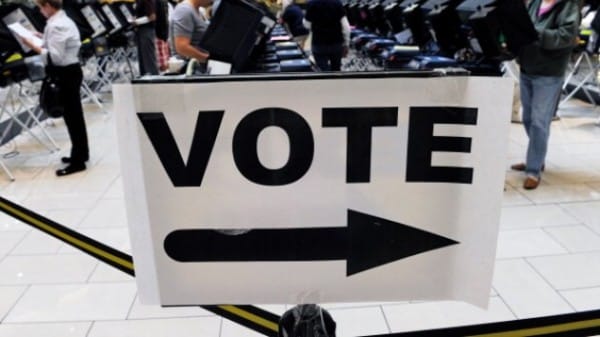
The State of Ohio asked the US Supreme Court Friday to block a ruling that allows all registered voters to cast ballots during the three days leading up to the Nov. 6 election, continuing the battle over early voting rights in that state.
The plea was filed with Justice Elena Kagan after a heated legal battle between the Obama campaign and Ohio’s Republican-led administration over the extent that early voting should be offered to residents.
Early voting began on Oct. 2 in Ohio, but residents were to be originally cut off Nov. 2 after the law constructed by Ohio officials went into effect earlier this year. The law would have only permitted military voters to vote during these three days; however, the three-judge panel from the 6th US Circuit Court of Appeals blocked the law from taking effect and cited it as unconstitutional after the Democratic Party sued the state.
Democrats sued on the grounds that Ohioans would not have equal access to the polls and argued that everyone should be allowed the same access, while the Republican administration in Ohio defended its legislation, stating that local election boards needed the weekend to prepare for Election Day, and that military voters needed the additional days in the case of unexpected deployment.
Ohio Secretary of State Jon Husted filed the appeal claiming that the decision undermines states’ rights.
“This is an unprecedented intrusion by the federal courts into how states run elections, and because of its impact on all 50 states as to who and how elections will be run in America we are asking the Supreme Court to step in and allow Ohioans to run Ohio elections.”
The Circuit Court’s ruling would ultimately leave local board of elections offices to decide whether or not voters will be allowed to cast ballots on the weekend and Monday before Nov. 6, similar to past years.
If the Supreme Court rejects Husted’s application, he said he would set up regular voting hours for each of Ohio’s 88 counties.
A local board of elections employee in Cuyahoga County said as the election nears, confusion grows among employees set to administer the ballots. He said he’s not even fully aware of what hours -- if any -- he will be working the days before the election.
“The problem is that many counties don’t know if this appeal will be upheld or not. So we have no idea if Husted will set uniform hours or if we’ll be working that weekend.”
State law dictates that local election boards determine the hours in which their early voting polls operate, but the secretary of state serves as a tiebreaker if the board remains in gridlock.
Opponents of the law say the move is an attempt to suppress Democratic voters, including African Americans and Latinos, who in 2008 turned out in record numbers. About 30 percent of Ohio’s total vote came in ahead of Election Day in 2008.
Bob Bauer, general counsel for Obama for America, said that the ruling would secure that all citizens be able to exercise their right to vote. "As a result of this decision, every voter, including military, veterans, and overseas voters alongside all Ohioans, will have the same opportunity to vote early through the weekend and Monday before the election."
Many residents simply feel that they're being used as pawns in a political game. Lacey Scarborough, a long-time resident of Cuyahoga County in Northeast Ohio, considers herself to be an independent voter in this election. “I’m starting to become a little cynical about the sheer arrogance of partisan politics in Ohio. I do happen to believe that the right to vote should be given to as many individuals as possible, but that doesn't mean that we can’t come to an agreement about a reasonable way to achieve that,” said Scarborough.
Editor's Note: The Supreme Court has sided with the Democratic party. In a one sentence ruling the Court wrote: "The application for stay presented to Justice Kagan and by her referred to the Court is denied."
IVN.us will continue to report on this unfolding development.