
 Independent Voter Project
On November 19, a California judge will hear arguments to determine whether California’s presidential primary rules violate the constitutional rights of California’s 5.6 million “no party preference” voters.
For presidential contests, the Golden State has some of the most confusing primary rules in the country for independent voters. By default, “no party preference” voters (NPPs) in the state are given a ballot without any presidential candidates at all. If they want to participate, they must choose the ballot of a party that allows them to do so.
The Independent Voter Project and 6 individual plaintiffs argue that the confusion is a consequence of forcing voters to affiliate with a political party as a condition of participating in the presidential primary.
Interestingly, California’s constitution actually requires an “open presidential primary.” However, since the Democratic Party successfully challenged California’s old “open blanket primary” system all the way to the Supreme Court in 2000, the state has conducted a “semi-closed” primary instead.
What does that mean?
Most simply, a voter in California that wants to vote in the presidential primary can only do so if: (1) a party lets them, and (2) the voter actively requests a special ballot to do so.
Here are some key takeaways from the plaintiff’s case:
- Forcing voters to choose a party ballot as a condition of voting is a violation of an individual voter’s right of non-association; the very same right the Democratic Party asserted in the 2000 case, Democratic Party v. Jones.
- If political parties have the right to not associate with voters who don’t join their party, don’t independent voters have a right not to associate with political parties as a condition of voting in a taxpayer-funded primary election?
- The rules serve to suppress voter turnout among California’s 5.6 million voters by denying these voters an equal opportunity to participate in the greatest drive of voter turnout: the presidential primaries.
- This voter suppression has a drastic effect on NPP representation up and down the ballot, as studies show, resulting in more partisan, less diverse, and less representative election outcomes.
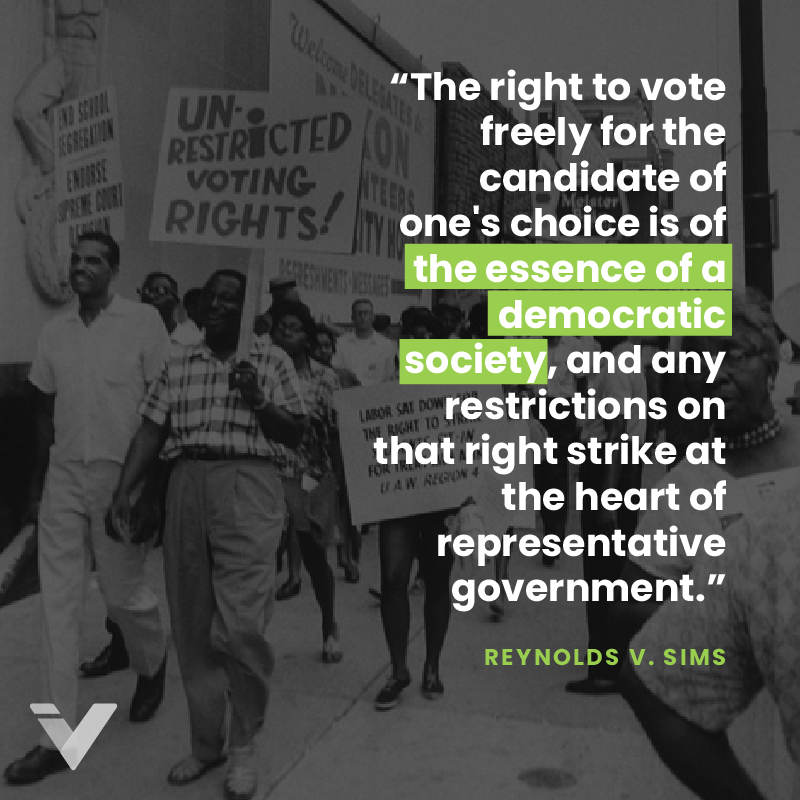
- Cases including Gray v. Sanders (the right to vote includes the primary election), Harper v. Virginia State Board of Elections (invidious barriers, like a poll-tax, violate the fundamental right to vote) and Reynolds v. Sims (every voter must be treated equally) support the position that forcing some voters to choose a party’s ballot as a condition of voting is an unconstitutional burden on the right to vote.
The California secretary of state’s office, in its defense, has argued that the semi-closed primary does not violate the rights of independent voters because independent voters can vote in some of the party primaries.
The plaintiffs do not, however, suggest that independent voters want to, nor should they, have to vote in party primaries. The plaintiffs are asking the secretary of state to simply list all the presidential candidates on the ballot currently given to no party preference voters.
Whether or not the political parties choose to count these NPP votes when nominating a presidential primary is their decision. As IVP points out, the parties don’t even have a legal obligation to count the votes cast in their own primaries. Those decisions are made by party rules and at the party conventions.
It is ironic though (or is it?) that the state has been quick to assert all of the private rights of political parties, rather than the rights of the state itself. The constitution clearly states that California “shall host an open presidential primary” and the state's only interest (should be) to administer elections that serve every voter, not just those who join a political party.
We believe that voting is a right of citizenship. Therefore, it is a fundamental right and no state can set up an election process that gives party-affiliated voters opportunities that other voters do not get.
Our case goes beyond California. It doesn’t matter what state you’re in. The fundamental question is: Does your election serve the political parties, or the voters?
Across the country, states are putting the private interests of the political parties before voters.
That’s why we’re stepping in to defend the rights of EVERY voter, including the 43% of America that does not want to join either major party.
And we’re just getting started.
But, we won’t be successful without your support and action. Let’s make a statement to the California establishment.
We need EVERY voter that wants to see the plaintiffs win this case to sign the petition and contribute.
It’s going to take all of us coming together to show the states: they need to be on the side of the voters! Can you chip in $3 to help us reach our goal?
