
 Shawn Griffiths
Comedian and late-night series host John Oliver made his latest episode of Last Week Tonight about redistricting and its consequences on the 2026 midterms. And while Oliver breaks down the ongoing mid-cycle redistricting fight, he also wraps things up with one message:
“America needs to ‘unf–k’ its maps.”
He specifically said this in response to the knee-jerk reaction from Democrats that their party should continue to respond like California and “fight fire with fire” as Republicans further gerrymander states they control.
He explained it might seem satisfying in the short-term, but in the long term, they “may not like how that fight ends.”
Oliver correctly notes that gerrymandering in the US goes back centuries. It is something that foreign leaders find baffling when they come to the US and congressional elections are explained to them.
Because no other developed democracy lets private political parties have as much control over elections as the US (a point Oliver kind of breezes through).
Oliver’s biases can be debated, but he's not wrong that the current mid-cycle fight started with Republicans in Texas, then escalated with Democrats in California and Republicans in Missouri, and now 9 states have gerrymandered their maps in the last two years:
Alabama, California, Florida, Louisiana, Missouri, North Carolina, Ohio, Tennessee, and Texas. Utah also adopted a new map in 2025 that was ordered by a court, which is why it is not included in the count.
But state lawmakers have tried to escalate in 8 other states: Georgia, Indiana, Maryland, New York, South Carolina, Virginia, and Washington.
Virginia voters temporarily adopted a new map that would have given Democrats an advantage in all but one district. State courts ended up declaring the vote a violation of the state constitution on technical and procedural grounds.
This mid-cycle gerrymandering fight is expected to escalate further following the Supreme Court's decision in Louisiana v. Callais, which in part said the Voting Rights Act cannot compel a state to draw minority-majority districts.
States now have even greater room to argue that they are redrawing their maps for political purposes because SCOTUS already ruled in Rucho v. Common Cause (2019) that federal courts will not interfere in a partisan gerrymander.
Four states used Callais to quickly push through new maps: Florida, Tennessee, Louisiana, and Alabama. Democrat-controlled states like Colorado, Illinois, Maryland, and New York could decide to join in as well.
One House Democrat even said there is a nuclear option in Illinois that would create a 17-0 map for Democrats.
States continue to evaluate their options, but as they do, the idea that the US House is meant to accurately represent the population of each state ceases to mean anything. It is not about representation. It is about control—and who has it.
This isn't new. While Illinois may consider a nuclear option, it already has one of the worst gerrymandered maps in the US, just like Texas or Florida. Both parties gerrymander—and they always have.
 Shawn Griffiths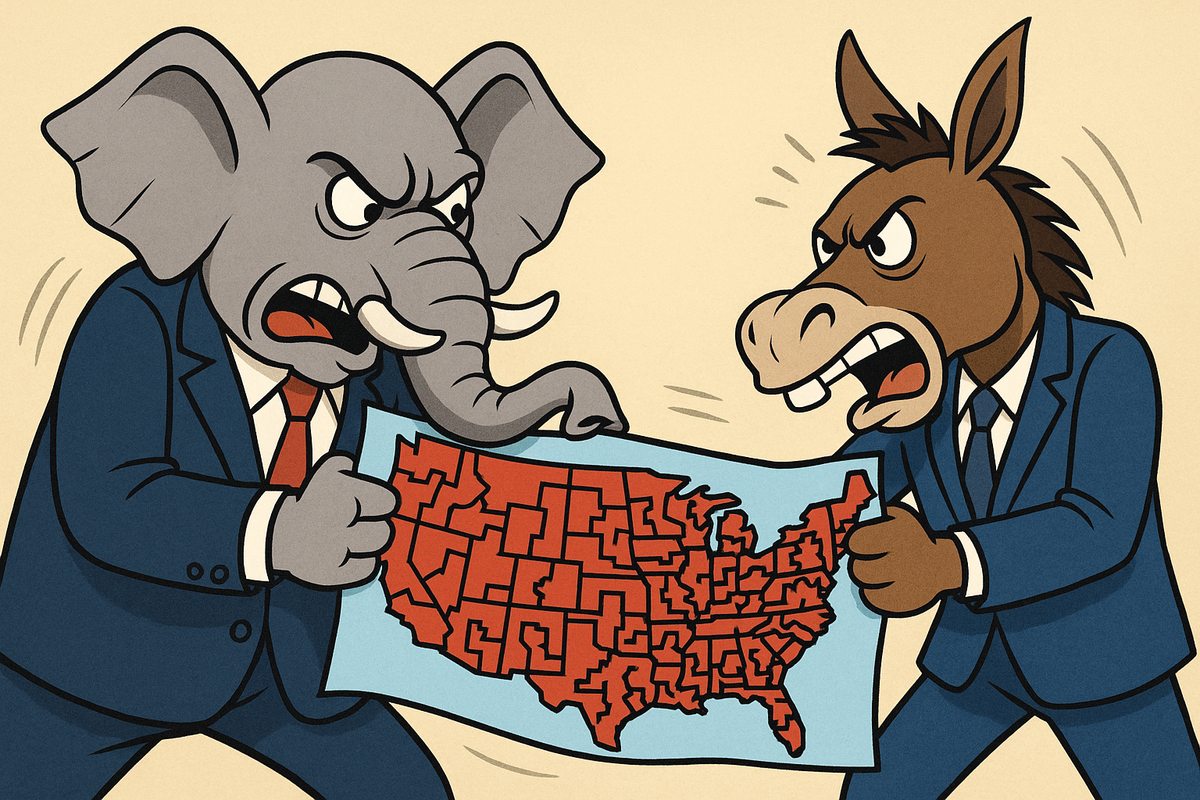
Oliver makes the point that escalation does not get the US closer to a system where “voters choose their representatives, and not the other way around.” Some reforms he suggests are popular. Others would be hotly debated.
But he is right about one thing: the current situation is clearly “untenable.” Check out the full segment above.