Democratic strategist James Carville may be wrong about a great deal, but he did have it right when he started the popular phrase, “It's the economy, stupid.”
The health of the U.S. economy drives the outcome of pretty much every other major issue before us. In particular, what happens with the environment, national debt, and the effectiveness of government is inextricably linked with the activities of our economy.
Our economy has just had a heart attack, and without a full recovery it will not have the strength to carry us where we need to go. Full recovery requires both an extensive exam and a health-wise strategy to repair our economic ills and help our country grow toward a sustainable economic livelihood.
We simply do not need any more witch doctor ideologues who, instead of using an informed diagnosis, chant slogans trying to invoke the spirits of free markets, economic stimulus, and government rightsizing.
Right now, we have an opportunity to set the country’s direction for strong and sustainable growth over the next few decades. For the most part, our economy has indeed carried on in spite of the actions of government and powerful interests. After decades of charlatan medicine, now is precisely the time for an independent diagnosis.
There is a refrain in the field of system dynamics that says: “Don't just do something, stand there!” Now some may take that to mean that we should not get involved, but non-intervention is still an action in itself.
What this refrain really means is that we should indeed take a minute to stand there and evaluate the problem before we act. Rather than chant slogans, we need to use modern tools to examine the patient and uncover the systemic root causes of the illness. By understanding the system, we can then identify the incentives that are producing the behavior that we do not want to see.
When we look at the economy, we see a system that is stagnant and largely controlled by old and powerful interests. The product of this system is the single largest transfer of wealth our nation has ever seen.
One aspect of this wealth transfer is clearly seen in the widening gulf between growth in productivity and wages. As observed in research by Mishel, productivity and wages increased almost in lockstep from 1948 to 1973. But, between 1979 and 2007 wages stagnated while productivity continued to climb. Where did all the money from this increased productivity go then? Credit: Economic Policy Institute
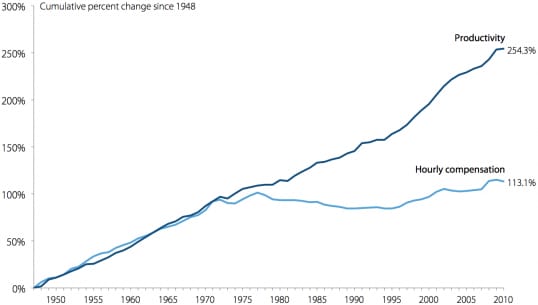
During this same period, the top 1 percent of all households secured almost 60 percent of the gains, with the top 0.1 percent accounting for over a third. That means that 99 percent of Americans have seen little to no improvement in their relative economic position. This is not how a healthy economy functions. When part of the body rewrites the rules and begins draining sustenance from the rest, it is called cancer.
Turning this around does not require the heavy hand of government forced redistribution. In fact, that is largely what has already been happening to allow for this disease to take root. Instead, what is required first is a correction of the huge advantages given to well connected businesses and special interests, which is again why corruption in Washington is the first issue.
Second, we must use the necessary evil of taxes more wisely. Instead of taxing things that nourish and renew our economic body, we need to be taxing the activities that pollute and destroy its health.
By correcting these two imbalances, we can once again put the U.S. economy back on its feet with a healthy heart for taking on the great challenges before us. With vitality restored we then need to have a national strategy for how we meet the needs of our country and our planet. Automation is set to massively disrupt industry and transport, which will require a huge portion of Americans to transition into jobs that go beyond manual labor and reach into new and budding industries.
Higher education will need to be rapidly expanded to meet industry demands, maintain affordability, and to accommodate the influx of laborers needing to be retrained.
Energy demands will need to be met with investments that ensure greater sustainability and lower costs, instead of becoming increasingly reliant on finite resources that will only get more costly and inefficient to extract.
These will not be easy reforms to make, but by taking a fresh and independent look at our economy, we will at least be stepping in the right direction.
Bruce Skarin is a Massachusetts independent candidate for US Senate. To Learn more about his campaign visit www.bruce2014.org.
Photo Credit: iris 42 / shutterstock.com