The "Under God" Controversy
"I pledge allegiance to my Flag and the republic for which it stands, one nation indivisible, with liberty and justice for all." (1892)
It sounds familiar to many of us, but it doesn't seem quite right. Growing up, I had to recite the Pledge of Allegiance every day in school. As a child, the phrase "Under God," which does not appear in the above quote, never even registered to me. They were just words to be recited along with the rest. This may be because I was raised Catholic, so I was used to the term, or it may not. I honestly can't tell. What you read above though is the original Pledge of Allegiance though it started out as just a poem.
The original poem was written by a Baptist minister named Francis Bellamy, who was also a Christian socialist, in 1892. It was published in a youth magazine called The Youth's Companion as part of the National Public School Celebration in honor of the 400th anniversary of Columbus's discovery of America. It would slightly be changed to say "to the republic," which would be used from 1892-1923. In 1923, it would be changed again to read "to the flag of the United States" but that would only last for a year before the addition "of America" was added to it. Bellamy didn't like the changes as it ruined the rhythm of his original poem.
"I pledge allegiance to the Flag of the United States of America, and to the republic for which it stands; one Nation indivisible with liberty and justice for all." (1924 - 1954)
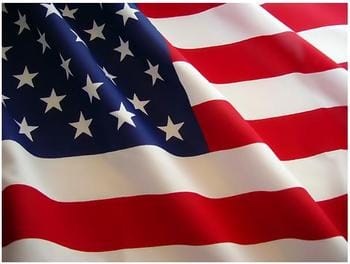
Many of older generations will remember citing that particular version of the Pledge of Allegiance. It wouldn't be until 1954 that the phrase would changed to "one Nation, Under God." It was the idea of an Illinois lawyer, who happened to be the Chaplain of the the Illinois Society of the Sons of the American Revolution in 1948. His name was Louis A. Bowman. He added it because of Abraham Lincoln. It is said that Lincoln spoke the words "under God" in his Gettysburg Address. It is hard to say whether he did or did not since there are hand-written copies of it both ways. The Abraham Lincoln Museum in Springfield, Illinois currently has a copy of the Everett copy of the Gettysburg Address on display. It was written by Lincoln to Edward Everett who had spoken for over two-hours before Lincoln. Everett wanted Lincoln to include the words "under God" in his copy. It would not be until 1953 that Rep. Louis C. Rabaut (D-MI) would sponsor legislation that officially added "under God" to the Pledge. President Eisenhower would get behind the proposal in 1954, and it would be passed. It marked the first time legislation had been passed officially changing the Pledge of Allegiance.
So why am I bringing this up? Any challenge that has been made to get the phrase "Under God" removed has met with failure. The courts have ruled that it can stay, and no legislation striking it would ever get through Congress. That's because there is a new lawsuit that has been brought up. The difference is that this particular case is not being sought in federal court but rather in state court, and that state is Massachusetts. They are using the exact same "equality" clause in the Massachusetts Constitution that allowed the state to be the first in the nation to allow same-sex marriages.
In Newdow v. Rio Linda Union School District (2010), the United States Court of Appeals for the Ninth District upheld that "under God" was constitutional, which was upheld by an appeals court as it stated it was not establishing a religion but was "patriotic in nature." But how do we define was is patriotic and what is religious? The lines get messy when we start thumbing through history. When reciting speeches made by past presidents, it's not uncommon to come across a mention of God. Even Washington, himself, used God in speeches and correspondences, as did Lincoln. In fact, one of the most recognizable lines from Lincoln's Second Inaugural states, "With malice toward none; with charity for all; with firmness in the right, as God gives us to see the right..."
"Such being the impressions under which I have, in obedience to the public summons, repaired to the present station, it would be peculiarly improper to omit in this first official act my fervent supplications to that Almighty Being who rules over the universe, who presides in the councils of nations, and whose providential aids can supply every human defect, that His benediction may consecrate to the liberties and happiness of the people of the United States a Government instituted by themselves for these essential purposes, and may enable every instrument employed in its administration to execute with success the functions allotted to his charge." George Washington's First Inaugural
There has always been a constant back and forth between politics in the political arena. It would be improper to state that a president cannot state his/her beliefs in certain times, especially when we can trace such a tradition back to the very beginning. But there still remains that difference between a personal belief that is simply spoken in a speech and one that is recited by people with the particular phrase in it. In another case in 2010, the United States Court of Appeals for the First Circuit upheld a lower New Hampshire court ruling that stated it didn't violate the constitution so long as reciting the Pledge was voluntary. I grew up saying the Pledge without incident. Have times changed that much or were we just all religious in my public school? Why can't someone who has an issue reciting those words just omit them personally when saying the Pledge? It's doubtful anyone would even notice that someone didn't speak two words. And I guess the last question is why is this even such a situation? It's not like there aren't easy solutions to this that don't involve the court system. Whether "Under God" stays or goes, it's all rather a moot point since it wasn't even in the original poem written by the Baptist minister to start with and seems to be there to stay now unless there is a significant push to change it from the public, which I don't see happening.