 IVN Editorial Board
SAN DIEGO, Calif —California voters registered No Party Preference are not a small slice of the electorate. They account for nearly 5.3 million registered voters in the state (22.82% of the electorate), and this does not count voters registered with a party that consider themselves independent-minded.
Following a record turnout in the nonpartisan Top Two primary, largely driven by independents, it is clear these voters are not only paying attention to what is happening in their state, but they are engaged, and can reshape the California political landscape.
 Cara Brown McCormick
On the statewide November ballot, there are 4 high-profile propositions in which independent-minded voters will cast the most decisive votes ahead of and on Election Day: Prop 39 on Voter ID, Prop 40's billionaire tax, and two competing measures—Props. 41 and 42.
Polling shows Democrats and Republicans are sharply divided over Props. 39 and 40, while independent-minded voters are less predictable.
A UC-Berkeley Institute of Governmental Studies poll found 54% of likely NPP voters, specifically, opposed Prop. 39, while they were split over Prop. 40. Meanwhile, Props. 41 and 42 have large pools of undecided voters.
In a close statewide contest, a voting bloc representing nearly one-quarter of California's electorate is large enough to determine the fate of these closely watched propositions, especially when these voters do not move uniformly with either major party.
In the legislature, there are two proposed amendments — ACA 23 and ACA 24 — that will not be on the November ballot. However, they directly impact the voting rights of independent voters and their confidence in the elections process.
ACA 23 asks a fundamental question: Should the state’s top elections official run with a party label? Meanwhile, ACA 24 would explicitly make it clear that no voter can be denied the right to vote in any integral stage of the taxpayer-funded elections process for any reason.
Here is a quick guide on where all 6 proposals stand.
Proposition 39: Require Voter ID and Citizenship Verification
What It Does: Prop. 39 requires voters to show government-issued identification when casting a ballot in person. For Californians who vote by mail, they have to place the last 4 digits of their ID number on their ballot envelope.
The latter requirement is important because most voters in the state cast a mail-in ballot either by drop box, mail, or they return it to a polling location/elections office. If the number on the envelope doesn’t match their voter registration, their ballot could be invalidated.
The California Voter ID Initiative also requires election officials to produce an annual report on the percentage of voters whose citizenship has been verified and requires California to offer free voter ID cards.
Its cost, according to the Legislative Analyst Office (LAO), falls between tens of millions and the low hundreds of millions.
IVN has followed the proposal since before it qualified for the ballot, including how its provisions differ from the federal SAVE America Act, which has stricter citizen verification and voter ID requirements.
 Cara Brown McCormick
Who Supports It: Yes on 39 is sponsored by California Asm. Carl DeMaio’s group, Reform California. Its supporters include the Transparency Foundation, Latino American Political Association, California Women's Leadership Association, and Howard Jarvis Taxpayers Association. The Yes campaign argues that an ID requirement would increase confidence in elections while preserving vote by mail and other existing voting options. They also emphasize the requirement for free voter ID.
Who Opposes It: The official opposition includes ACLU California Action, Common Cause and the League of Women Voters of California. US Sen. Alex Padilla, the California Nurses Association and California School Employees Association also signed arguments against the proposition. Opponents say California already verifies voters and that the measure adds unnecessary barriers and costs. They also raise privacy concerns about placing identification digits on mail-ballot envelopes and argue that voters without readily available documentation could be disproportionately affected.
Follow The Money: According to the Fair Political Practices Commission's September 8 reporting, the top contributors to the Yes campaign have put in about $15.4 million. Wisconsin businessman Richard Uihlein accounts for $10.5 million, while Reform California's ballot-measure committee has contributed just over $3 million. Nicole Shanahan, Douglas Leone, Tyler and Cameron Winklevoss and others have also contributed.
On the No side, top contributions across two committees total roughly $9.7 million. The largest listed donors include the Federated Indians of Graton Rancheria, Reed Hastings, SEIU organizations, construction labor groups, the California Teachers Association, Quinn Delaney, ACLU of Northern California, and the California Donor Table.
Note: Campaign-finance figures in this guide are based on the California Fair Political Practices Commission's top-contributor disclosures available September 8, 2026. They do not represent a complete accounting of all campaign receipts or expenditures and will change as additional reports are filed.
What Does Polling Say: In August, Berkeley IGS found 42% of likely voters supported Prop. 39 and 51% opposed. Republicans backed it 93%, while 80% of Democrats opposed it. Among NPP voters, 36% supported the measure and 54% opposed it.
CalMatters reported in March that a 2025 Berkeley IGS poll found that 54% of voters supported showing voter ID when casting a ballot. The poll was conducted before Prop 39 was certified for the ballot.
Proposition 40: The Billionaire Tax
What It Does: Prop. 40 imposes a one-time tax of up to 5% on covered assets exceeding $1 billion for certain California taxpayers. Covered assets include businesses, securities, art, collectibles, and intellectual property.
Real property and some pension and retirement assets are excluded.
The LAO states that 90% of the revenue generated from this wealth tax has to be directed toward healthcare and 10% toward food assistance or education-related programs. It is projected to generate tens of billions of dollars that will be spent over several years.
LAO also says it could potentially reduce ongoing state income-tax revenue from billionaires by less than $1 billion annually.
IVN previously took a deep dive into how the wealth tax would work and later reported on the negotiations that failed to remove it from the November ballot.
Who Supports It: Prop. 40 is sponsored by SEIU-United Healthcare Workers West. US Sen. Bernie Sanders, Rep. Ro Khanna, the California Nurses Association, and California LULAC are among those backing it, and the California Democratic Party has endorsed it.
Supporters say the tax would require an extremely small number of ultra-wealthy Californians to replace healthcare and safety-net funding affected by federal cuts. They argue that the state can raise substantial revenue from accumulated billionaire wealth without increasing taxes on middle- or lower-income Californians.
Who Opposes It: Opposition crosses some of California's usual partisan and interest-group lines. Gov. Gavin Newsom opposes it, as does Democratic gubernatorial candidate Xavier Becerra. Organizations that oppose it include the California Teachers Association, Planned Parenthood Affiliates of California, California Medical Association, California Primary Care Association, California School Boards Association, California Professional Firefighters, State Building and Construction Trades Council of California, California Chamber of Commerce, and California Taxpayers Association.
The San Francisco Democratic County Central Committee also voted 17-4 in August to oppose the measure, setting up a big-stage showdown between center-left Democrats and the DSA.
Opponents argue that taxing wealth rather than income may encourage wealthy taxpayers and businesses to leave California, reducing future income-tax collections. They also argue that a one-time revenue source does not solve California's long-term healthcare funding problems and object to exempting the new revenue from existing constitutional spending and school-funding rules.
Follow The Money: SEIU-UHW and its affiliated political committees account for about $31.4 million in top reported contributions to the committee supporting Prop. 40 and opposing Props. 41 and 42 (which are countermeasures to Prop 40).
On the other side, Building a Better California, whose top donors include Google co-founder Sergey Brin and venture capitalist John Doerr, has contributed $29.5 million to one No on 40 committee. Ripple Labs and Ripple co-founder Chris Larsen have each contributed $5 million to another opposition committee.
Altogether, the FPPC lists roughly $40.2 million in top contributions to the two Prop. 40 opposition committees.
What Does Polling Say? Berkeley IGS found 48% of likely voters supported Prop. 40 when asked in August, 41% opposed, and 11% were undecided. Democrats supported it 70%, Republicans opposed it 80%, and NPP voters were split.
One Thing Voters Need to Know About Props. 40, 41, and 42
Understanding Prop. 40 requires understanding the next two propositions.
Props. 41 and 42 contain provisions saying that conflicting measures on the same ballot do not take effect if they do not receive more Yes votes. In other words, if Prop 40 passes, but Prop. 41 or Prop. 42 also passes with more affirmative votes, a court could find the measures conflict and prevent Prop. 40 from taking effect.
Proposition 41: Ban New Taxes That Conflict with State Spending Limit (A Countermeasure to Prop. 40)
What It Does: Prop. 41 prohibits new state taxes from being designed so that their revenues are excluded from California's voter-approved state spending limit. This is important because Prop. 40 specifically exempts revenue from its billionaire tax from this limit.
Further, new statewide special taxes would require the State Auditor—an independent, nonpartisan office—to review the programs that would receive the money before voters decide on the tax and conduct recurring audits afterward.
Who Supports It: The official Yes argument is signed by the California Society of CPAs, former California State Auditor Tom Hayes, and the California Taxpayers Association. Former State Controller Steve Westly and the CalAsian Chamber of Commerce are also featured in the Yes campaign's case.
Supporters emphasize the auditing provisions. They argue voters should receive independent information about programs before approving taxes to fund them and that tax revenue should remain subject to California's existing spending restrictions.
Who Opposes It: SEIU-UHW, which sponsored Prop. 40, leads the No campaign. Opponents focus less on the merits of audits themselves and more on Prop. 41's interaction with Prop. 40. Their argument is that the measure was placed on the ballot primarily to give opponents another way to defeat the billionaire tax.
Follow The Money: The financial disparity is substantial. Building a Better California has contributed $58.25 million to the Yes on 41 committee, while Reform California has added about $21,800. Building a Better California lists Brin and Doerr as its top donors.
The opposition is funded through the same SEIU-UHW committee backing Prop. 40 and opposing both Props. 41 and 42. That committee reports roughly $31.4 million in top contributions, but the FPPC specifically cautions that those dollars support activity involving all three measures and cannot be attributed entirely to Prop. 41.
What Does Polling Say? The August Berkeley IGS poll found 35% of voters supported Prop. 41 and 37% opposed it. Roughly a quarter of voters were undecided, reflecting much lower awareness of Props. 41 and 42 than the billionaire-tax fight.
Proposition 42: Ban New Taxes on Personal Property (Another Countermeasure to Prop. 40)
What It Does: Prop. 42 amends the state Constitution to prohibit new state taxes on personal property. The definition includes business interests, intellectual property, financial assets, retirement accounts, and investment accounts. It would also prohibit certain retroactive taxes and would apply to taxes enacted or taking effect beginning January 1, 2026.
Like Prop. 41, it includes a conflict clause. If Prop. 42 and Prop. 40 both pass, but Prop. 42 receives more Yes votes, a court could determine that Prop. 40's billionaire tax conflicts with the new constitutional ban and cannot take effect.
Who Supports It: The Yes campaign includes the California Professional Firefighters, State Building and Construction Trades Council of California, Peace Officers Research Association of California, AMVETS Department of California, California Small Business Association, and senior and retirement groups.
Supporters frame Prop. 42 more broadly than the Prop. 40 fight. They say Californians should have constitutional protection against future state taxes on retirement funds, savings accounts, pensions, and other property that represents money on which taxpayers may already have paid income taxes.
They also argue that taxpayers should not be subjected to new taxes applied retroactively.
Who Opposes It: Again, SEIU-UHW leads the No campaign. Opponents argue that the measure's immediate purpose is to block Prop. 40 and that references to ordinary Californians' retirement and savings accounts obscure the fact that its passage could also protect the assets targeted by the billionaire tax.
Follow The Money: This is currently the biggest of the three related campaigns measured by FPPC-listed top contributions. Building a Better California has contributed $64.25 million to the Yes on 42 committee, with Reform California adding roughly $22,500.
The No campaign uses the combined SEIU-UHW committee supporting 40 and opposing 41 and 42, with approximately $31.4 million in top reported contributions spread across those efforts.
What Does Polling Say: Berkeley IGS found 40% of likely voters supported Prop. 42 in August and 37% opposed it, with roughly a quarter still undecided.
ACA 23: Make California's Secretary of State a Nonpartisan Office
This one is not on the November ballot, but it could go before voters in a future election. It directly addresses a question increasingly being asked by voters: Should the official administering elections represent a political party while doing it?
What It Would Do: ACA 23 amends the California Constitution to make the Secretary of State a nonpartisan office, joining judges, county and city offices, school offices, and the Superintendent of Public Instruction.
Candidates would still campaign and voters would still elect the Secretary of State. The difference is that political parties could not formally nominate candidates for the office and a candidate's party preference would not appear on the ballot.
IVN first reported on the amendment shortly after it was introduced and later covered the broader push to separate California's election administration from partisan offices.
 Shawn Griffiths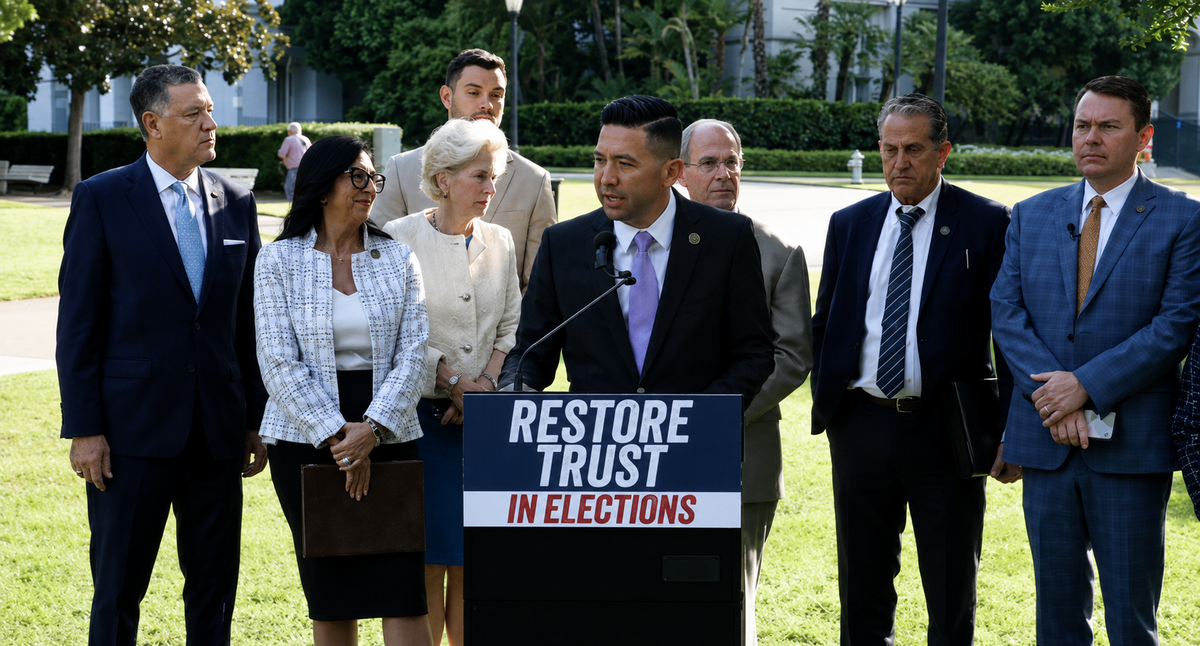
Who Introduced It: ACA 23 was jointly introduced on August 10 by Republican Assemblymembers Natasha Johnson of Lake Elsinore and Josh Hoover of Folsom. The introduced version lists no additional joint authors or coauthors.
Who In the Legislature Supports It: State Sen. Roger Niello publicly joined Johnson and Hoover to call for its passage. At their Sacramento press conference, they were joined by Assemblymembers Carl DeMaio, Alexandra Macedo, Laurie Davies, Diane Dixon, Stan Ellis, Kate Sanchez, Tri Ta and David Tangipa, all Republicans. Their attendance demonstrated support for the proposal, though they were not listed as coauthors on the introduced text.
Who Outside the Legislature Supports or Engages With It. Former Assemblyman and current Secretary of State candidate Don Wagner and Victor Marani of the American Independent Party joined the lawmakers at their press conference. IVN also spoke with Election Reformers Network founding executive director Kevin Johnson about the underlying idea. Johnson said states should consider reforming the Secretary of State but argued that simply removing the party label does not go far enough. He suggested combining nonpartisanship with qualification and conflict-of-interest rules.
That broader concept also has historical precedent. IVN Editor Shawn Griffiths noted in his coverage that the bipartisan Carter-Baker Commission recommended greater nonpartisanship and conflict-of-interest protections in election administration in 2005.
Who Opposes It: ACA 23 has not had a policy hearing, so there is no committee analysis identifying a formal opposition coalition and no legislative roll call showing who opposes it.
Where It Stands: ACA 23 was introduced on August 10 and is still listed only as “from printer” in legislative tracking. That timing proved critical. Beginning August 17, the Legislature was in a floor-session-only period in which ordinary policy committees could not meet, and August 31 was the last day for each chamber to pass legislation before final recess.
The Assembly now lists itself as adjourned for final recess. ACA 23 received neither a committee nor a floor vote. Therefore, it cannot advance from the 2025-26 session.
The proposal would have to be reintroduced in the 2027-28 Legislature. If it is, it would need a two-thirds vote in both chambers before being sent to voters. 2028 would be the earliest ballot opportunity for it.
ACA 24: Guarantee The Right to Participate in Publicly Funded Elections
ACA 24 is founded on a simple idea: the right to vote comes from citizenship, not from joining a political party. And it would enshrine this idea into the California Constitution.
What It Would Do: ACA 24 adds language to the California Constitution stating that an eligible voter cannot be excluded from “meaningful participation at any integral stage of any publicly funded election,” including a primary election, for any reason, including party preference.
California's nonpartisan Top Two system already allows every registered voter to vote for any candidate in primaries for congressional and state voter-nominated offices. ACA 24 would prevent the state from moving to an election system that does not guarantee equal access to taxpayer-funded elections.
The amendment came amid a separate campaign to “Undo the Top Two,” which is collecting signatures for a potential 2028 ballot measure to repeal California's nonpartisan primary system and restore partisan primaries.
The Secretary of State cleared that initiative for circulation in July.
 Shawn Griffiths
Who Introduced It: Assemblymember Stephanie Nguyen (D-Elk Grove) is the lead author. The introduced text lists David Alvarez, Anamarie Ávila Farías, Blanca Rubio, and Lori Wilson as joint authors.
Coauthors are Patrick Ahrens, Jasmeet Bains, Lisa Calderon, Mike Gipson, Corey Jackson, Alex Lee, Tina McKinnor, Blanca Pacheco and José Luis Solache. All 14 lawmakers who signed onto ACA 24 are Democrats.
Who In the Legislature Supports It: Because ACA 24 hasn’t had a committee or floor vote, the only legislators formally on record supporting it are its author, joint authors, and coauthors. Nguyen describes the amendment as “a voter-centered bill, not a party bill,” while Wilson argues that eligibility to participate should not depend on choosing a political label.
Like ACA 23, if the amendment moves through the legislature it needs a two-thirds vote in both legislative chambers, which means Democratic votes alone are not sufficient. The proposal needs Republican support as well.
Who Outside the Legislature Supports It: The amendment is sponsored by More Choice California, a coalition of election reform advocates and organizations, led by the Independent Voter Project (IVP). The coalition includes co-chairs like Lenny Mendonca, a former economic advisor to Gov. Newsom, and Anne Marie Schubert, a former Republican and Sacramento County district attorney.
Supporters argue that if taxpayers fund an election that plays an integral role in choosing public officials, a voter’s right to participate comes from their status as a citizen and eligible voter rather than membership in a private political organization.
Who Has Signaled Opposition. There is no formal legislative opposition yet on record. However, the Undo The Top Two campaign is pushing an initiative not only to go back to partisan primaries, but would remove “all voters may vote” from the state constitution.
“Undo the Top Two” is led by longtime Democratic consultant Steven Maviglio. He is joined by former California Republican Party Chair Ron Nehring, Republican Asm. Carl DeMaio, California labor leader Lorena Gonzalez, and California Democratic Party Chair Rusty Hicks.
None of these figures have explicitly stated their position on ACA 24. However, the goals of Undo the Top Two conflict with the amendment’s guarantee that party preference cannot be used to exclude voters from publicly-funded primary elections.
This includes the nearly 5.3 million voters registered No Party Preference.
Where It Stands: ACA 24 was introduced on August 24. Legislative records show no action beyond its introduction and printing. By that point, the Legislature was already in its floor-session-only period. It received no committee hearing and no vote before final recess.
Like ACA 23, ACA 24 is finished for the 2025-26 legislative session. However, this issue is not going away and should remain on voters’ radar because supporters are determined to give them the final say.
Primary sources for this guide: California Secretary of State 2026 Official Voter Information Guide · FPPC November 2026 Top Contributors · UC Berkeley IGS proposition polling · IVN's overview of the November ballot · IVN coverage of ACA 23 · IVN coverage of ACA 24