 Chad Peace
The consultants behind the "Undo the Top Two" initiative claim their measure protects the right of independent voters to participate in primary elections. The text of their own initiative says the opposite.
The politicians who put the top 2 on the ballot and the dark money group @ivn will say anything to preserve their power. The truth: initiative says indps can vote in primaries, which is what the law says in Arizona, New Mexico, Colorado, new England states, and now DC. https://t.co/TYTRbJBj3m
— Undo the Top Two (@undotoptwo) June 25, 2026
Here is what they are not saying, or don’t understand.
Any partisan primary forces a conflict that does not have to exist: the right of voters to cast a meaningful vote, against the right of a political party to control who picks its nominees. The Independent Voter Project's position is simple: the building block of a democracy is the voter.
The people pushing to undo Top Two are building on a different premise. To them, the building blocks of democracy are the political parties.
That difference is the whole fight. And it is a fight the US Supreme Court has already focused on California.
“Undo the Top Two” Wants Primaries to Serve Political Parties
"Undo the Top Two" eliminates California’s current nonpartisan primary and puts a semi-closed primary in its place. A semi-close primary changes the fundamental purpose of the primary election.
A nonpartisan primary treats every voter and candidates exactly the same. The purpose is for all voters to nominate candidates, regardless of party, to the general election ballot.
 Shawn Griffiths
A semi-closed primary allows political parties and their members to utilize the taxpayer-funded primary election to nominate a candidate to represent THE PARTY on the general election ballot.
In a semi-closed primary, voters who are not members of a qualified political party have no right to participate in primary elections.
Under the “Undo the Top Two” measure, the only way an independent voter gets to participate is if a party chooses to “allow” them to participate.
That system exists in several states. New Mexico opened its primaries to independents for the first time this year. Washington, D.C. approved funding to do the same after voters passed Initiative 83.
It is also true that these systems give independents a say. A limited say, and only if a political party decides to open a given primary election. If they do, the voter is still confined to one party's candidates in every contest, with none of the choice a nonpartisan primary provides.
Technically, independent voters could still have a limited say in the election. That is where the truth ends.
What The Initiative Text Actually Does
Nowhere in the initiative does it grant No Party Preference (NPP) voters the right to participate in primaries. Independent and NPP voters are not even mentioned. Not once.
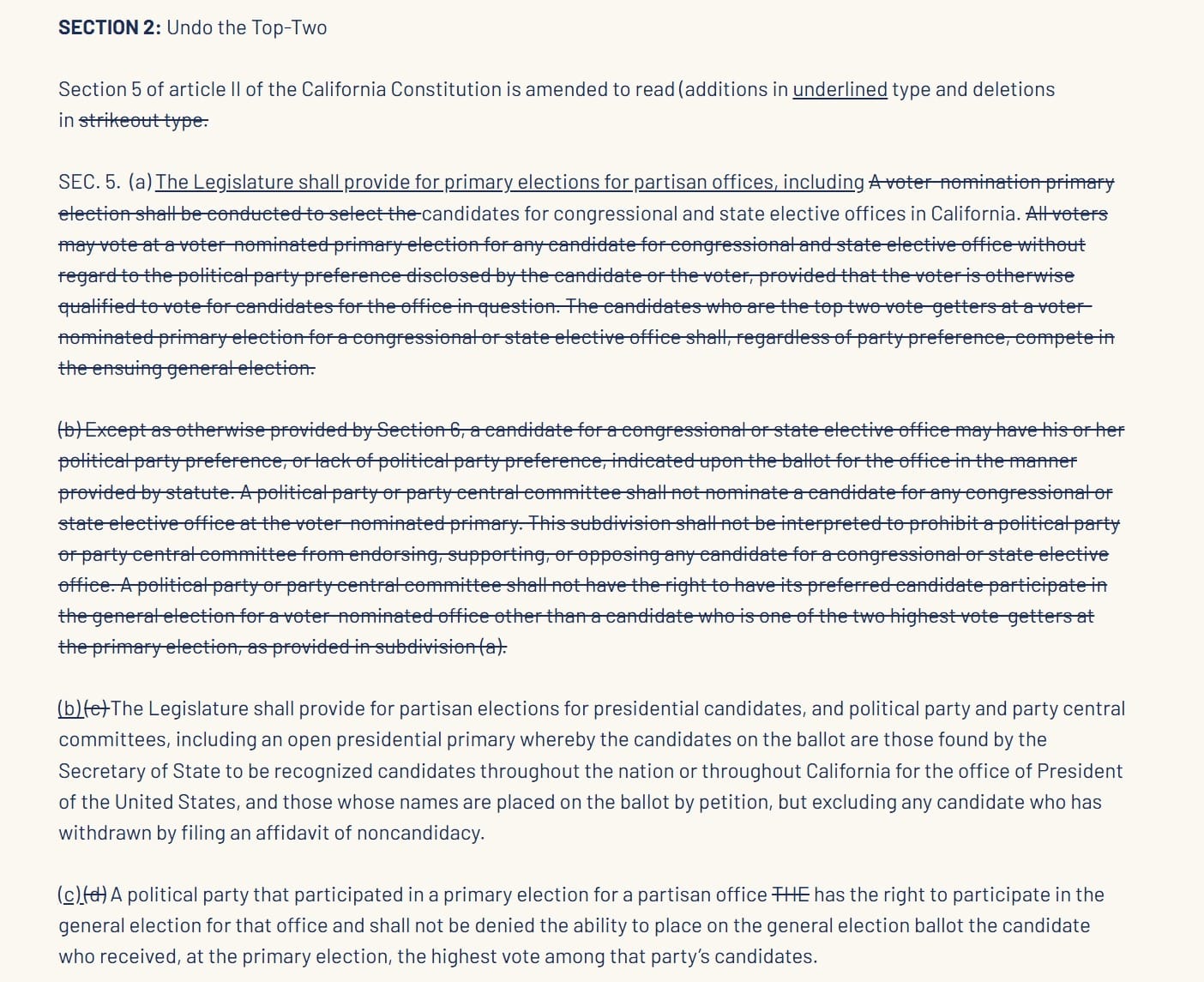
What the measure does is strike the existing constitutional guarantee that "a voter nominated primary election shall be conducted" and that "all voters may vote at a voter nominated primary election for any candidate."
In its place: "The Legislature shall provide for primary elections for partisan offices."
That is the swap. A guarantee that every voter may vote for any candidate is replaced with a direction to the Legislature to run private partisan primaries. The promise of equal voter access is removed from the Constitution.
"Just trust us" is the only assurance independent voters have to access the primary election—at all.
The Jones Problem They Don't Mention
The proponents have said publicly that they want to "restore" and "go back to" the system California used before Proposition 14. That word choice runs through their website and the press coverage.
There is a problem with going back, and it is a legal one they leave out.
Before Top Two, California briefly ran a blanket primary, where every voter received a ballot listing every candidate and the top finisher from each party advanced to the general. The political parties sued to kill it.
In California Democratic Party v. Jones, 530 U.S. 567 (2000), the Supreme Court struck it down. The Court held that forcing a party to let non-members help choose its nominee is a severe burden on the party's First Amendment right of association.
As Justice Scalia wrote for the Court, the conflict in that case existed only because the state created the conflict by forcing parties to associate with non-members.
So, the parties cannot constitutionally run the blanket primary they once had. Jones forecloses it. That leaves the closed or semi-closed partisan primary as the only realistic destination of a repeal, because the party gets the power to decide whether independents get in at all.
That is the part they omit. They invoke "the truth" while leaving out the one ruling, their own ruling, that defines what "going back" can legally mean.
Why the 'Rights' Framing Matters
The deeper point is the one the courts have wrestled with for decades, and it is why IVP treats this as a voting rights question, not a policy preference.
In United States v. Classic, 313 U.S. 299 (1941), the Supreme Court held that when a primary is an integral part of the election process, the right to vote in it is protected just as the right to vote in the general election is.
In Gray v. Sanders, 372 U.S. 368 (1963), the Court rooted "one person, one vote" in a case about a primary, holding that voters are entitled to an equally meaningful vote at every integral stage of the process.
Read together, those cases stand for a straightforward idea: a meaningful vote includes the stages that actually decide elections, and in most California districts, the primary is that stage.
A nonpartisan, voter-nominated primary honors that. Every voter and every candidate are on one ballot, on equal footing. A partisan primary does the reverse. It conditions full participation on joining one of two private organizations, which is exactly the burden IVP and others have spent years challenging in court, including in a petition to the US Supreme Court arising out of New Jersey's closed system.
 Jeremy Gruber
That is the conflict "Undo the Top Two" skips over. And the selective storytelling does not stop at Jones.
They cite New Mexico, but leave out that reformers spent more than a decade chipping away at partisan resistance in a state where half the legislative seats regularly go uncontested. Reform failed repeatedly before the Legislature finally gave independents a limited right to vote.
They cite DC, but leave out that Democratic leadership sued to block Initiative 83 and fought to keep open primaries and ranked choice voting from taking effect at all. It took two years of pressure before the DC Council honored what nearly three-quarters of voters approved.
They cite Colorado, but leave out that the Colorado GOP keeps litigating to close the primaries, the same posture Republicans have taken in Texas and Democrats have taken in states like Hawaii.
There is also their own recent record on trusting them at their word.
The California Constitution promises independent redistricting and bars partisan gerrymanders. Some of the same operatives backing “Top Two” repeal argued in 2025 that Democrats "had to" gerrymander, that they were “fighting fire with fire.”
Just trust them.
This Is the Voting Rights Discussion We Need to Have
Does the taxpayer funded election process belong to political parties, or to voters?
"Undo the Top Two" says its initiative gives independents the right to vote in taxpayer-funded primaries. The text does not. In fact, they remove the fundamental right to vote in the primary and significantly limit voter choices.
Under the “Top Two” nonpartisan primary, California is only one of three states where every voter, and candidate, is treated equally. If the real complaint is that voters want more candidates from more parties to choose from in November, there’s a way to do that.
Keep the nonpartisan primary and simply advance more candidates to the general election.