Skip to content
Subscribe

Eliminate the Electoral College? You'll Never See Your Candidate Again

Published:

As a follower of politics, I love seeing all the hair-brained ideas that sprout up from time-to-time arguing for this change or that, without really considering what would happen if it was actually put into practice.

We live in a federal republic. Big states have a larger share of influence, but smaller states still maintain at least some balance through the equal representation in the Senate.

The Electoral College was part of this framework. Presidential candidates had to win at the state-level, but an enormous win in one state couldn't skew the entire result.

That is, a candidate might win 99% of the vote in California and it wouldn't matter; they only win the delegates apportioned to the state.

This highlights the problems with eliminating the Electoral College; the very nature of campaigning would change, and most Americans would never see a candidate again.

America is facing growing urbanization -- almost 81 percent of the population lives in cities.
Even worse, right at one-third of the U.S.'s total population lives in only ten metropolitan areas!

We're used to the battleground state phenomenon, where states become flyovers because they are pocketed wins. However, if we eliminated the Electoral College, candidates could campaign in the top 20 metro areas and win the lion's share of votes.

This would be a politicking nightmare -- candidates jockeying to dominate the airwaves in the markets with the most people, while others totally ignore the rural and nationwide vote.

The biggest losers, though, would be the Republicans.

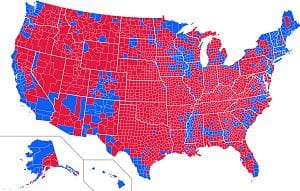
The red/blue map is often dominated by where the urban regions are located. Solid swaths of red are typically wide spreads of rural America.

Whether we like to admit it or not, the urban/rural divide is often represented in the red/blue map -- and forcing candidates to campaign along the urban/rural divide would be a stacked deck in favor of the Democrats.

Our Founders knew that they weren't forming a perfect form of government, that's why they allowed for a mechanism for change. But to think that we should change to a system where Democrats could campaign in 20 cities while Republicans scramble to unify the rural areas, how would this improve the existing system?

Photo Credit: Brendan Smialowski/AFP/Getty Images

Adhere to the IVN etiquette

By posting a comment, you agree to adhere to our etiquette rules: No partisan attacks, no personal attacks, substantiate your sources, no self-promotion.

Contact IVN

Questions about this article or our coverage? Send us a message. A free IVN member account is required.

Message sent

Thanks, we’ll review it and get back to you if needed.

Message not sent

Sorry, something went wrong. Please try again.

Sign in to send a message

Messages are tied to your IVN member account. Signing in is free and takes a few seconds.

Republish this article

Republishing guidelines

Republish IVN articles for free. Independent Voter News articles may be republished online or in print under a Creative Commons BY-NC-ND 4.0 license, on these terms:

  1. Credit the author and IVN. Keep the byline ("By Author Name, Independent Voter News") and the attribution note at the end, which links to the original.
  2. Keep the meaning. You may update time and place references and apply your house style. You may trim for length, as long as the cuts don't change the meaning or misrepresent the author. Keep the headline. Mark any additions as your own (for example "Additional reporting by ...").
  3. Translations are welcome. Translate faithfully, add "Translated from English by [your outlet]", and tell us at editor@ivn.us.
  4. Keep the links, including the link to the original article.
  5. Keep the tracking image. The HTML includes a 1-pixel image that counts readers on your page. It collects no personal information.
  6. Photos and illustrations. Images credited to IVN may be used with this article only. Images credited to others (AP, Getty, Unsplash, Wikimedia and so on) stay under their owners' terms. Secure the rights or switch "Include images" off.
  7. Don't sell it. You can't sell our articles or sell ads specifically against them. Your normal site advertising is fine.
  8. No implied endorsement. Don't suggest that IVN or the author endorses you, your candidates or your causes, or that donations to you support IVN.
  9. Keep labels. Opinion or analysis pieces keep that label.
  10. Point search engines to the original. Where your CMS allows, set the canonical URL to the original IVN article.
  11. No bulk or automated republishing, and don't submit our articles to aggregators (Apple News, Google News, MSN) as your own.
  12. Corrections and removals. Update your copy when we correct it, and remove it promptly if we ask. We'll contact you at the email you give us.
  13. Questions or print republication: editor@ivn.us.

IVN staff: fill in who you're inviting above, then create the invite.

Preparing the article

Eliminate the Electoral College? You'll Never See Your Candidate Again

Choose a format
  • HTML
  • Email HTML
  • Markdown
  • Formatted (.docx)
  • Plain text
  • WordPress blocks
  • PDF
Choose a platform

Photos credited to others need their owners' permission.

To for

Republishing somewhere else? Questions? editor@ivn.us