Credit: occupyboston.org
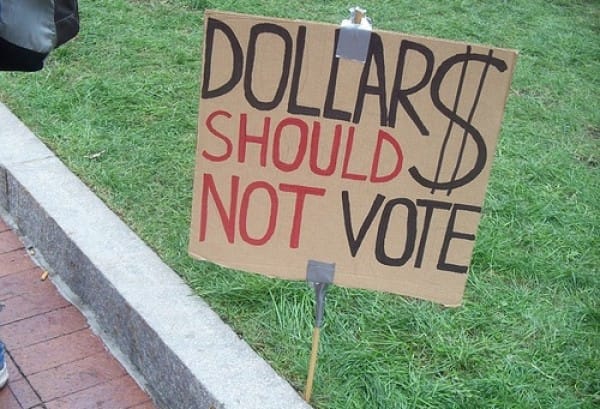
Harvard Law Professor Lawrence Lessig knows about the money that flows through the election cycle. Just this Tuesday, Lessig testified before Congress at a hearing regarding the Citizens United decision. The hearing examined the effects of the decision and possible responses, like the Disclose Act and Fair Elections Now Act. What's important is that Lessig authored a 17 page testimony backed by daunting statistics in campaign finance.
Professor Lessig is careful not step on partisan grounds and appeals to the interest of fairness. Both Democrats and Republicans are caught in the race of fundraising to keep their campaigns alive and strong. He is also careful of not pointing the finger to the Citizens United decision as the sole proprietor of campaign contribution problems. Lessig uses the term "corruption" not in the legal sense, but in the sense that the government is no longer accountable to its citizens.
Among the many statistics Lessig compiled, they all point to the fact that those who contribute to an election are exclusive. He states that .26% of Americans contribute $200 in an election cycle. Half-a-percent contribute the individual maximum of $2500 to a congressional candidate. To top off the statistics, .01% contribute $10,000 in total during an election cycle. Yes, all of these percentages are under one percent.
Attention must be placed on Professor Lessig's recommendations on how to move away from the exclusivity. He states in his testimony,
"By structuring an election system in which candidates must rely upon small contributions from citizens only, the system assures that candidates pay attention to the needs of those contributors — and hence the needs of these citizens."
Lessig goes on to advocate disclosure legislation, requiring politicians to reveal their records of contributions. However, he notes that disclosure alone is not enough to reform the system. Disclosure is also ineffective for balancing super-PACs, made possible through Citizens United. It is the combination of disclosure and "citizen funded elections" that will make the difference.
The "Funders", Lessig calls the main contributors in campaigns. When discussing super-PACs, he notes that exactly 196 Americans are responsible for 80% of the funding super-PACs expend. That is .000063% of American citizens. A political culture is developed where politicians are accountable to the "Funders" and is no longer dependent on the people.
Ezra Klein evaluated the hearing and its implications in a recent column for Bloomberg. In his article, he agrees that the Disclose Act alone does not curtail the massive amounts spent on elections. He notes the libertarian perspective of scholar Ilya Shapiro, advocating the shrinking of government. The key is to not limit the amount of money, but limit its effectiveness. Klein mentions that the only absolute solution to campaign finance is to call for a constitutional amendment. However, Klein is still skeptical of such a solution.
"The other side of the coin -- and, I admit, this is utopian thinking -- is a constitutional amendment making it possible to limit the role of private money in politics. This is not a solution I like endorsing, because it seems impossible to imagine it actually happening. But it was, presumably, difficult for a previous generation to imagine that the Constitution would be amended to permit the direct election of senators, thus necessitating expensive campaigns that only a small fraction of Americans would fund. Yet here we are."
The Senate Judiciary Committee held the hearing Lessig testified at on July 24th, and was chaired by Assistant Majority Leader Dick Durbin of Illinois. The hearing was titled "Taking Back Our Democracy: Responding to Citizens United and the Rise of Super PACs". Citizens United v. Federal Elections Commission enabled unlimited campaign contributions from corporations and unions. Senator Bernie Sanders of Vermont also spoke before the committee and discussed income inequality.
Campaign finance reform attempts to shift the focus towards small contributions and a larger percentage of the citizenry. There is still the view that elections are essentially fundraising contests. If there is reform that makes politicians more accountable to their supports, then perhaps it is a step in the right direction.