"We have to fix this," said President Obama shortly after the 2012 presidential election saw widespread problems with long waiting times at polling places across the country. The single most poignant example of someone affected by the problem was Desiline Victor, a 102-year-old woman who waited in line for 5 hours to vote.
Eighteen months later, after a presidential commission and proposed legislation from Congress, it appears the U.S. is not on a path to “fix this” anytime soon.
Despite useful recommendations (online and same-day voter registration, along with more early voting access), the reforms will do little to shorten wait times. They don’t address the cause of the problem -- paper ballots.
In 2012, there was a startling correlation between waiting times in each state and the type of voting technology employed by that state. With few exceptions, if you waited in line for many hours to vote, it meant you would be voting on a paper ballot.
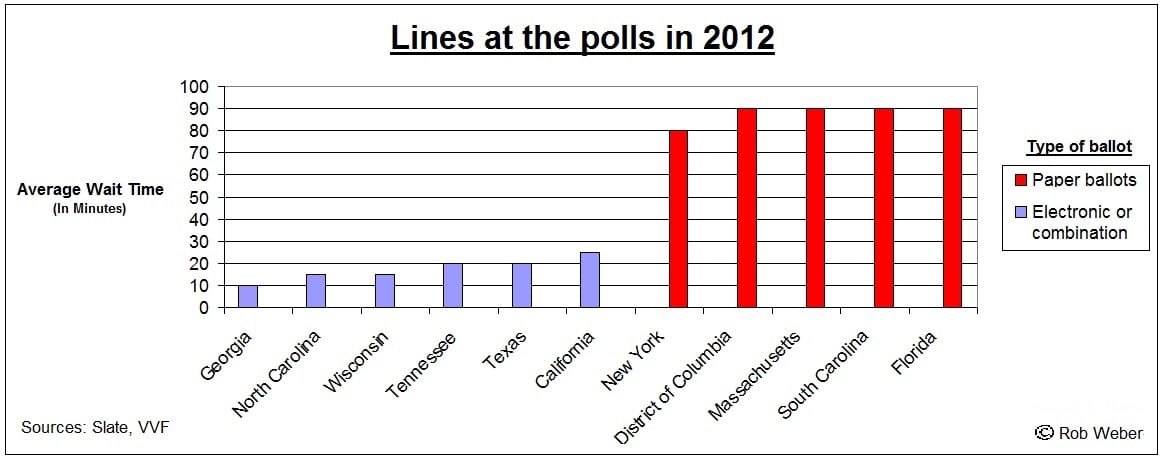
Source: Cyber The Vote
Georgia, which votes almost entirely on electronic ballots, had an average wait time of 10 minutes. Florida, which votes exclusively on paper ballots, had an average time of 90 minutes. California, despite being the most populated state in the nation, had only a 25 minute median average wait time, with much of the state using electronic voting.
The most telling example of a state where paper ballots were synonymous with long lines in 2012 was New York. Voters waited for an average of 80 minutes, an unprecedented high average for the state.
For generations, New Yorkers voted using mechanical lever voting machines. The single-step voting process was one that reliably recorded and tabulated votes, while providing an easy-to-read and easy-to-understand voting experience without 80 minute delays.
By 2012, however, all lever machines in New York had been replaced with a two-step paper ballot/optical scan tabulation voting system. New Yorkers went from pulling levers to filling out little ovals with a pencil on sheets of paper. After marking the ballot, the voter must wait in line again to feed the page into the tabulating machine.Optical scan systems use an outdated technology, which first appeared on a large scale in the 1960s and 70s. They are highly flawed systems that are prone to problems when a voter accidentally leaves a stray pencil mark on a ballot. The entire ballot will be discounted by either the scanning machine or a hand counter as "irregular" and is usually thrown away.
Such things as “over-votes” and irregular ballots didn't exist in New York during the many decades of lever machine use.
Why did New York choose such an obsolete yet expensive system with which to replace their beloved (albeit aged) lever machines?
New standards based on the need for a VVPAT (Voter Verified Paper Audit Trail), which is a literal demand for all votes to either be done on paper or produce a paper "receipt," led the state to choose optical scan ballots. Despite their fatal flaws, these systems are billed as "ideal" by election administration and integrity groups nationwide.
Meanwhile, after fully retiring them in 2012, New York City had to drag the old lever machines out of retirement for the mayoral primary in 2013 because the new systems could not handle last minute changes on the ballot. Officials and the media claimed that ballot changes could not be made in time for the election because of limitations with the software of the new "electronic voting machines".
Optical scan election systems are not electronic voting machines. They are simply paper ballots that are fed into a tabulating computer.
In fact, it was the extra time required to print new paper ballots at the last minute that caused the problems in the New York mayoral primary. Ballots on both the old lever machines and modern digital voting machines can be reconfigured almost instantaneously. Only paper ballot systems require a lengthy turnaround time for printing.
New Yorkers, along with all U.S. voters who currently mark paper ballots, are going to have to figure out what they have gained from this switch to paper. We can already see the costs and we have deemed them to be unacceptable.
Image credit: Southern Coalition