 Eveline Dowling
The June 2 California governor's primary ended without the Republican lockout that Democratic strategists had feared, but only narrowly. With 99 percent of results in, Democrat Xavier Becerra leads with 28 percent of the vote and Republican Steve Hilton advanced in second place with nearly 25 percent.
Democrat Tom Steyer, who had been polling competitively for months, finished third with 23 percent and is out of the race entirely. More than 2.1 million Steyer votes played no role in determining who advances to November. In a state where Democrats outnumber Republicans nearly two-to-one, the top-two system converted a fragmented Democratic majority into a close race decided by a few percentage points.
 Independent Voter Podcast
This is not a failure of individual candidates nor of all-candidate primaries, but the result of a plurality voting system in the primary that is not designed to handle competitive, multi-candidate fields. The good news is that the fix does not require a constitutional amendment but instead by a simple statute.
For future Top Two primaries, legislators could pass laws to enact ranked choice voting (RCV) in the primary and more reasonable ballot access and a write-in option in November elections with RCV.
Under the top-two rules, two Republican candidates with a combined total below 40% could advance to November over a fractured Democratic field. This happened in Washington State’s Top Two election for state treasurer in 2016, and nearly happened again in another key statewide race in 2024.
The Seattle Model of Top Two Elections
Seattle voters have adopted all of these changes, with RCV in the primary now moving toward implementation. Voters will rank candidates in order of preference, with the candidate with the fewest votes being successively eliminated and those votes counting for the next ranked choice until two candidates remain.
Those two advance to the November general election, as Proposition 14 requires, and ensure the majority of voters are never locked out.
 Shawn Griffiths
Consider how this would have changed June 2. Rather than Steyer's nearly 20 percent of the vote going to waste and Becerra barely surviving on a plurality, RCV would have redistributed lower-ranked candidates' votes until two candidates had majority support.
The outcome might have been the same, or it might not, but it would have better reflected California voters' true preferences rather than how well campaigns managed the coordination problem of a crowded field.
The evidence base for this approach is now substantial. Research synthesized in a 2025 American Bar Association report on RCV finds that RCV elections consistently produce winners with broader support, reduce spoiler dynamics in multi-candidate fields, and reward unifying candidates. These findings translate directly to the coordination problem California faces.
Voters consistently tell pollsters they like RCV after voting with it, and numerous states and cities have seen voter turnout surge after adopting RCV. With sufficient time for planning, California will be able to tally RCV results as quickly and transparently as its non-RCV elections. The statewide experience in Maine and Alaska is instructive on legislative reception as well.
In Maine, where RCV has been used for federal elections since 2018, the legislature has repeatedly acted to expand and clarify its use and added it for presidential elections in 2019, and is seeking to extend it to the governor this year.
In Alaska, research published in Political Research Quarterly found the state's top-four/RCV system is associated with more unifying candidates winning elections, and a 2024 poll found that 82% of Maine voters described RCV as easy to use and more popular than ever in the state.
These findings represent a growing scholarly consensus that RCV, when properly implemented, delivers the representative outcomes that plurality systems in crowded fields cannot.
Why This Moment Matters
This reform has a germane behavioral component. Watch any California governor's debate and the incentive problem of the current system is clear. One student observer at the April Pomona College debate left "more confused than ever" after candidates descended into what one participant called something “worse than my teenagers at dinner."
 Cara Brown McCormick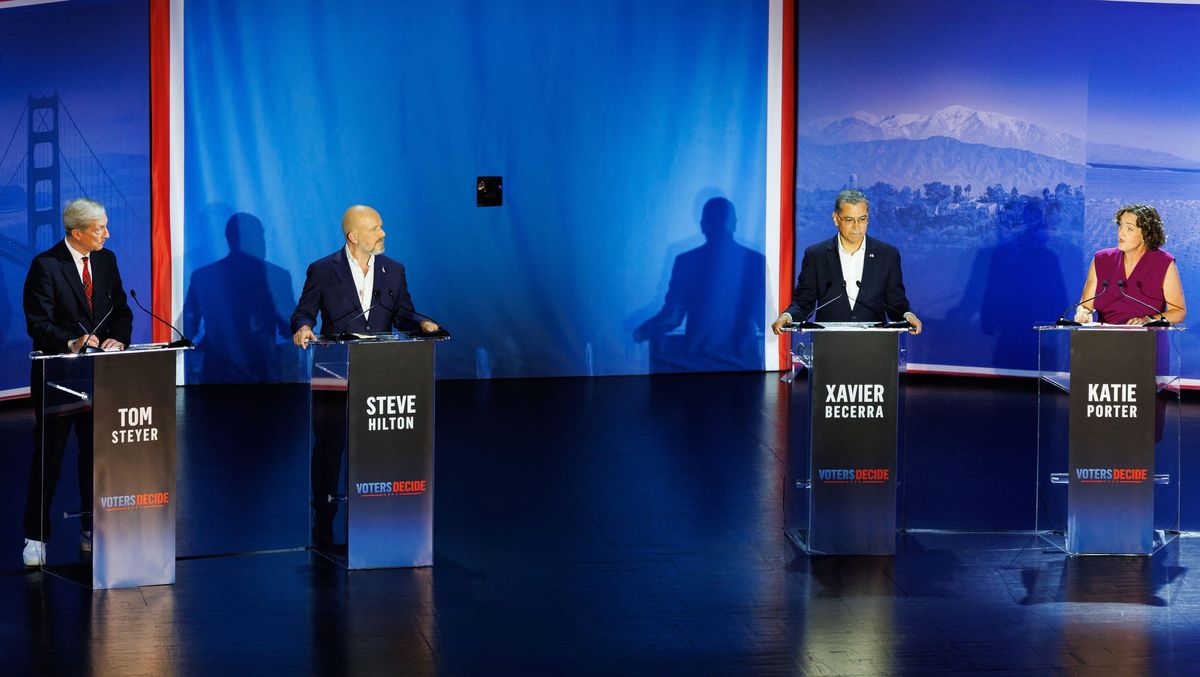
Debate moderators warned against a "food fight" at the outset of a subsequent debate. The candidates ignored the warning, trading personal insults alongside policy attacks despite sharing broadly similar positions on most major issues.
In a crowded field governed by plurality rules, candidates face structural pressure to distinguish themselves through negative attacks instead of persuasive appeals. This occurs because the difference between moving forward or being knocked out often hinges on securing only a tiny fraction of votes.
RCV changes that calculus with great examples from recent gubernatorial debates among Maine Democrats and Republicans. Because candidates aim to be ranked favorably by a wider audience, there is a reduced incentive to engage in personal attacks that could alienate potential supporters.
The political science literature shows that, across RCV and plurality jurisdictions, voters in RCV jurisdictions were significantly more likely to report campaigns as less negative. My research, co-authored with fellow scholars, finds that RCV is associated with increased voter mobilization, driven in part by the more civil and candidate-accessible campaign environment the system creates.
The 2026 governor's race is attracting attention from a political class that typically does not engage with electoral system design. Candidates, party officials, and journalists are now asking, "Why does California's system produce this kind of strategic pressure?”
That attention creates a window for legislators to introduce a concrete, technically sound proposal for future elections that speaks directly to an observed failure rather than asking the public to accept an abstract argument for electoral innovation.
The Seattle model is well-suited to that moment. It's incrementally understandable, keeps the voter-approved top-two system, adds a clear ranking mechanism to the primary, and expands voter choice in the general election.
It does not require a ballot measure campaign nor ask California to take a leap of faith on an untested system. And most pressingly, it directly addresses the coordination problem currently consuming Democratic Party attention in the governor's race, not by restricting competition, but by making it safer.