
Skip to content
Subscribe

California Education Data More Crucial as Funding and Standards Change

Published:
California Education Data More Crucial as Funding and Standards Change

Credit: hxdbzxy / Shutterstock.com

Most of California's educators are excited about the new funding formula that'll help struggling school districts. They're also being phased into teaching through Common Core standards, while new standardized tests are developed. However, a crucial part of making sure this all works effectively and is conducive to educational goals is currently missing.

The Public Policy Institute of California (PPIC) delved into the state of education data in an August 2013 report, and found:

"The state has made considerable progress in building an educational data system. Unfortunately, it remains unfinished. We have a large accumulation of data, but they remain inaccessible to most of those who could use the information to improve the quality of education in California."

The PPIC is referring to the incomplete P-20 system, which would help longitudinally track student academic progress from pre-kindergarten to K-12 all the way through college to workforce outcomes. Outlined is the progress of the P-20 system: Credit: PPIC.org
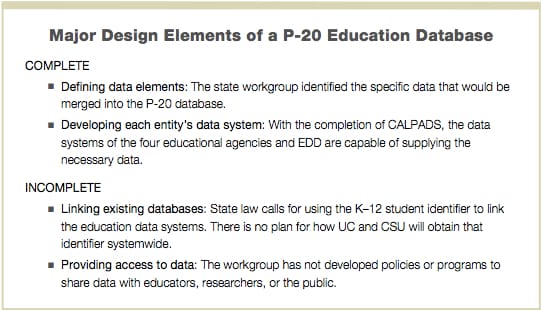
Credit: PPIC

So, why is it helpful to have all this data about a student and his or her performance from the first day of class to the first day on the job? It's not about academic advisors looking over a student's shoulder every step of the way. It's not about a college admissions officer or potential employer looking into your history before evaluating your application or scheduling an interview.

If the state wants to make the best education policy decisions, it should know what works and what does not work. Part of doing that is analyzing meaningful data that isn't fragmented over the years. Does a certain policy in K-12 lead to higher college admissions or higher employment? Policymakers and school administrators can't be sure with the current system of education data.

The current system of tracking student progress falls short of what P-20 envisions:

"It is estimated that 15 to 20 percent of school-aged children move to another school each year; and without a statewide longitudinal data system, the schools or districts that accept mobile students often have very limited information on their prior achievement."

Educators, parents, and students can ban together to request policy changes and give recommendations to lawmakers, but lawmakers and education experts would still be perplexed on crafting a solution without solid data.

It may not be the most exciting or flashiest of policy decisions, but accountability and education data in California is underdeveloped. At a time when policies are drastically changing, a system of data collection and determining what it all means becomes more useful.

Do you see any flaws in having a detailed database of student progress, similar to the P-20 system? Is there potential for the data to be mishandled? Governor Brown has been opposed to establishing a large database because of costliness; is this a necessary cost considering California's history tight budgets?

Adhere to the IVN etiquette

By posting a comment, you agree to adhere to our etiquette rules: No partisan attacks, no personal attacks, substantiate your sources, no self-promotion.

Contact IVN

Questions about this article or our coverage? Send us a message. A free IVN member account is required.

Message sent

Thanks, we’ll review it and get back to you if needed.

Message not sent

Sorry, something went wrong. Please try again.

Sign in to send a message

Messages are tied to your IVN member account. Signing in is free and takes a few seconds.

Republish this article

Republishing guidelines

Republish IVN articles for free. Independent Voter News articles may be republished online or in print under a Creative Commons BY-NC-ND 4.0 license, on these terms:

  1. Credit the author and IVN. Keep the byline ("By Author Name, Independent Voter News") and the attribution note at the end, which links to the original.
  2. Keep the meaning. You may update time and place references and apply your house style. You may trim for length, as long as the cuts don't change the meaning or misrepresent the author. Keep the headline. Mark any additions as your own (for example "Additional reporting by ...").
  3. Translations are welcome. Translate faithfully, add "Translated from English by [your outlet]", and tell us at editor@ivn.us.
  4. Keep the links, including the link to the original article.
  5. Keep the tracking image. The HTML includes a 1-pixel image that counts readers on your page. It collects no personal information.
  6. Photos and illustrations. Images credited to IVN may be used with this article only. Images credited to others (AP, Getty, Unsplash, Wikimedia and so on) stay under their owners' terms. Secure the rights or switch "Include images" off.
  7. Don't sell it. You can't sell our articles or sell ads specifically against them. Your normal site advertising is fine.
  8. No implied endorsement. Don't suggest that IVN or the author endorses you, your candidates or your causes, or that donations to you support IVN.
  9. Keep labels. Opinion or analysis pieces keep that label.
  10. Point search engines to the original. Where your CMS allows, set the canonical URL to the original IVN article.
  11. No bulk or automated republishing, and don't submit our articles to aggregators (Apple News, Google News, MSN) as your own.
  12. Corrections and removals. Update your copy when we correct it, and remove it promptly if we ask. We'll contact you at the email you give us.
  13. Questions or print republication: editor@ivn.us.

IVN staff: fill in who you're inviting above, then create the invite.

Preparing the article

California Education Data More Crucial as Funding and Standards Change

Choose a format
  • HTML
  • Email HTML
  • Markdown
  • Formatted (.docx)
  • Plain text
  • WordPress blocks
  • PDF
Choose a platform

Photos credited to others need their owners' permission.

To for

Republishing somewhere else? Questions? editor@ivn.us