Skip to content
Subscribe

Bipartisan Cooperation Reduces Ohio Drug Penalties

Published:

In a bipartisan effort to abate overcrowding in state prisons, Ohio’s Senate Bill 337 went into effect last week, reducing Ohio drug penalties and giving convicted felons a second chance at employment.

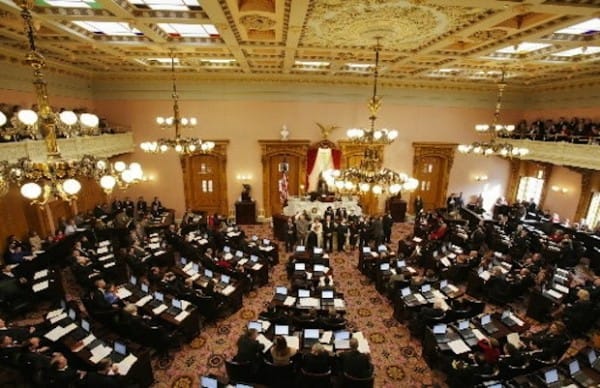
The measure, which was signed into law by Gov. John Kasich (R) and sponsored by Sen. Shirley Smith (D) and Sen. Bill Seitz (R) last June, was overwhelmingly approved by both houses of the General Assembly.

The primary purpose of the legislation is to eliminate some of the employment barriers that individuals with criminal records are faced with, as well as to reduce penalties for victimless crimes.

The bill reduces the penalties for possession of drug paraphernalia for the purpose of using marijuana from a fourth-degree misdemeanor to a minor misdemeanor. This legally equates possession of drug paraphernalia to possession of marijuana itself.

Rep. Tracey Maxwell Heard, (D), who sponsored the bill in the House, said that it is a prime example of what legislators can achieve when they put partisan politics aside:

“Who knew Democrats and Republicans could work together—and on something that is considered heavy-lifting, you have to do legislation like this in a bipartisan manner because if not, we’re just throwing someone under the bus for being soft-sided on crime.”

The bill also affects 1.9 million Ohioans with criminal records. Convicted felons who are subject to collateral sanctions now have the ability to petition for a “certificate of qualification,” which will give them access to some occupational licenses that were previously unavailable. It will allow also individuals to seal two misdemeanors, or one felony and one misdemeanor.

There are more than 49,000 inmates in Ohio prisons and this legislation would help prevent those who are not yet hardened criminals from becoming institutionalized.

Legislative Liaison for the Ohio Department of Rehabilitation and Correction Scott Neely said he thinks the bill was passed with nonpartisan support because, after a decade of Republicans passing “tough-on-crime” legislation, Ohio’s prisons cannot sustain either the inmate population or the costs such a population requires:

"This required bipartisan support because most human beings believe in second chances. Something had to give."

James Kosta, a gas station attendant and a felon convicted, said he’s eager to see the legislation go into effect:

“When I was 24 I lost custody of my daughter after a child support spat. After a few months of missing her terribly, I decided to visit her without permission. I was charged with kidnapping and was immediately unemployable ... I’m stuck at a dead-end job as a result.”

Adhere to the IVN etiquette

By posting a comment, you agree to adhere to our etiquette rules: No partisan attacks, no personal attacks, substantiate your sources, no self-promotion.

Contact IVN

Questions about this article or our coverage? Send us a message. A free IVN member account is required.

Message sent

Thanks, we’ll review it and get back to you if needed.

Message not sent

Sorry, something went wrong. Please try again.

Sign in to send a message

Messages are tied to your IVN member account. Signing in is free and takes a few seconds.

Republish this article

Republishing guidelines

Republish IVN articles for free. Independent Voter News articles may be republished online or in print under a Creative Commons BY-NC-ND 4.0 license, on these terms:

  1. Credit the author and IVN. Keep the byline ("By Author Name, Independent Voter News") and the attribution note at the end, which links to the original.
  2. Keep the meaning. You may update time and place references and apply your house style. You may trim for length, as long as the cuts don't change the meaning or misrepresent the author. Keep the headline. Mark any additions as your own (for example "Additional reporting by ...").
  3. Translations are welcome. Translate faithfully, add "Translated from English by [your outlet]", and tell us at editor@ivn.us.
  4. Keep the links, including the link to the original article.
  5. Keep the tracking image. The HTML includes a 1-pixel image that counts readers on your page. It collects no personal information.
  6. Photos and illustrations. Images credited to IVN may be used with this article only. Images credited to others (AP, Getty, Unsplash, Wikimedia and so on) stay under their owners' terms. Secure the rights or switch "Include images" off.
  7. Don't sell it. You can't sell our articles or sell ads specifically against them. Your normal site advertising is fine.
  8. No implied endorsement. Don't suggest that IVN or the author endorses you, your candidates or your causes, or that donations to you support IVN.
  9. Keep labels. Opinion or analysis pieces keep that label.
  10. Point search engines to the original. Where your CMS allows, set the canonical URL to the original IVN article.
  11. No bulk or automated republishing, and don't submit our articles to aggregators (Apple News, Google News, MSN) as your own.
  12. Corrections and removals. Update your copy when we correct it, and remove it promptly if we ask. We'll contact you at the email you give us.
  13. Questions or print republication: editor@ivn.us.

IVN staff: fill in who you're inviting above, then create the invite.

Preparing the article

Bipartisan Cooperation Reduces Ohio Drug Penalties

Choose a format
  • HTML
  • Email HTML
  • Markdown
  • Formatted (.docx)
  • Plain text
  • WordPress blocks
  • PDF
Choose a platform

Photos credited to others need their owners' permission.

To for

Republishing somewhere else? Questions? editor@ivn.us