
 Steve Peace
The state’s nonpartisan Top-Two primary was never designed to guarantee a Democrat-versus-Republican general election. Nor was it designed to prevent two Democrats or two Republicans from advancing to the final round.
It was designed to let all voters decide who advances.
And when you look at California’s newly released voter registration numbers, the possibility of a Democrat-versus-Democrat general election in 2026 looks less like a flaw in the system than a fairly predictable outcome.
According to the California Secretary of State’s latest registration report, Democrats account for 10.4 million registered voters, or 45 percent of the electorate. Republicans account for 5.8 million voters, or 25 percent. Meanwhile, voters registered with No Party Preference or a minor party number account for almost 7 million, or more than 30 percent of the electorate.
Independents and minor-party voters now outnumber Republicans in California.
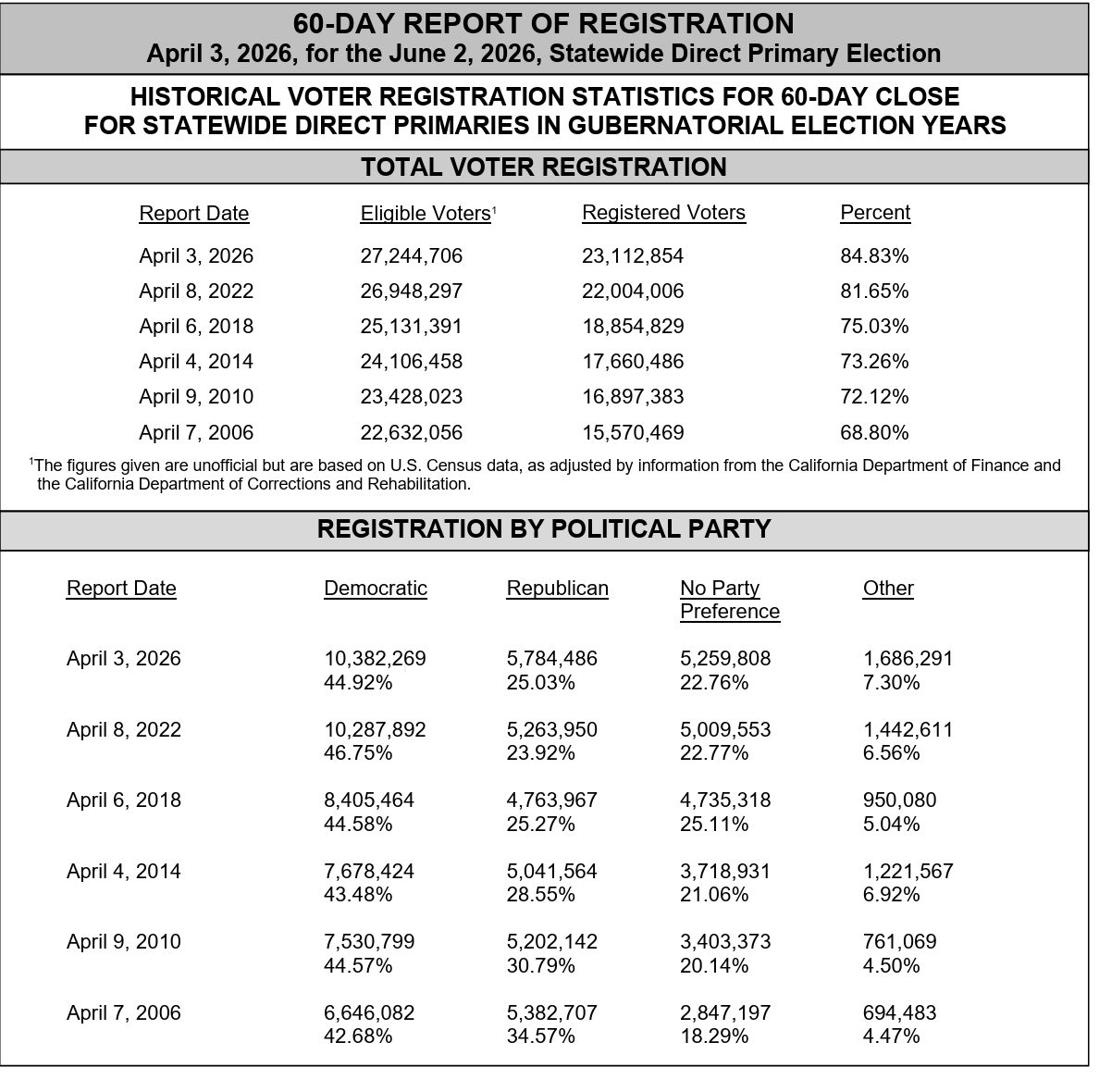
Those numbers really matter because they expose how artificial much of the recent panic over California’s Top-Two system has become.
Over the past several months, Democratic political operatives and consultants managed to spin up an entire media narrative that California could somehow end up with a Republican-versus-Republican general election for governor. Political reporters eagerly chased the story after a handful of early polls showed Steve Hilton and Chad Bianco near the top of the field. But the same polls also showed enormous numbers of undecided Democratic voters.
 Shawn Griffiths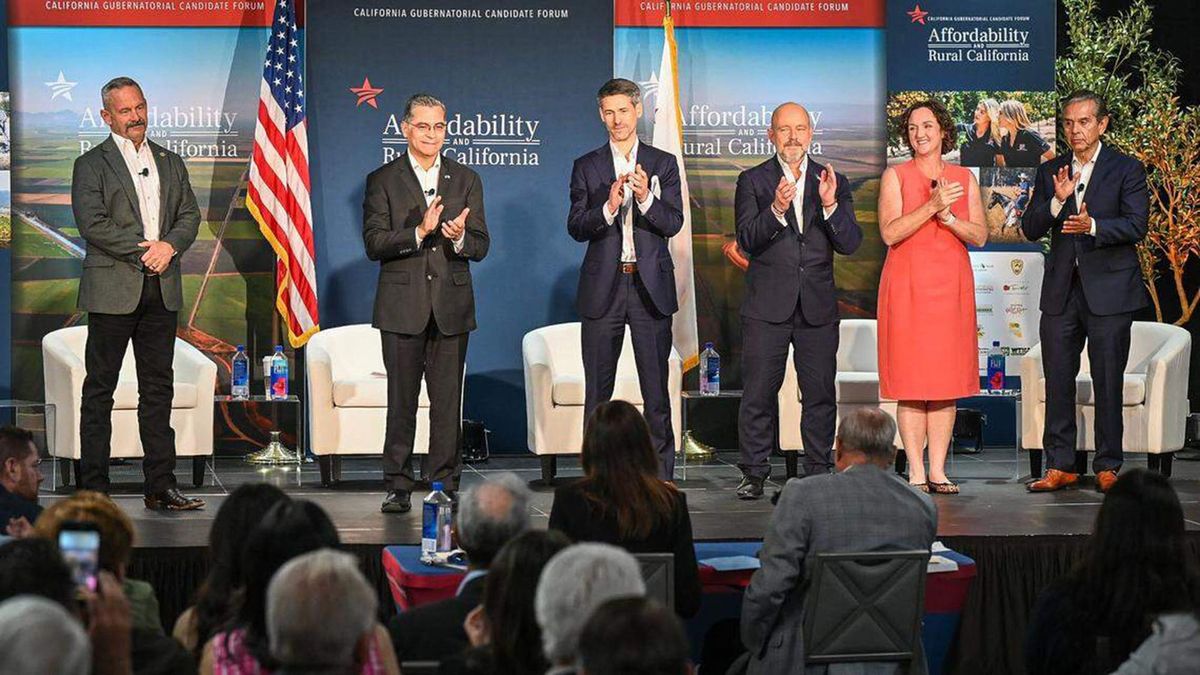
In a state where Republicans represent just 25 percent of registered voters and nearly 75 percent of voters are not Republicans, the idea that two Republicans were actually going to lock Democrats out of the general election was always politically implausible. Nevertheless, the Republican operatives went right along with the false narrative being created by the Democrats, knowing full well that the only way a Republican will wind up in the Governor’s office is if voters only have two Republicans to choose from.
The hysteria was useful to all of the insiders for another reason, though.
It created a pretext for longtime opponents of the Top-Two primary to revive efforts to dismantle it altogether.
One of the loudest voices pushing the Republican-versus-Republican narrative was Democratic consultant Steven Maviglio, who has opposed Top-Two for years and used the polling frenzy to promote a ballot initiative to undo the system entirely.
Party insiders in both parties have always been uncomfortable with Top-Two.
The system takes power away from political organizations and gives it directly to voters.
Under the old partisan primary structure, nearly 7 million voters were locked out. This gave party leaders far more control over who reached the general election. Candidates only needed to survive low-turnout partisan primaries dominated by highly ideological voters, consultants, activist groups, and party machinery.
Top-Two disrupted that arrangement by placing every voter in the same election, regardless of party registration.
That loss of control still drives political insiders like Maviglio crazy.
Of course, they prefer systems where party institutions act as gatekeepers. Top-Two weakens that gatekeeping power by allowing independents and crossover voters to shape who advances to the November ballot.
And in California, those voters matter enormously.
If more than 45 percent of Californians are Democrats, it should not be surprising that many Democratic voters may want two Democrats to choose from in November.
If Republicans represent just one-quarter of the electorate, they are not automatically entitled to one of the two spots in the final election simply because they are one of the two major parties.
And California’s nearly 7 million independent and minor-party voters may decide they prefer a Democrat-versus-Republican race or a Democrat-versus-Democrat race.
That decision belongs to voters, not party officials.
Critics often argue that a Democrat-versus-Democrat general election denies voters a “real choice.” But California Democrats frequently disagree sharply on housing, taxes, labor regulation, public safety, education policy, energy development, and the role of government itself. Those differences carry real consequences for voters.
More importantly, a nonpartisan primary does not exist to preserve partisan symmetry.
It also does not exist to produce so-called “moderates.”
It exists to reflect voter preferences.
So if a party representing 25 percent of voters cannot elect one of its candidates as one of the top two finishers in an election open to all voters, that is not evidence that the system failed. It is evidence the electorate made a choice.
California adopted the Top-Two primary to expand participation and ensure that the candidates advancing to the general election are those with the broadest support across the electorate, not simply the strongest within partisan silos.
A Democrat-versus-Democrat general election is not evidence that democracy is breaking down. It may be evidence that California’s democracy is working exactly as voters intended.
Elections should be decided when the most people vote. That’s what nonpartisan primaries favor. It’s not about political parties, or candidates, or favoring one philosophy over another. It’s about empowering voters.
By now, we should not be surprised when we see the same polarizing players agreeing on only one thing — they simply oppose voters making their own choices. Nothing is perfect. But Top Two has empowered every voter in California. Can we make it better? Perhaps. But not by suppressing voter rights and returning to a system that is controlled by political party bosses.
Dan Howle is Chairman of Independent Voter Project. Steve Peace is the author of California's Nonpartisan Top-Two Primary.