 IVN Editorial Board
Tuesday featured primary elections in 3 states—New York, Maryland, and Utah—that are being framed as a battle for the future of the Democratic and Republican Parties, a test of ideological factions, a referendum on Trump, and a preview of November’s midterms.
All of these things are true.
But there is a more important story that much of the political press will ignore: In all 3 states, millions of voters are told that their tax dollars can fund the election, but their votes are not welcome in it.
The reason? They committed the gravest sin in a system designed at every level to benefit two private political parties—they dared to register as independents.
New York and Maryland hold closed primaries. Utah calls its system partially open, but the state’s Republican primary—the contest that often matters most in a deep red state—is closed to independent voters.
Different states. Different political cultures. Same message:
Join a party, or sit down.
The Biggest Election Story Is Who Cannot Vote
Independent Veterans of America, a group founded and led by Paul Rieckhoff, broke down the numbers: More than 5 million independent voters across the 3 states were shut out of many of Tuesday’s most consequential contests.
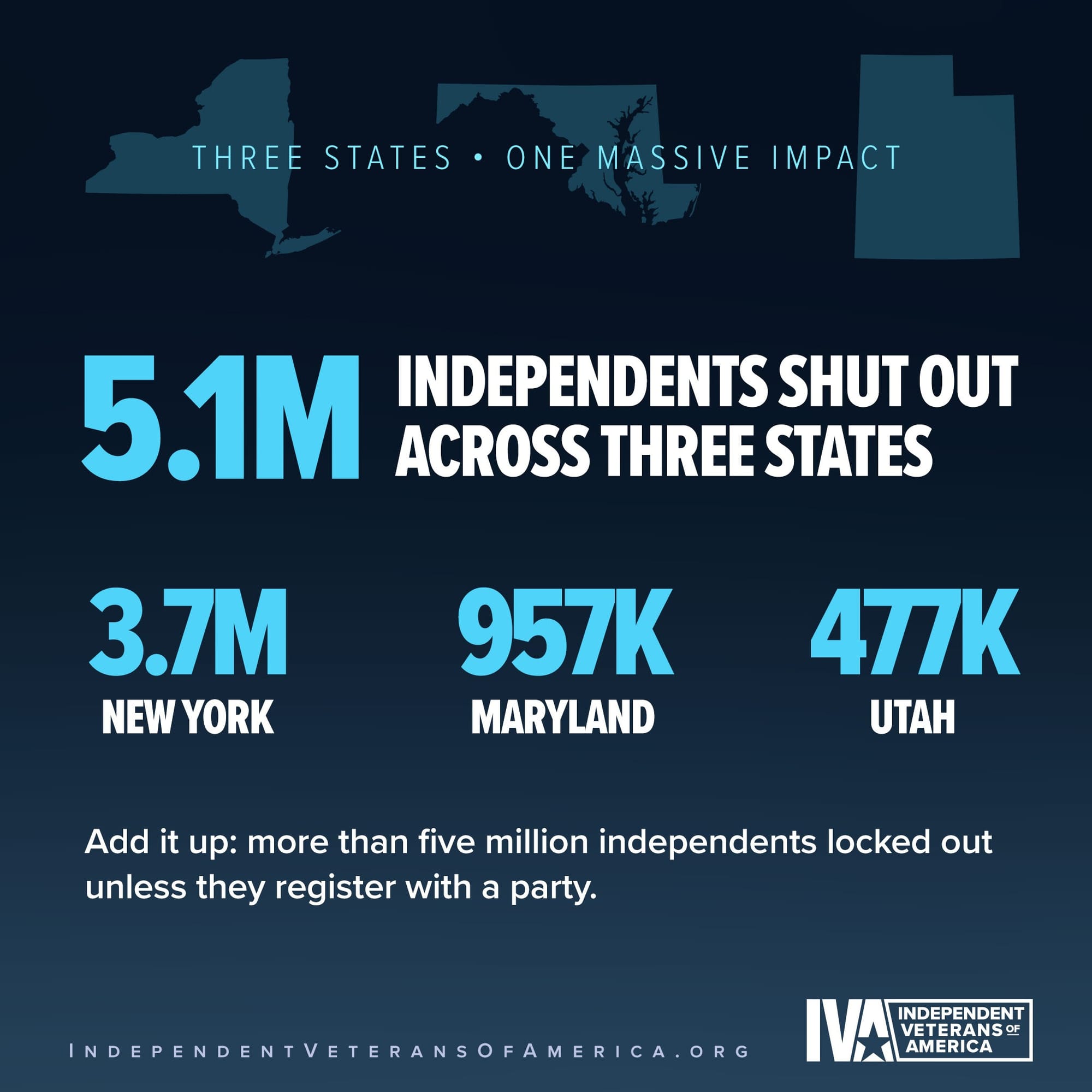
In New York, roughly 3.7 million registered voters are not enrolled in either major party. That is nearly 30% of the state’s electorate. 1.2 million of these voters are in New York City alone, accounting for 1-in-5 registered voters in the city.
Yet both the state and the city run one of the most restrictive primary systems in the country. Unless a voter enrolled in a party months before the primary election, they cannot cast a ballot in any of Tuesday’s contests.
The Senate finally votes to stop Trump on Iran. The Weird Note From His Assistant.
— Paul Rieckhoff🇺🇸🇺🇦 (@PaulRieckhoff) June 24, 2026
A Huge Primary Night in NY, MD, SC and UT. And America’s Huge Primary Problem. “A Million Independents Like Me Can't Vote"
My weekly Tuesday Primary Night segment on CNN’s OutFront with Erin… pic.twitter.com/L04AqGP7iF
It does not matter if the Democratic primary effectively decides the general election in their district. It does not matter if they pay taxes. They are out.
 Jeremy Gruber
Maryland offers the same exclusion. More than one million voters are independent, roughly one-quarter of the electorate, but the state also uses closed partisan primary elections.
Then there is Utah, which prefers to call its system partially open, but the truth is—the party with the most control over election outcomes intentionally keeps independent voters locked out. It is just a different kind of closed system.
Independent Utahns may request ballots for certain party primaries. But the Utah Republican Party primary remains closed to voters who are not registered with the party. In a state as red as Utah, the GOP primaries regularly decide who will get elected.
“Partially closed sounds like a compromise. In practice it means: you may vote in the primaries that don't count, and you're barred from the one that does,” Rieckhoff states.
In Most Cases, The “Primary” IS the Election
Political insiders routinely describe primaries as internal party business. They argue party nominations should only be decided by party members. But there are two flaws to this argument.
One, these elections are publicly funded and administered. It isn't just party members funding them. Second, these primary elections are oftenthe election that matters—and party leaders know it.
In heavily Democratic New York districts, the majority party’s nominee is seen as the de facto winner. In heavily Republican Utah districts, the GOP nominee holds the same advantage.
When independent voters are excluded, they are not merely missing a preliminary round. They are being barred from the decisive election. The general election in more than 90% of contests is less about choice, and more of a formality.
Millions of Americans are reduced to spectators in elections that determine their representation. They can vote in November, yes—but only after the meaningful choice has already been made for them by a smaller pool of party-approved voters.
That is not equal participation. It is a two-tiered electorate. It is a system in which independents are treated as second-class voters.
Publicly Funded. Privately Gated.
The central contradiction is impossible to ignore.
These primaries are not private events held in a party’s headquarters. Election officials administer them. Poll workers staff them. Counties and states budget for them. Taxpayers fund them.
But when unaffiliated voters arrive, they are told the election is not "theirs."
A voter does not lose their citizenship because they refuse to wear a red jersey or a blue jersey. They do not become less entitled to representation because they reject the tribal identities that have driven 47% of Americans to identify as independent.
Yet closed primaries punish independence by design. The system tells voters: You are free to think for yourself, and register as you want, as long as you do not expect equal voting rights. If you want that, then join a party.
And both major parties treat party registration as proof that voters belong to them. It is not.
Open Primaries and the Independent Voter Project commissioned a poll that found nearly 40% of registered Democrats in New York City say they are independent voters who only registered with the party to vote in primary elections.
This may explain at least in part why a majority of Democrats in the city support changing the rules to let independents participate in primary elections and even more (60%) think the Democratic Party should open its primaries even if the rules aren’t changed.
Many voters register with a party because their state gives them no other practical option. They register because they want access to a meaningful election, not because they have suddenly developed loyalty to a political brand.
This, of course, does not represent all voters. In closed primary states like Oregon and Nevada, registered independents actually outnumber both major parties because they refuse to play the parties’ game—even if it means they are punished by the system for that choice.
The Consequence: 6% of The Electorate Has Already Elected Half of Congress
Tuesday’s primaries in New York, Maryland, and Utah illustrate what may be the defining story of the 2026 midterms: Most congressional races are being decided in low-turnout party primaries long before most voters see a general-election ballot.
According to Unite America, 90% of US House races are expected to be uncompetitive in November. As of Tuesday, 51% of the House had already been effectively decided by just 6% of eligible voters nationwide.
That is not a representative democracy. It is a system in which a small, highly partisan slice of the electorate picks Congress while the overwhelming majority of voters are left choosing between a foregone conclusion and staying home.
And if voters think Congress has completely lost touch with the American public as a result, it is because its members have.
The voters determining these electoral outcomes are not representative of the electorate as a whole. Unite America reports that the primary electorate is four times more partisan than the general electorate.
In other words, the people with the most power over who represents everyone are often the people least reflective of everyone. This is what happens when millions of voters are disenfranchised and told they don’t get a meaningful voice.
This is what happens when the largest voting bloc in the country is locked out of elections.