 Jeremy Gruber
Editor's Note: The following is an exclusive series on IVN from the better elections group Open Primaries. The content originated from the group's weekly newsletter, "Primary Buzz."
A new CNN poll delivers a number that should reframe American politics: 47% of Americans now identify as political independents, the highest level in more than a decade of CNN’s tracking. Nearly half the country no longer claims affiliation with either major party.
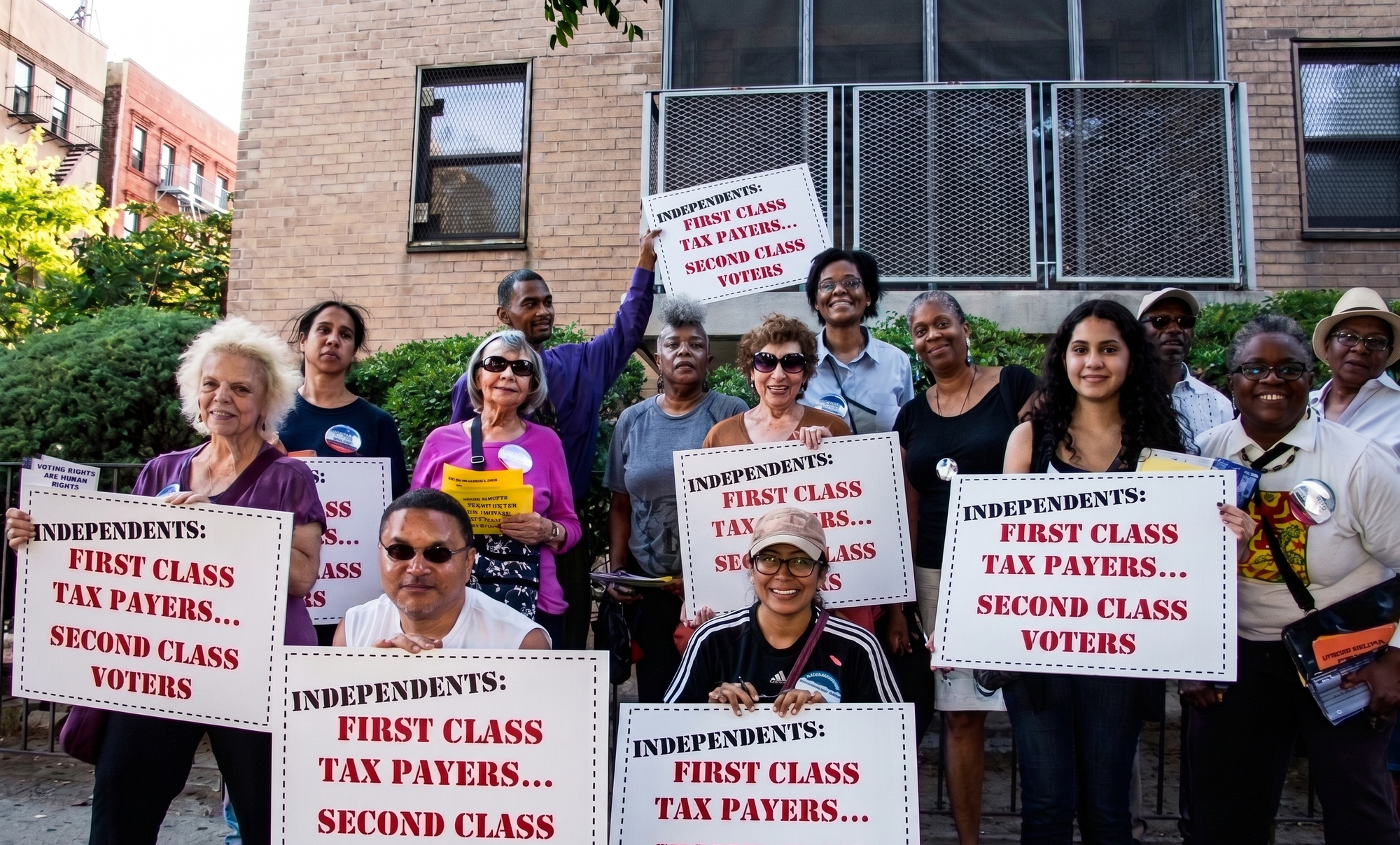
Democrats stand at 27% and Republicans at 26%. What was once a stabilizing two-party system is now out of sync with growing numbers of people fatigued by red vs blue.
Among registered voters, the picture is even more stark. Independents account for 41%, compared to 31% Democrats and 28% Republicans. The result is a widening structural mismatch: a political system still governed by two parties that no longer command majority allegiance, controlling access to elections in a country where independence is now the plurality identity.
Still, over the past year, most political coverage has continued to mischaracterize independents by collapsing them back into Democratic or Republican “leaners,” effectively denying the scale of the shift. But a growing stream of reporting, such as this new poll, now recognizes independents as the defining political bloc of our era.
This growing shift raises a fundamental question: Can a system designed by partisans for partisans remain legitimate when the country is going independent?
What We're Talking About
NYC Democratic Voters Signal Support for Opening Primaries as Party Labels Blur Across the City
A new survey conducted by IVC Media and commissioned by Open Primaries and the Independent Voter Project doesn’t just suggest change in New York City politics-it detonates a core assumption of it. Among registered Democrats in New York City, 51% support opening primaries to independent voters, with just 23% opposed. The city’s dominant political institution is now, according to its own voters, something they want to open up.
But the more striking finding isn’t about policy-it’s about identity collapse inside the party label itself. Roughly 40% of registered Democrats say they are not actually Democrats but explicitly describe themselves as independents forced into Democratic registration just to vote in the election that decides the outcome. Indeed, among Latino Democrats, only one in three identify as true Democrats at all.
 Mike Madrid
This is no longer a party system reflecting voter affiliation-it is a system quietly requiring misclassification to function. The implications land hard in a city where over a million independent voters-54% of whom are people of color- are locked out of the elections that determine most outcomes.
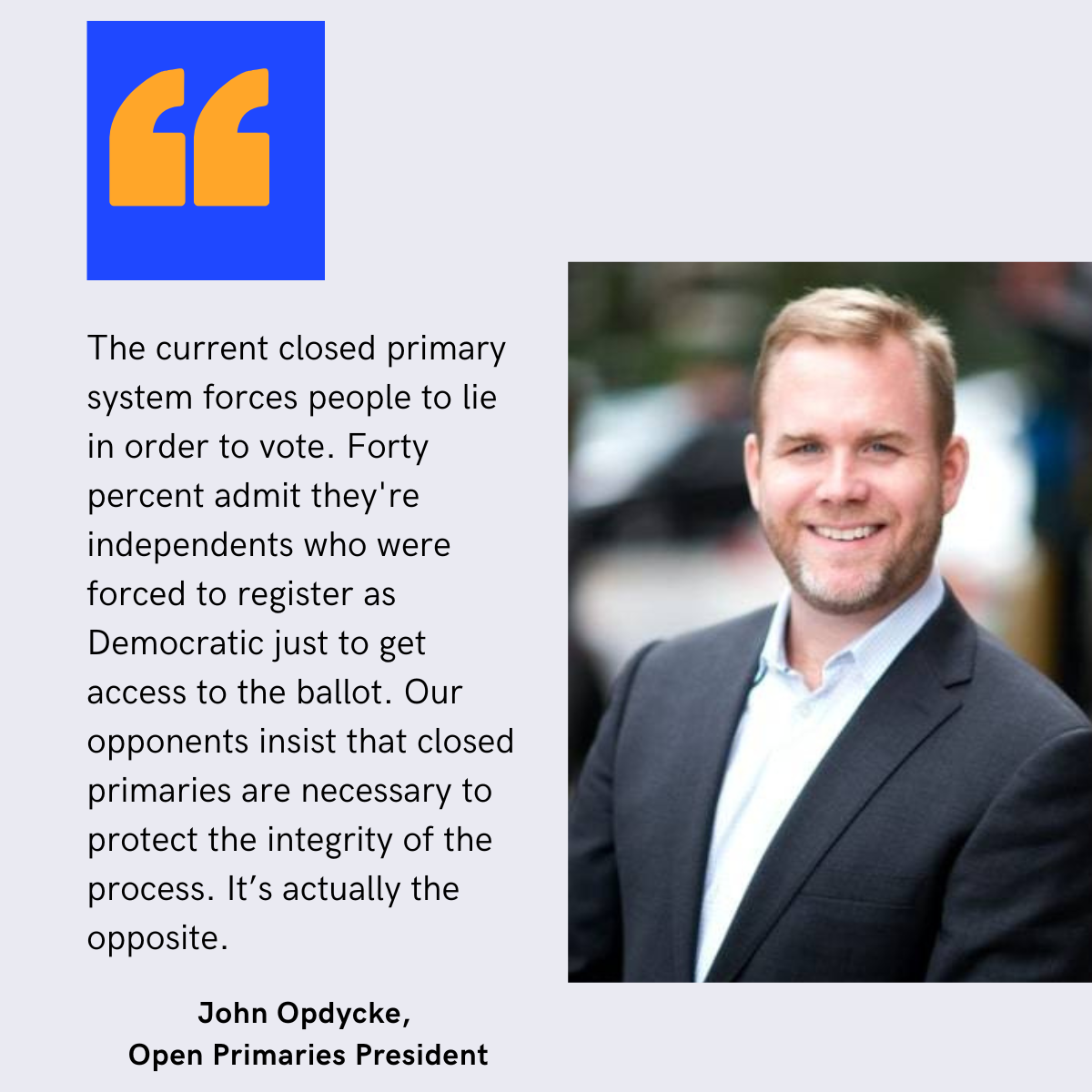
The Revolt Against Closed Primaries Is Exploding in America’s Biggest Cities
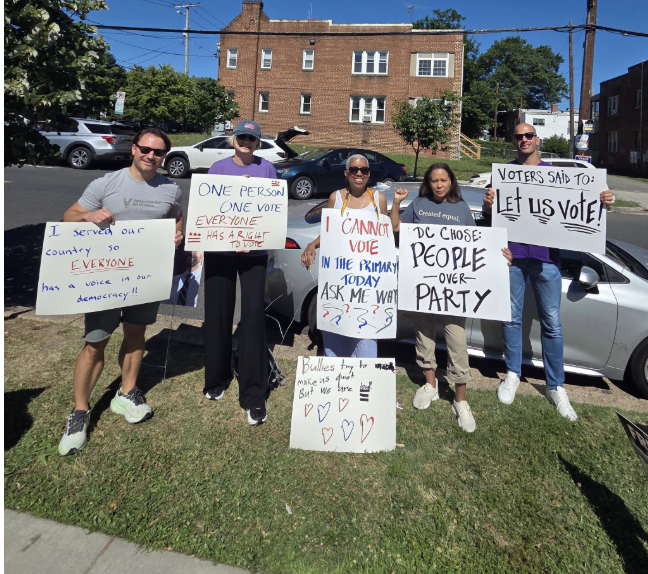
The frustration with closed primaries is no longer simmering - it is erupting. After DC voters overwhelmingly approved an open primary ballot initiative in 2024 with 73% support, only to see the City Council refuse to fund it, close to 100,000 Washington voters were once again shut out of a system they rejected in elections this week. Undeterred independents protested at the polls including Grow Democracy DC founder Lisa Rice, OP supporter Tanya Hutchins and Veterans for All Voters CEO Alberto Ramos:
Now voters in Maryland and New York are confronting the same exclusion as they head toward their own closed primaries.
Check out Open Primaries Board member and Harlem-based physician Dr. Jessie Fields as she speaks out before the CRC and the National Action Network on how closed primaries are the civil rights issue of our time and her decades-long battle for voting rights for independents:
The demand is growing louder: voters, not parties, should decide who gets to vote. Watch OP SVP Jeremy Gruber as he breaks down what’s happening in DC, Maryland, and across the country on FOX 5 News.
In Case You Missed It
Louisiana: Independents still have access to the state’s primaries, for now.
New York: Let New Yorkers Decide on Open Primaries.
Oklahoma: Second objection filed to rejection of state question for open primaries in Oklahoma.
Washington D.C.: DC Says Open Primary Costs Too Much. Its Budget Says Otherwise.
Twenty Five Years – Everything (and Nothing) has Changed
With National Organizing Director Cathy Stewart
Twenty-five years ago this month, Michael Bloomberg stood on the steps of City Hall in his first press conference as a NYC Mayoral candidate. Back then, Mike was a 50 to 1 longshot, running on the Republican and Independence lines - NYC has “fusion voting” that allows candidates to run on multiple ballot lines. I was there as a leader of the NYC Independence Party. We brought the issue of opening the primaries in NYC to Mike - and if you want all the juicy details, buy this book!
Mike stayed true to his word and empaneled a Charter Revision Process to push forward on letting all voters vote. I remember the first public hearing like it was yesterday. Dozens of independent voters showed up to testify. But ACORN and Working Families Party activists actually tried to shut down the hearing! The police had to be called. The entire Democratic Party apparatus said “No Way” to letting independents vote. They ridiculed us and when we finally got a measure on the ballot, they crushed us by 35 points.
My colleagues and I - Dr. Jessie Fields, Dr. Lenora Fulani, Harry Kresky, Fred Newman, John Opdycke, Jackie Salit and hundreds of independent voters and activists across the city - got the ball rolling way back in 2002. And here we are 25 years later. It’s a whole new day, but our opposition is beating the same drum. Here’s what they said in 2002 - the same things they are saying now!
“Open Primaries will disempower people of color.” Ironic, given that 54% of the 1.2 million independent voters in NYC are Asian, African-American, or Latino.
“Open Primaries will invite mischief and party raiding.” Dead wrong - it’s actually the opposite and our new polling proves it. Closed primaries force people to join parties they don’t believe in!
“We don’t need open primaries - we have public financing of campaigns in NYC!” Or as Brad Lander put it during the 2025 Charter Revision Commission hearings – “I don’t see an urgent reason to overturn how we’ve been doing things here for generations.”
So, let’s keep up the pressure. If you live in New York City, you can help by testifying in person or in writing - shoot me an email at cstewart@openprimaries.org and I will get you all the details on how to do that. If you don’t live in NYC, you can help by doing a volunteer phone shift or donating money to help expand our “independent to independent” texting operation.
Wyoming Supreme Court Takes Up a Fundamental Question: Who Gets to Participate in Public Elections?
A major fight over the future of voting rights in Wyoming is now before the state’s Supreme Court.
The court recently heard arguments in a case challenging Wyoming’s “crossover voting ban” - a law that prevents voters from changing party affiliation within 96 days of a primary election. Prior to the ban, voters were allowed to change affiliation up to and including on Election Day; creating a de facto open primary.
The question before the court goes to the heart of voter access in the state: how far can the government restrict when citizens may affiliate with a political party in order to participate in taxpayer-funded elections?
The plaintiffs argue that Wyoming’s law violates state constitutional protections guaranteeing the “untrammeled exercise of the right of suffrage” and equal political rights. They contend that the restriction does not protect elections - it simply locks voters out of meaningful participation in the contests that often determine who represents them.
The case is supported by Open Primaries, which is working with attorneys and advocates across the country on legal challenges involving closed primaries and barriers that prevent independent voters from participating in public elections.
The state argues the case is not about voting rights, but about protecting political parties’ ability to control their nominations and prevent “strategic voting”. But the justices repeatedly returned to the central constitutional question: when does regulating party participation cross the line into restricting a citizen’s right to vote?
At stake is a core issue facing states across the country: whether primary elections -which are publicly funded and often decisive -can exclude large numbers of voters from the democratic process.
As independent voters continue to grow nationwide, courts and lawmakers are increasingly confronting a basic reality: the rules governing elections shape who gets a voice. The Wyoming Supreme Court’s decision could have implications beyond the state’s borders. Several states, including first-to-vote in the nation New Hampshire, use a similar system to the one formerly employed in Wyoming.
We’ll keep you updated on the Court's decision. In the meantime, you can read all about cases challenging closed primaries around the country on our litigation portal.