 IVN Editorial Board
Independent voters are no longer a political afterthought. They are the majority.
And when these voters look at the state of politics in the US, they see the lack of accountability, representation, competition, and meaningful choice that the system produces.
Because the system—at every level—is designed to benefit two private political corporations: The Republican and Democratic Parties.
Across the country, organizations are building campaigns around a simple but disruptive premise: voters should not have to join a private political party to have a meaningful say in publicly funded elections.
Some are fighting to open primaries. Some are recruiting and supporting candidates outside the two-party lanes. Others are taking on gerrymandering, campaign spending, ballot access, and ranked choice voting.
Their strategies differ and they may not agree on everything, but their work is converging around a growing demand for more voice, more competition, and more choices.
Here are 10 organizations independent voters should watch in the months and years ahead.
1. More Choice California
More Choice California is the newest group on this list. Still, it is composed of state leaders and pioneers who have been active in the reform space for decades—and are responding to a threat from party operatives to “Undo the Top Two” and take choice away from 6.9 million independent California voters.
 Shawn Griffiths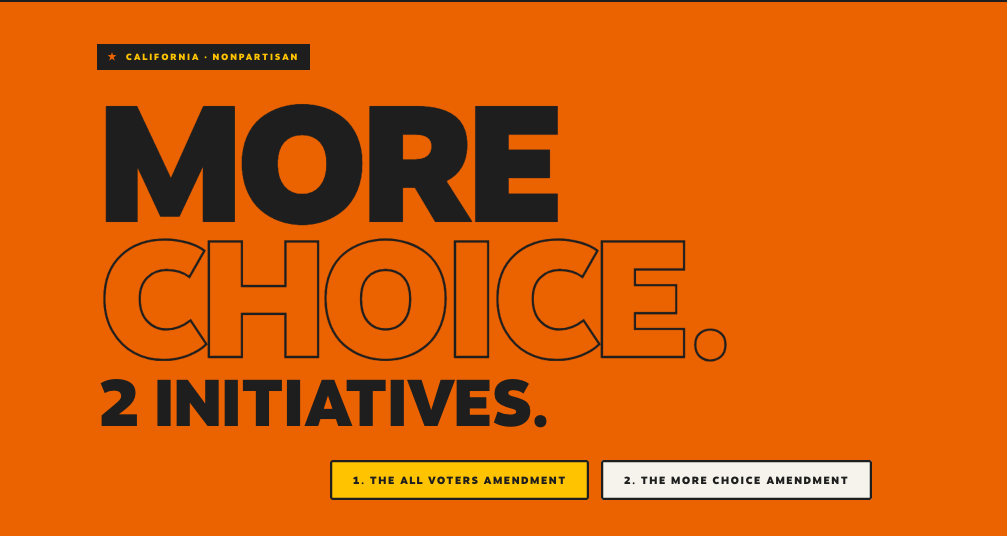
More Choice California is advancing two proposed constitutional amendments:
- A “Right to Vote Amendment” that would codify the right to vote for every eligible voter to participate in publicly funded primaries, regardless of party, and
- A “More Choice Amendment” that would move California from its current nonpartisan “Top Two” system to a nonpartisan Top 4 (or 5) system using instant runoffs in the general election.
The coalition is devoted to protecting California’s nonpartisan primary and giving voters more than two options when turnout is highest in November. If more than two candidates advance to the November ballot, voters can rank their options in order of preference.
The Independent Voter Project leads More Choice California. The coalition's Honorary Co-Chairs are:
- Lenny Mendonca, former chief economic advisor to Governor Gavin Newsom,
- Former California Assembly Minority Leader Kristin Olsen-Cate,
- Reform leader John Palmer, and
- Former Sacramento County District Attorney Anne Marie Schubert.
See the full list of advisors on the coalition’s website. Its committee, stacked with former elected officials, reform advocates, veterans, and third-party voices, will be worth watching as the debate over California’s primary system intensifies.
2. Independent Veterans of America
Independent Veterans of America (IVA) is organizing politically independent veterans into a national force in elections and public life.
Founded by Paul Rieckhoff—veteran, organizer, author, podcaster, political strategist, and reform leader—IVA’s mission is to build a large community of independent veterans who can help reform elections, expand participation, combat extremism and disinformation, and support a new generation of public-service leaders.
For #IndependenceDay (and in the wake of that abysmal debate), we’ve launched an inspiring and urgent new project to recruit, support and elect independent veteran candidates for elected office. Introducing #IndependentVeteransOfAmerica@IndyVetsAmerica pic.twitter.com/JTbIkKZlgG
— Independent Veterans of America (@IndyVetsAmerica) July 2, 2024
IVA understands that veterans are uniquely positioned to challenge party-first politics because many have already put service to the country above partisan identity.
A reminder on this Independence Day.
— Paul Rieckhoff🇺🇸🇺🇦 (@PaulRieckhoff) July 4, 2026
Learn more at @IndyVetsAmerica: https://t.co/PnDKnpzE9k.
And help us change it. #LetUsVote 🗳️🇺🇸 pic.twitter.com/vOgdTHabOe
Unlike many reform groups that focus solely on policy, IVA is also building the infrastructure veterans need to run as independent candidates. Its 2026 endorsed-candidate list includes veterans running for U.S. House and Senate in several states, including:
- Idaho,
- Mississippi,
- Illinois,
- California,
- Nebraska,
- Pennsylvania,
- South Dakota, and
- Montana.
IVN has featured articles on some of these candidates, and author Matt Shinners will continue to cover them as we head into November 2026.
The organization has also been vocal about closed-primary exclusion, recently shining a light on the millions of independent voters shut out of primaries in states like New York, Maryland, and Utah.
3. Veterans for All Voters
Veterans for All Voters (VAV) is another veteran-led organization focused on reducing polarization and strengthening accountability in American politics. Its work centers on support for the powerful combination of nonpartisan open primaries and instant runoff voting.
The group’s preferred reform is Final Five Voting, but it also pushes anti-gerrymandering efforts and greater transparency around money in politics. Its central message is “Country Over Party,” framing political and structural reform as a continuation of public service rather than another partisan project.
The group is building a national network of veterans, military families, and supporters who can advocate locally for reforms that empower voters.
5 miles covered, 6 memorials visited, 300lbs of food donated to neighbors facing housing insecurity.
— Veterans for All Voters (@OperationVAV) May 27, 2026
Thank you to our VAV NY leaders for helping lead such a meaningful event. #NYCMemorialDayRuckMarch pic.twitter.com/ARwNt3hlsi
In response to a recent Supreme Court decision that said states can allow a grace period for mail-in ballots postmarked by Election Day but received after, VAV called it “a win for military voters, overseas citizens, everyday Americans.”
“Veterans for All Voters was proud to sign on to an amicus brief defending that principle on behalf of military members, veterans, and their families. When a service member follows the rules and casts a ballot on time, that vote should count. Period.”
VAV helps normalize election reform within communities often viewed as politically diverse yet highly trusted by the public. It has helped reform efforts spanning from Nevada to New Mexico to Washington, D.C
4. Independent Voter Project
The Independent Voter Project has been a major force in the independent voter movement for more than two decades, from sponsoring California’s nonpartisan Top Two primary in 2010 to challenging closed-primary systems in court and educating independents about their voting rights.
Top Two is what the organization is best known for, but it also recently ran a successful independent voter turnout program during California’s 2026 primary elections and authored Measure K in San Diego to ensure city elections don’t end before November.
Additionally, as mentioned earlier, IVP leads More Choice California.
The group’s influence extends well beyond California. Its current work includes legal strategy, voter-access campaigns, research, and media through IVN and the Independent Voter Podcast.
Its litigation efforts span from California to Florida and New Jersey.
In June, IVP co-sponsored a virtual town hall with the Forward Party and Open Primaries focused on ballot-access barriers in New Mexico, Texas, and Arizona. These are three states where independent voters and candidates face their own challenging obstacles.
As more states debate nonpartisan primaries and independent voter rights, IVP remains one of the organizations most directly involved in moving reform ideas from theory into campaigns and courtrooms.
5. Forward Party
The Forward Party is trying to build something that many voters say they want: a political home distinct from the Democratic and Republican parties. Still, few organizations have successfully sustained a growing and lasting alternative to the manufactured two-party system.
Or as reformers have come to call it—the “duopoly.”
The duopoly does hear you and listen to you...
— Forward Party (@Fwd_Party) June 30, 2026
...as long as you're in the Left/Right 10%.
Let's build something for the rest of us.
The Forward Party supports candidates who identify as independents, Forward, Democrats, Republicans, and more provided they align with its emphasis on practical problem-solving, accountability, and reducing partisan dysfunction.
Candidates must also support some type of election reform that aligns with the party’s principles (e.g. open primaries, ranked choice voting/approval voting/STAR voting, etc.)
Forward has endorsed independent congressional and Senate candidates in multiple states in 2026, backed an independent gubernatorial candidate in Rhode Island, and supported a lawsuit challenging Texas ballot-access requirements for independent statewide candidates.
It's a noteworthy approach because the party does not demand ideological uniformity or insist that every candidate use the Forward label. This is something many parties expect from their candidates, especially the Republican and Democratic Parties.
Instead, this unique party—co-founded by former presidential candidate Andrew Yang and former New Jersey Gov. Christine Todd-Whitman—is attempting to build an electoral ecosystem in which candidates outside the major-party establishment have more support, visibility, and viable routes to office.
6. Open Primaries
Open Primaries is one of the country’s clearest and most persistent advocates for the idea that no voter should have to join a political party to vote. It has pursued this mission through state campaigns, litigation, education, research, and partnerships with local reform groups.
Most recently, the organization filed a lawsuit challenging Maryland’s use of closed primary elections on behalf of individual voters in the state—one of a growing number of cases it has directly been involved in or supported.
It even launched a litigation portal this year to help voters keep track of these efforts, and it tracks the complicated and often confusing primary rules that govern voters across the country.
Open Primaries, along with the Independent Voter Project, commissioned a poll in June that found most Democrats in NYC want primaries opened to independent voters, and the group continues to lead reform efforts in the city.
 Shawn Griffiths
For America’s 250th birthday, the group released the ‘Declaration of Independents,’ which is a statement from independent voters across the country affirming that voting rights belong to citizens, not parties, and every voter should enjoy equal voice, treatment, and dignity.
Open Primaries also took part in an independent voter turnout campaign in New Mexico, where semi-open primary elections were used for the first time in 2026. Anyone interested can keep up with the latest news by checking out “Primary Buzz” every week.
7. American Promise
American Promise is a cross-partisan reform group with one mission and one mission only: To ratify the “For Our Freedom Amendment.” And in that effort, it has made significant progress by building support state-by-state to gain bipartisan support in Congress.
Its leaders and volunteers have petitioned state legislatures across the US to put on the record their support for an amendment that would give Congress and state lawmakers the authority to pass and enforce campaign finance rules they deem necessary.
This is increasingly difficult as Supreme Court decisions block efforts and rules aimed at reining in unchecked spending—the latest case being National Republican Senatorial Committee v. FEC in 2026.
“This case is part of a long line of federal court decisions dating back to the 1970s, and until something changes, waves of lawyers will continue to bring cases to the Court to knock down anti-corruption guardrails and the American people will be left with even less say over money in politics, not because they ever voted for that, but because those choices were taken out of their hands by the Supreme Court," said American Promise Co-Founder and CEO Jeff Clements
 Matt Shinners
American Promise argues that for nearly 200 years of the nation’s history, voters and their elected leaders set the rules for money in politics, until the Supreme Court began stripping that authority away over the past 50 years.
Its work is cross-partisan by design and remains focused on the mission. The group does not endorse candidates. It does not get involved in campaign politics. It remains committed to achieving a constitutional amendment that has broad public support.
And its strategy is working. Half of the US states have passed some form of resolution supporting an amendment that does exactly what American Promise is proposing. To ratify an amendment, it needs 38 states.
In June, US Rep. Tom Barrett of Michigan introduced a resolution in Congress proposing a constitutional amendment on campaign finance, reflecting the core solution American Promise has long advanced: restoring the authority of Congress and the states to set reasonable rules for money in elections.
Clements said:
“Twenty-five state legislatures — representing red, blue and purple states alike — have called on Congress to support this amendment, often with unanimous support. We thank Representative Barrett for heeding the growing call of Americans and our states to move the constitutional amendment process forward.”
The role money plays in elections is a major concern among Americans. If the debate over party power is really about whether voters or political insiders control the system, campaign-finance rules are one of the places where that fight is most visible.
8. The People
The People is a nonpartisan civic-engagement organization built around a broader question: How do every day Americans find common ground and take action together in a political environment designed to keep them divided?
The group describes its mission as helping create a government that is truly “of, by, and for the people,” with programs that combine election reform, civic education, facilitation training, and public dialogue.
Executive Director Katie Fahey quickly became a rising star in the independent reform space when, in 2018, she led the Voters Not Politicians campaign to adopt independent redistricting in Michigan.
Fahey’s campaign grew from a Facebook post into a statewide ballot initiative, Proposal 2, which passed with 61% of the vote.
Although Fahey is a leading voice in the anti-gerrymandering space, she has emerged as a role model for other reform efforts—something that has carried over to The People, which does not focus on a single type of reform.
The group co-founded the Respect Voters Coalition, which works to protect citizen-led ballot initiatives and direct democracy. It also operates Operation Vote America, citizen-engagement forums, and Deliberations.US, which brings nonpartisan political conversations into schools, universities, and communities.
9. Unite NY
Unite NY is building a statewide reform movement around the slogan “More Voices. More Choices.” Its agenda includes 5 pillars of reform: ranked choice voting, open primaries, ballot-access reform, term limits, and a citizen ballot-initiative process.
The argument is that New York’s political system has become too closed, too restrictive, and too insulated from the voters it is supposed to serve.
The group’s work is particularly noteworthy because New York combines closed primaries, which shut out 3.7 million independent voters, with some of the country’s most restrictive ballot access laws.
Unite NY is currently working on reform efforts in Buffalo, including open primaries, ranked choice voting, and improved ballot access. It is asking the city's charter revision commission (CRC) to put these reforms on the ballot.
It also submitted more than 45,000 petitions signed by New York City voters to open primary elections to all voters in the Big Apple. It comes after multiple attempts to get the city's CRC to put an initiative on the ballot.
The proposal calls for a nonpartisan primary in which all voters and candidates participate on a single ballot. Using ranked choice ballots, the election would advance 3 candidates to November, where RCV will also be used.
To circumvent the CRC, the city council now has to take up the proposal or more signatures may need to be collected.
In February, Unite NY released its 2026 Voter Empowerment Index, which found substantial support among New York voters for changing election rules, including open primaries and other reforms to improve ballot access for third-party candidates.
10. Rank MI Vote
Rank MI Vote is a Michigan-based, volunteer-led organization advocating for ranked choice voting. The group argues that ranked ballots would give voters more choice, reduce the spoiler effect, allow candidates to win broader support, and make campaigns less dependent on partisan fear and negativity.
Its message to Michigan voters is simple: “Vote Your Hopes, Not Your Fears.”
The organization has already helped build a substantial grassroots network and points to ranked-choice voting victories in Michigan cities including Ann Arbor, East Lansing, Kalamazoo, and Royal Oak.
Its statewide 2026 ballot campaign was paused after organizers concluded they would not collect enough signatures in time. Still, the group has said its broader campaign for ranked-choice voting will continue.
In a hotly contested battleground state like Michigan, Rank MI Vote has a chance to further lead in reform, garnering substantial attention and support.