
Editor's Note: This opinion piece originally published on author Dan Sally's website and has been republished on IVN with permission from the author. Photo Credit: Gage Skidmore / Flickr
Donald Trump’s appearance in front of the National Association of Black Journalists went exactly as you would have expected it to. He was combative. He lied profusely. He engaged in a 2024 version of birtherism by questioning whether it was Harris’s Black or Indian half that was running for president.
In this sense, the only thing shocking about his appearance was that people were shocked.
What was notable about the coverage that followed was what was lacking. From the day Biden stepped out of the race until that moment the news cycle had been wall-to-wall coverage of Harris’s ascent, with the occasional story on Vice Presidential candidate JD Vance’s “cat lady” comment.
Whether intentionally or subconsciously, Trump left the NABJ with 100% certainty the conversation would be all about him.
After almost a decade as a political figure, Trump understands a truth he said out loud that many still seem reluctant to accept - that he could literally shoot someone in the middle of Fifth Avenue and not lose a single vote.
This perplexes many, as it defies the conventional strategy of trying to win an election by winning more votes than your opponent. But a closer look at the electoral math of the last two election cycles shows us that Trump doesn’t need to win more votes, he just needs to make sure his opponent loses them.
The Blue Wall Has an Orange Ceiling
Trump’s surprise victory in 2016 came with him flipping the traditionally Democratic-leaning states of Wisconsin, Michigan, and Pennsylvania - part of the so-called “Blue Wall” Democrats relied on in presidential elections. This prompted changes within both parties to focus their messaging and platforms on working-class voters.
These changes proved not to matter all that much. In 2020, Trump lost all three states with almost the same percentage of the popular vote he won them by in 2016. The same holds true for the newly minted battleground state of Arizona.
The difference wasn’t Trump or his Democratic opponent - it was in the share of the popular vote that went to third-party candidates.
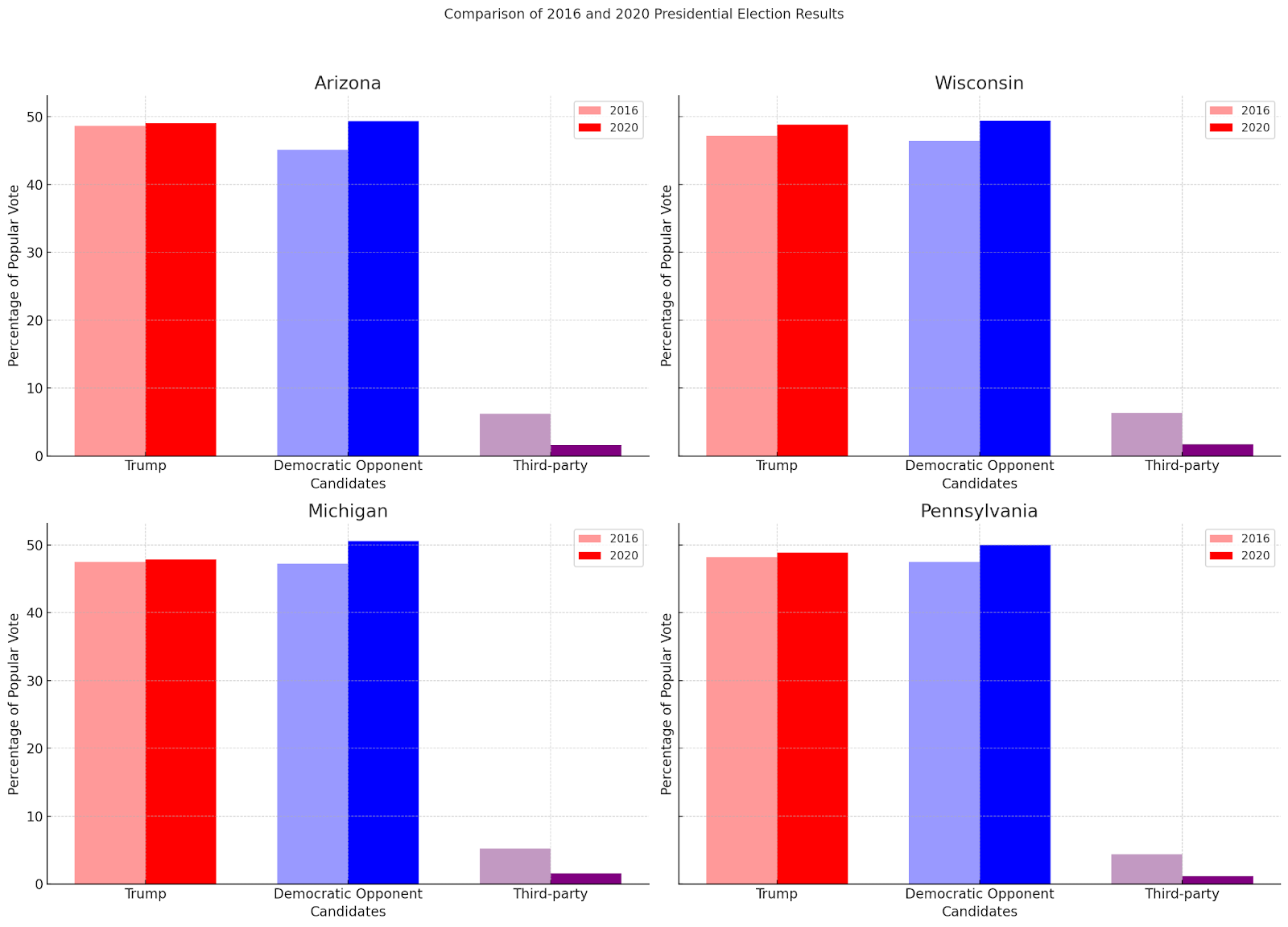
In 2020, Trump’s performance in all four states saw marginal changes while the percentage of votes going towards minor party candidates dropped by an average of 4%. And while Biden didn’t carry the same negatives as Clinton in her race against Trump, it was tough to argue he was an exciting candidate.
If anything, Biden’s appeal was the promise of a return to a more boring political news cycle.
This shows in exit polls taken in 2020, where around 40% of Biden voters said their vote was more against Trump than it was for their candidate, as opposed to only 22% of Trump voters saying the same about Biden.
Trump has never shown the ability to win a majority in the states he’ll need to win this election or the ability to expand his appeal beyond the core group of voters who’ve been with him since 2016. He’s also yet to find a way to lose that core group of voters.
In this sense, all publicity is good publicity for Trump, and all the better if it crowds out positive coverage of his opponent.
How 2024 is looking like 2016
Kamala Harris benefits from both the excitement among her base over a newer, younger candidate and that of those outside the party hungry for a Biden/Trump alternative. In this sense, she’s the most compelling Democratic candidate since Barack Obama.
But the electoral math isn’t 100% in her favor. While Trump is still polling below his high water mark in the Orange Ceiling states, RFK Jr. has qualified for the ballot in Michigan and appears to have the signatures necessary to qualify in Pennsylvania. He’s also polling at levels Libertarian candidate Gary Johnson saw at this time in the 2016 election.
Democrats haven’t been shy about launching legal challenges to remove minor party candidates who’ve threatened them in past elections. They used this tactic to blunt Ralph Nader’s 2004 campaign and again in 2020 against Green Party candidate Howie Hawkins.
Challenges to RFK’s ballot access in Pennsylvania are due on August 8th and, if Democrats decide not to contest his appearance, there’ll be two states with a third-party challenger strong enough to put the election into question.
The Bigger Problem
The presidency is too important of a job to be won by default, yet that appears to be what’s happening. America’s two futures are a Republican candidate a majority of voters have deemed unacceptable winning due to the vote being split between multiple candidates, or a Democratic candidate winning mainly because she’s less unacceptable than her major party opponent.
More troubling than this, both major parties have resorted to undemocratic means in past elections to limit the choices voters have on the ballot.
Ranked-choice voting in presidential elections would remedy this problem. It allows voters to rank their candidates in order of preference, meaning those voting for minor party candidates could throw their vote behind their favorite major party candidate. This removes the threat of independent and minor party candidates spoiling the election and encourages major party candidates to compete for the votes of minor party voters, as opposed to trying to limit their choices.
It also requires a candidate to secure over 50% support from voters to win. This means Trump would have to appeal beyond his core base of followers and couldn’t rely on simply having a larger minority of voters than his opponent.
This might not change his behavior in settings such as his appearance in front of the NABJ, but it would create such a thing as “bad publicity” in presidential elections.