Credit: Politico
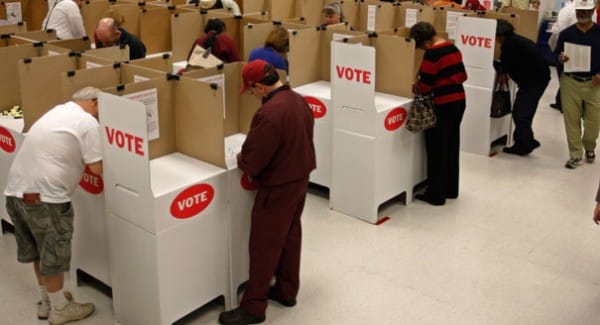
In our nation today, there are likely a great many Americans who view the Republican-Democrat two-party state as a natural product of our political process. Yet nothing could be further from the truth. The political dominance of these two particular factions at all levels of government is rather a result of the regulation of our political process by partisan Republican and Democratic lawmakers and their party bosses. To maintain the current two-party system over the last century, they have passed innumerable laws and regulations at the local, state and federal level to control everything from access to the ballot, to the primary elections process to the voting methods employed in our elections, all in the interest of maintaining a distribution of power which solidifies their monopoly on public offices. The results of this historical tendency are plain to see.
It is therefore no surprise that for a growing number of Americans, the forced choice between the candidates of the major parties resembles nothing so much as decision between Tweedle Dum and Tweedle Dumber. What reason is there then to maintain our political system in its current form? Any number of simple electoral reforms would open our politics to the millions of Americans who are marginalized by the Republican-Democrat partisan political charade. In the present article, we will consider three such reforms.
Ballot Access Reform: One of the primary means by which Republican and Democratic lawmakers limit voter choice is by controlling access to the ballot by erecting barriers that can be extremely difficult for Independent and third party candidates to overcome, while automatically qualifying the candidates of the major parties. In an article for the Harvard Law Record in 2009, Theresa Amato argued that the ballot access system in the United States is discriminatory and overwhelmingly burdensome. As she stated there, third party and Independent groups must navigate “51 different sets of Byzantine rules, written the by the partisan members of the legislatures of the fifty states and the District of Columbia.” Many of these laws, she states, are “blatantly unconstitutional” but state legislatures have been loathe “to bring the election codes into compliance with judicial rulings.” Despite these laws, many third party and Independent candidates nonetheless obtain access to the ballot, but their campaigns are hobbled by the process. Amato suggests that we level the playing field to ensure fair elections and “federalize federal ballot access laws by creating one federal statute applicable to all federal elections.”
Primary System Reform: In the vast majority of states, primary elections are the means by which the Democratic and Republican parties nominate their candidates for a given office, and in states with closed primaries (roughly half), only party members may cast ballots in those elections, thus disenfranchising millions of Independent voters across the country. Why should tax payers be forced to subsidize an internal party process that they are prohibited from participating in? The solution here is rather simple: primary elections should be open to all registered voters or they should not be publicly funded. If the parties desire to maintain closed primary elections, they can privately fund these elections themselves. Surely, their corporate sponsors would be willing to supply the necessary funding, as, in many cases, they already own the major parties' candidates.
Voting System Reform: Political scientists have long held that the method by which we vote, known as plurality voting or first-past-the-post, has had a great part in maintaining the two-party system. The general rule of thumb is that the zero-sum plurality system tends to favor the development of a political system dominated by two factions. Arguably, the situation is even more dire, as the system has devolved into one-party rule in state legislatures across the country. Reformers argue that the implementation of alternative voting methods can help to open our political system to candidates who are marginalized by the two-party state. There are a number of potentially viable alternatives to the plurality system. Organizations such as Fair Vote advocate for the implementation of Instant Runoff Voting to “uphold the goal of majority rule and voter choice.” Under instant runoff voting, voters rank their choices for a given office in their order of preference, rather than simply ticking off a box for a candidate they may not honestly support. The instant runoff is not the only possible alternative voting method. The Center for Election Science, for instance, advocates for the implementation of a method known as approval voting in which voters indicate all the candidates of which they approve. The candidate with the most approvals wins. Rather than the zero-sum game of the plurality system, approval more closely approximates a consensus-based process.
There are, of course, many other areas in which we can improve our electoral process. What are your favored reforms?