Press conference following a drug raid at San Diego State University
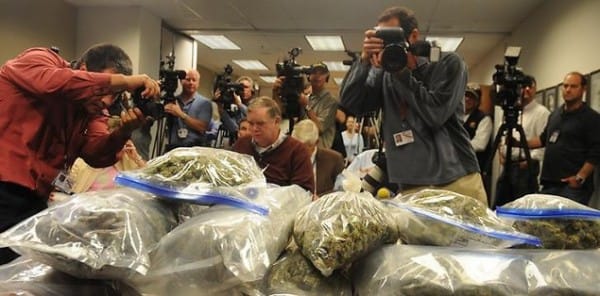
The War on Drugs is a controversial issue in the 21st century. From legalizing marijuana, to opening the border between California and Mexico, to the DARE program and California's harsh “three strikes rule”, politicians and citizens are all over the place when it comes to what further actions to take. The only consensus seems to be that action needs to be taken.
Mexico has reported 47,515 people have died in the drug war since 2006, and an estimated one in eight prisoners incarcerated in the United States in 2006 were there for cannabis offenses.
Phil Terhaar, a sergeant in the San Diego police department and a professor at the University of Phoenix, has first hand experience with the War on Drugs, most specifically the challenges faced on a border town.
The War on Drugs, in his opinion, started altruistically enough. He also acknowledges critics of the expensive policy and whether the outcomes have been effective.
“It started in 1983. The whole idea was that drugs were out of control, a lot of young kinds were getting hooked on drugs so it was kind of a presidential decision to fund more programs through the DEA and the FBI to address drugs coming into the country,” says Terhaar. “There’s a lot of money coming into the program. And so there’s a lot of skepticism as the whether the money has been used wisely to stop the drug flows into the United States. Most skeptics are saying not enough has been done and too much money is being wasted, and that it hasn’t stopped the flow of drugs.”
Specifically, Terhaar addresses the violence spillover from Mexico and the rise in crime he feels decriminalizing marijuana has caused here in America.
“I’ve seen an incredible amount of violence already with the dispensaries opening up," he said. "We had more armed robberies and gang robberies at these dispensaries, and these victims did not always report it because they did not want to get in trouble and lose their business. So there's a lot of underground black market business going on.”
Not an advocate of drug legalization, Terhaar is also not is support of enhancement laws or the “Three Strikes Rule,” which can put people in jail after 3 minor drug offenses. Terhaar says it’s gotten “to the point where prisons are over crowded. And it’s a huge expense to every single tax payer in the state of California as we pay about $42,000 dollars per inmate to be in prison per year.”
The problem with California's incarceration rates is the state doesn't have the money to sustain these programs, nor the money to pay for new prisons, he says. Therefore, counties and cities are looking at early release options.“[San Diego County has] early release programs called drug court and entry court, its rehabilitation programs, and the rehabilitation programs only cost $8-12,000 dollars a year its more to reintegrate people into society and to get them to not continue to use drugs, hang out with drug dealers and going down that path. Its been pretty successful,” he said.
Instead of harsher sentencing or legalization, Terhaar advocates education.
“Even I know in the police department, DARE programs and the anti-drug programs for kids, those programs have really gone down by the wayside because they just can't fund them anymore. So they are funding more into enforcement rather than education and I don’t think that’s necessarily too beneficial.”
“You just don’t see enough of that positive stuff. We are seeing more and more kids addicted to prescription drugs. Prescription drugs right now are the number one drug killer for young teens as opposed to illicit drugs like heroin, cocaine, and meth.”
“If they can’t get it , they go down to Tijuana, buy it illegally, and then cross it illegally back into the United States."
Policing a major metropolitan area that borders Mexico is clearly a challenge from a drug control perspective. Drug raids along the border regularly make national headlines. But there are perhaps a few different avenues for California voters to take in order to make the War on Drugs a more effective and sustainable program.