Skip to content
Sign up free
News

Vice Presidential Debate Conversations Could Change Election

By Terri Harel

2-minute read

Photo credit: Charlie Neibergall(AP)
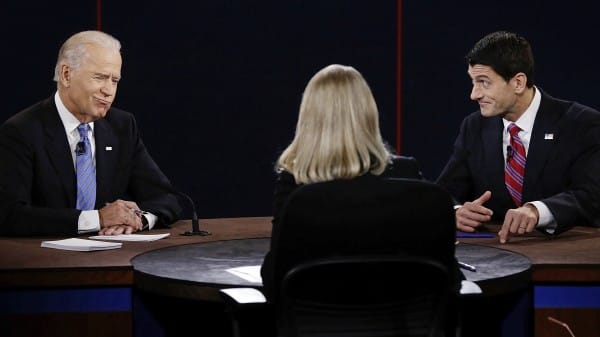
Thursday's vice presidential debate got off to a heavy start, with moderator Martha Raddatz's first question posing the recent Libyan turmoil at the US embassy. The debate did not slow down from there. Social media was afire with vice presidential debate conversations and many media sources provided a play-by-play fact check of the candidate's claims.

Biden was vivacious and, at times, vicious in his remarks.  No doubt, this is the Obama camp's response to the President's listlessness in the first debate. Paul Ryan, who is a new comer to the national stage, seemed much more composed and fiesty than Biden and delivered his answers methodically rather than passionately.

Most publications and TV networks were reporting a "draw," although University of Wisconsin communications professor Kathryn Olson told Reuters that Biden dominated the conversation and commanded the debate.

The vice presidential debate certainly served as an entertaining confrontation, especially compared with the uncomfortable bout between Romney and Obama last week.  However, the vice presidential candidates did not cover questions with any more depth than their running partners.

Vice President Biden offered a substantial amount of detail in his responses on Medicare, foreign affairs, and the budget, and served well to highlight his extensive experience in public office, but still seemed easily distracted from his point. Ryan seemed more rehearsed and rigid in his answers, often firmly repeating his answers despite the moderator's request for ellaboration. Yet, both candidates threw out personal bait to their audience, in an irrelevant cry for emotional appeal on each issue.

No novel political tactics were at play here, but the candidates' performance was surprising, surely entertaining, and offered an enticing preview of the next presidential debate. If anything, the debate furthers the interesting developments in social media and journalism. Voters have, at their fingertips, an unprecedented amount of discourse to participate in and information available to research.  The incredible impacts of these conversations on this presidential race are already being felt, and with an eye towards future of electoral processes, will be imperative to track.

Let us know what you think! Did the vice presidential debate matter? Did it change your vote?

Some additional fact check resources:

CNN

New York Daily News

Politico

FactCheck.org

Tweets by @JoeBidenTweets by @PaulRyanVP

Tags: News

Adhere to the IVN etiquette

By posting a comment, you agree to adhere to our etiquette rules: No partisan attacks, no personal attacks, substantiate your sources, no self-promotion.

Get IVN’s Free Weekly Newsletter:Get IVN’s Free Newsletter

Get IVN’s Free Weekly Newsletter:Get IVN’s Free Newsletter

Nonpartisan Issues. Diverse Perspectives.

Check your inbox and click the link to confirm.

Republish this article

Republishing guidelines

Republish IVN articles for free. Independent Voter News articles may be republished online or in print under a Creative Commons BY-NC-ND 4.0 license, on these terms:

  1. Credit the author and IVN. Keep the byline ("By Author Name, Independent Voter News") and the attribution note at the end, which links to the original.
  2. Keep the meaning. You may update time and place references and apply your house style. You may trim for length, as long as the cuts don't change the meaning or misrepresent the author. Keep the headline. Mark any additions as your own (for example "Additional reporting by ...").
  3. Translations are welcome. Translate faithfully, add "Translated from English by [your outlet]", and tell us at editor@ivn.us.
  4. Keep the links, including the link to the original article.
  5. Keep the tracking image. The HTML includes a 1-pixel image that counts readers on your page. It collects no personal information.
  6. Photos and illustrations. Images credited to IVN may be used with this article only. Images credited to others (AP, Getty, Unsplash, Wikimedia and so on) stay under their owners' terms. Secure the rights or switch "Include images" off.
  7. Don't sell it. You can't sell our articles or sell ads specifically against them. Your normal site advertising is fine.
  8. No implied endorsement. Don't suggest that IVN or the author endorses you, your candidates or your causes, or that donations to you support IVN.
  9. Keep labels. Opinion or analysis pieces keep that label.
  10. Point search engines to the original. Set the canonical URL of your copy to the original IVN article (the HTML we give you includes the tag).
  11. No bulk or automated republishing, and don't submit our articles to aggregators (Apple News, Google News, MSN) as your own.
  12. Corrections and removals. Update your copy when we correct it, and remove it promptly if we ask. We'll contact you at the email you give us.
  13. Questions or print republication: editor@ivn.us.

IVN staff: fill in who you're inviting above, then create the invite.

Preparing the article

Vice Presidential Debate Conversations Could Change Election

Choose a format
  • HTML
  • Email HTML
  • Markdown
  • Formatted (.docx)
  • Plain text
  • WordPress blocks
  • PDF
Choose a platform

Photos credited to others need their owners' permission.

To for

Republishing somewhere else? Questions? editor@ivn.us