
 IVN Editorial Board
On May 8, Democratic political operative Steve Maviglio filed paperwork to repeal Proposition 14, the 2010 voter-approved measure that opened California’s primary elections to every voter regardless of party.
Within four days, former California Republican Party chair Ron Nehring and Reform California chair Carl DeMaio, a vocal supporter of the Trump administration, publicly endorsed the repeal. DeMaio committed funding and 18,000 signature-gathering volunteers.
An unusual bedfellow, Lorena Gonzalez, president of the California Federation of Labor Unions, told the New York Times that organized labor would “likely support” the effort to close primaries as well.
This is nothing new. California’s two major political parties have lined up against nonpartisan primaries for the entire history of the system.
 Shawn Griffiths
In 2010, both the California Democratic Party and the California Republican Party officially opposed Proposition 14. Then-CDP chair John Burton said the measure would “increase the costs of political campaigns in California.”
Then-CRP chair Ron Nehring said it would “limit voter choice.” Every ballot-qualified party in the state opposed the measure. Voters approved it anyway with 54% of the vote.
In 2019, Governor Gavin Newsom vetoed SB 212, a bill that would have allowed general law cities, counties, and school districts to use ranked choice voting. The bill had passed the Assembly 56-18 and the Senate 28-8. Newsom blocked it anyway.
In March 2026, current California Democratic Party chair Rusty Hicks went on the record saying the Top Two primary “needs to be revised or repealed” and that it “could be done as early as 2026.” Less than two months later, a Democratic operative filed the repeal initiative Hicks had publicly called for.
“It was extremely scary to envision the November ballot for governor with Republicans on it,” Maviglio said.
Hicks went so far as to issue an open letter urging lower-polling Democrats to exit the California governor’s race. Some took offense.
"It's really hard to sit here and be told you should get out of the race when, OK, we're Democrats, I thought we believed in having choice," former Assemblyman Ian Calderon told a Sacramento television station before dropping out himself.
Calderon was the first millennial elected to the California Legislature and the youngest Majority Leader in state history.
The Voting Rights of 6.9 Million Registered Voters in California
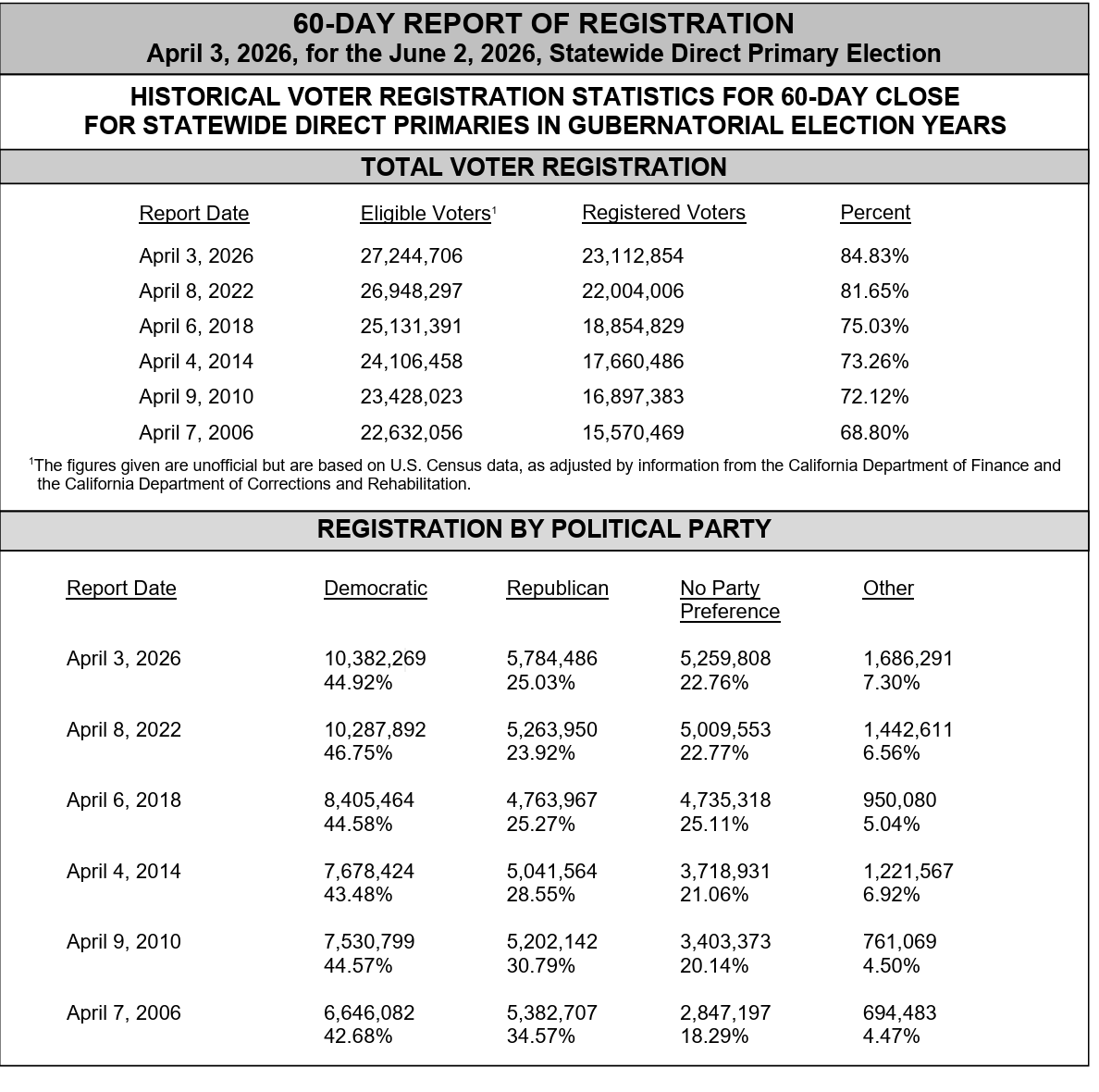
According to the California Secretary of State’s April 2026 registration report, voters registered with No Party Preference or a minor party total 6,946,099, or 30.06% of all registered voters.
This is a larger bloc than the entire registered Republican Party in the state, which sits at 25%.
If Proposition 14 is repealed, those 6.9 million voters lose access to the primary ballot unless each political party chooses to invite them. If they are registered with a minor party, they can only vote in that party's primary – if it has one.
Under the closed partisan primary system that existed before 2010, parties decided whether independent voters could participate. The state did not.
Anyone running for statewide office in California should be willing to say where they stand on that question. It affects the voting rights of more Californians than are registered with the Republican Party.
The Independent Voter Survey on Voting Rights
The Independent Voter Project sent a four-question survey to every candidate for California attorney general, governor, lieutenant governor, and secretary of state. Two of those questions go to the heart of the current fight:
Do you support the right of every voter, regardless of party preference, to participate in every publicly funded election, including primary elections?
Would you support expanding California voter choice by advancing the top four candidates to the general election and allowing voters to rank them in order of preference?
IVP’s position has been consistent for more than 15 years. If candidates or voters want more than two choices in November, the answer is to move forward with a Top Four primary with ranked choice voting – not to move backward to a closed system.
IVP made multiple efforts to contact all California candidates. However, given the importance of this issue to the voting rights of every Californian, IVN will update this article if any candidate publicly takes a position. What follows is where each candidate stands, based on the survey response and the public record.
Candidates for Governor of California on The Right to Vote
Sixty-one candidates appear on the June 2 primary ballot.
On record in support of the nonpartisan primary and more voter choice
Matt Mahan, the San Jose Mayor, responded to the IVP survey and answered yes to both questions. He has built his campaign on a record of delivering results in San Jose and a willingness to challenge his own party when it does not. He is the only candidate in the race to publicly commit to defending every voter’s right to participate in the primary.
On record supporting ranked choice voting
Tom Steyer, Democratic donor and former presidential candidate came out in strong support for California's statewide adoption of ranked choice voting on May 21.
"Let me say this, I don't think I can stay married unless I support ranked choice voting. Let me say this too. What you just said, look, in California, Catherine always says to me, Tom, you keep being shocked by the same things, when are you going to start realizing the way the world works? I've been shocked at how much the Democrat establishment and the Republican Establishment are absolutely, are absolutely in it for themselves. I've been shocked. I've been shocked, but it's true."
And so I want to make sure, look there's a million things we need to change, a million things, not just ranked choice voting, to make this a fairer state in terms of how we elect people.
But it's going to be absolutely critical for somebody to break this log jam. For somebody...I think it's amazing. People call me a populist, and I'm like does that mean I'm working for the people? You say that like it's a bad thing. And I really mean it. This system needs to change. This system needs to change. The people need to get their voice heard."
On record opposing the nonpartisan primary
Steve Hilton, the former Fox News host and Republican gubernatorial candidate, has publicly framed California’s Top Two primary as the problem. In a February 2024 episode of his show titled “The Problem with California’s Jungle Primary,” the show’s description on Hilton’s own website states the episode discusses “how California’s jungle primary has created a one-party system.” Hilton did not respond to the IVP survey.
No public position on the record
Xavier Becerra, former US Secretary of Health and Human Services and former California Attorney General; Chad Bianco, Riverside County Sheriff; Katie Porter, former US Representative; Tony Thurmond, State Superintendent of Public Instruction; and Antonio Villaraigosa, former Mayor of Los Angeles, all declined to respond to the IVP survey. None has publicly stated whether they would defend or repeal California’s nonpartisan primary system.
Candidates for Lieutenant Governor of California on The Right to Vote
Sixteen candidates appear on the ballot.
On record in support
Fiona Ma, the current State Treasurer, served in the State Assembly from 2006 to 2012, including as Speaker pro Tempore. She responded to the IVP survey and answered yes to both questions. Her support for putting independent voters’ rights into the state constitution is the position of someone who has spent her career inside California’s statewide elected leadership.
Michael Tubbs, the former Mayor of Stockton, responded "Yes" to every voter's right to participate in publicly funded elections, including the primary. He said he was "Unsure" about a Top Four system. He has built his political identity around expanding democratic participation, and his survey response is consistent with that record.
Jeyson Lopez responded yes to both questions. He added a comment to the questionnaire, saying, "Any legislation that exposes the American voter to participate in their constitutional right should be embraced!"
Gloria Romero, former state senator and majority leader, did not respond to the survey but was an early supporter of Proposition 14. She is a Republican who previously served in the state legislature as a Democrat.
On record opposing
None of the five leading candidates is publicly on record opposing the nonpartisan primary system.
No public position on the record
Ebie Lynch responded to the IVP survey but said she was "Unsure" in response to both questions; Josh Fryday, who currently serves as California’s Chief Service Officer in Governor Newsom’s cabinet; Janelle Kellman, former Mayor of Sausalito; and Oliver Ma did not respond to the IVP survey. None has publicly stated a position on whether every Californian should have a right to participate in California’s primary elections.
Candidates for Attorney General of California on the Right to Vote
Three candidates appear on the ballot, and only one has responded to the IVP survey. Only one candidate has stated a position on the right of every voter to participate in California’s primary elections.
On record in support
None of the three candidates is publicly on record supporting the nonpartisan primary system.
On record opposing
Michael Gates, Republican Deputy United States Attorney and former Huntington Beach City Attorney, said he does not support the right of every voter, regardless of party, to participate in all publicly-funded elections. He did not say "No" outright to a Top Four system, but said he was "Unsure."
No public position on the record
Rob Bonta, the Democratic incumbent appointed by Governor Newsom in 2021, and Marjorie Mikels, Green Party candidate.
The attorney general is the state’s chief law enforcement officer and the official most likely to be involved in any legal challenge to either the repeal or to a future Top Four reform. Voters only have the public position of one of the candidates in this race on whether every Californian has the right to participate in a primary election – and it is a "No."
Candidates for Secretary of State of the Right to Vote
Four candidates appear on the ballot.
On record in support
Don Wagner, the Republican candidate, is an Orange County Supervisor and former State Assemblymember. He responded "Yes" to every voter's right to participate in publicly funded elections, including the primary. He said he was "Unsure" about a Top Four system. His public support for the right of every voter to participate cuts directly across the lines that party operatives on both sides are trying to draw in the current repeal fight, given that the California Republican Party officially opposed Proposition 14 in 2010.
Michael Feinstein, the Green Party candidate and former Mayor of Santa Monica, also responded "Yes" to both questions. The California Green Party officially opposed Proposition 14 in 2010. Feinstein is the co-founder of the California Green Party and has publicly supported a Top Four primary with ranked choice voting for years.
I'm on the ballot for Secretary of State, promoting a representative multi-party democracy for California, w/proportional representation, ranked-choice voting, clean money/public financing of elections, election integrity w/results we can trust/verify, and voting rights for all. pic.twitter.com/Lj0nIdqDij
— Feinstein4SoS (@Feinstein4SoS) April 18, 2026
On record opposing
Shirley Weber, the Democratic incumbent and California’s current chief elections officer, has publicly stated she would prefer a return to closed partisan primaries.
In an October 2022 interview with CalMatters, in a section titled “Returning to partisan primaries,” Weber said the Top Two experiment “has failed.” She told CalMatters: “What it has done is that if you’re not a Democrat or Republican, you can see that you’re not going to make it to the fall.” She continued: “If we went back to the partisan system, it would not be as bad as where we are. Period.”
That is the official who currently administers California’s nonpartisan primary, on the record, favoring a return to the system that would have excluded 6.9 million California voters today if Proposition 14 had not passed in 2010. Weber did not respond to the IVP survey.
No public position on the record
Gary Blenner, the second Green Party candidate, did not respond to the survey and has not publicly stated a position.
The two candidates for secretary of state willing to publicly defend the right of every voter to participate in the primary for the office that runs California’s elections are a Republican and a Green, both breaking with their own parties’ institutional history.
The Democratic incumbent currently holding that office told the Los Angeles Times just last week, “I did not like the open primary,” and supports the Maviglio effort to return to a closed system that locks out independent voters.
Incumbent Democrats Breaking with the Party Chair to Defend Independent Voting Rights
Not every Democrat in California has aligned with their party chair’s position.
Former State Senator Steve Glazer, a Democrat who served in the State Senate from 2015 to 2024 and who built his career on independence from party leadership, publicly defended California’s Top Two primary system on X. Glazer’s public position cuts against the position taken by CDP Chair Rusty Hicks.
Perfect. The two dominant political parties who are controlled by extreme elements want to undo the Top Two political reform that handcuffs their power. . . In the name of good government. Good Grief! @joegarofoli @JeremyBWhite @LATSeema https://t.co/sCuc2bVejt
— Steve Glazer (@Steve_Glazer) May 17, 2026
The IVP survey was sent to candidates running for California constitutional offices. It was not sent to sitting members of the State Assembly. Three of them reached out anyway.
Assemblymembers David Alvarez (D-San Diego), Mike Gibson (D-Carson), and Anamarie Avila Farias (D-Martinez) reached out to the Independent Voter Project to make clear their support for California’s nonpartisan primary system.
“Protecting primaries means protecting voters,” said Avila-Farias. “Closed primaries shut people out and silence independent voices. We should be expanding participation, not restricting it. Protect voter choice. Protect democracy.”
Three sitting Democratic leaders and a former Democratic state senator publicly siding with cross-partisan reform while their state party chair has openly called for repeal of the nonpartisan primary is courageous.
It is a reminder that the Maviglio repeal effort does not speak for every Democrat in California.
A New “More Choice” Coalition Emerges to Defend and Advance the Right to Vote
On May 12, More Choice California launched as a cross-partisan coalition to defend the existing nonpartisan primary and advance a top-four primary with ranked-choice voting in the general election.
The More Choice coalition includes former Republican legislators, former Democratic administration officials, nonpartisan reformers, Latino political analysts, ranked-choice voting organizers, veterans’ advocates, grassroots leaders, and third-party voices. The Independent Voter Project leads it.
The coalition’s position is the same one IVP has held since drafting Proposition 14 more than fifteen years ago. If candidates and voters want more options in November, the path forward is to a top-four with ranked-choice voting. Not backward to a closed system that locks out the 6.9 million Californians who are not registered with either major party.
The candidates who went on the record in this survey have placed themselves on the side of every voter’s right to participate. The candidates who said nothing have left voters guessing on a question that affects the right to vote of more Californians than are registered Republicans.
Readers who want to support the right of every voter to participate in California’s primary elections can visit More Choice California.