
Twitter is now tracking your tweets to compile daily ratings on which candidate has the most user sentiments. Launched Wednesday, the social site will be updating their Twitter Political Index, or Twindex, everyday at 8pm, comparing the top two candidates with most user sentiments. The two most popular candidates being mentioned on Twitter are (unsurprisingly) Barack Obama and Mitt Romney. The Twitter political index, however, does not highlight any of the 6+ popular running third party candidates such as Jill Stein or Gary Johnson.
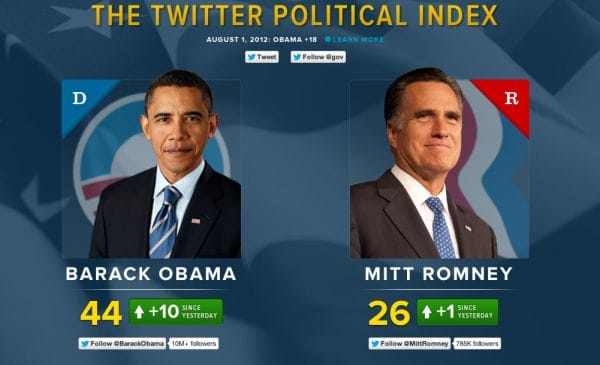
Twitter’s new political stats endeavor raises the discussion of the validity and value that an Index like this represents.
Regarding its value- the poll may actually have strong correlation to a more traditional public opinion research group, Gallup, which signifies the new ability to capture a tough thing: "the nuances of public opinion".
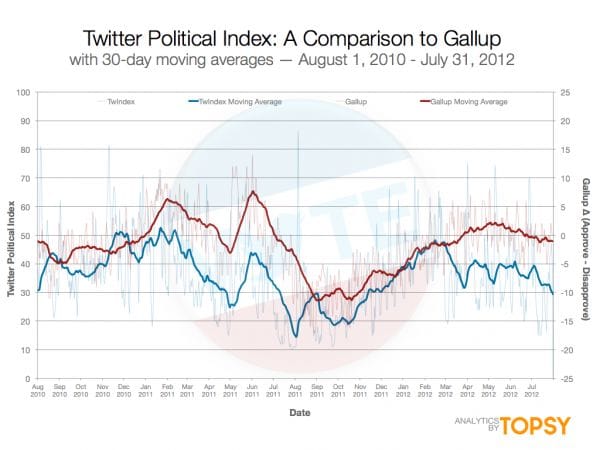
When asking questions regarding validity, the idea of what the goal of the index is trying to represent is crucial. The L.A. Times addresses this:
a recent Pew survey
And because I'm not skilled with algorithms or the entire discipline of mathematics for that matter, I am forced to put some trust in the partnership of Twitter and other notable research based organizations. The partnership comprises of Twitter, Topsy, USA Today, The Mellman Group and North Star Opinion Research. Topsy, in specific, is responsible for analyzing the 400 million tweets ranking them from 1 (the most negative) to 100 (the most positive).
On the site's blog, it explains:
all
A key part is the focus on Obama and Romney's gaining stats, and the subsequent exclusion of the other very present third party presidential candidates. This limits Twindex to essentially a poll on the two party system, which assuredly can't accurately depict the sentiments of all Twitter users, much less the United States.Although I am always hesitant of the actual validity in statistics, it's nevertheless interesting to see partnerships forming between traditional research based orgs and social media groups to find common ground and utilize their resources to gauge public interest and opinion.
Do you think Twitter polling is a good indicator of election results?