The Keystone state was clearly nicknamed for its importance in the creation of our fine country, and swing state Pennsylvania will continue to play an imperative role in the upcoming election. According to the latest polls, President Obama has a near 10 percent lead over Mitt Romney in the state which played an integral role in revolutionary America. An average of all polls put President Obama at 47.5% and Gov. Romney at 39.5%.
In 2008, the President won Pennsylvania by ten percent, leading to a 54.7 to 44.3 victory over Sen. John McCain.
The state is still considered a swing state for this year's contest, despite voting Democratic in the last five elections. Yet Pennsylvania also has a long history of voting Republican, largely from 1860 to 1934 and for a few years between 1934 and today. In a larger picture, Pennsylvania has not had a strong history of voting Democratic for an extended period of time until very recently. The years from 1828 to 1836 was the earliest block of time that Democrats captured the state. They would win again in 1844, from 1852-1860, from 1936 to 1944, from 1960 to 1968, 1976 and then again the last 5 elections.
Before that however, Pennsylvania was a considered a largely independent state, voting for a party other than Democrats or Republicans from 1789 to 1824 and then again in 1840, 1848, and most recently in 1912.
This election may prove interesting from other reasons than a merely historic swing state context. With a diminishing population, Pennsylvania has been given just 20 electoral votes, the lowest amount since 1808. From 1912 to 1928, Pennsylvania had 38 electoral votes.
This decline can most likely be attributed to the dwindling mining and manufacturing industries that have caused people to migrate from rural areas to the three largest cities (Philadelphia, Pittsburgh and Harrisburg), or out of state. Along with the shrinking population, Pennsylvania's economy has been rocky, which could also account for the recent shift from a predominantly red state into the blue.
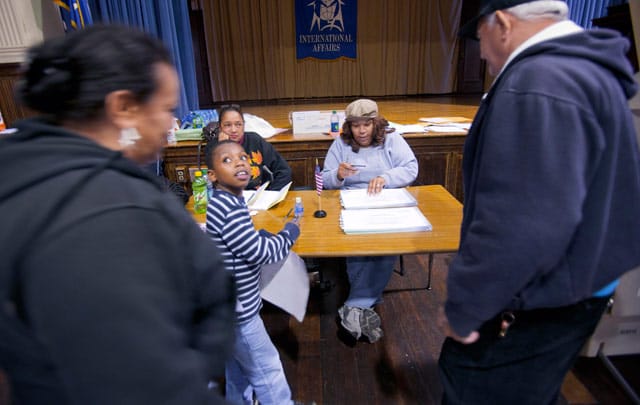
The second and most important new change expected to effect the 2012 election is the a recently passed voter-ID law. As of November, everyone voting in Pennsylvania will need to show a valid, PennDot or state issued photo ID in order to vote. Statistics taken as late as July 4th, show 758,939 registered Pennsylvanian voters don't have a Pennsylvania driver's license, college or work ID or an alternative PennDOT ID. This means 758,939 people could be cut out of the upcoming election, which is 9.2 percent of Pennsylvania's total voting population. The numbers double with regards to Philadelphia, the largest city in the state, where 18% of registered voters in the city, or 186,830 residents, don’t have an acceptable photo ID.
A recent editorial by the Philadelphia Inquirer charges Secretary of the Commonwealth Carol Aichele with telling Pennsylvania voters that only 1% of the population would be affected by the change. The editorial also claims Aichele and Pennsylvania Governor Corbett have, “ignored the fact that there is no hard, or even soft, evidence of a need for a law preventing voter impersonation in this state or others. In fact, a group of Republican lawyers could document only 400 voter-fraud cases in the entire country over a decade, less than one case per state per year. Most of those cases were vote-buying schemes that would not have been prevented by a voter-ID law.”
Some universities are planning campaigns and new student identification card distribution to adhere to the new law. As of April, nearly 80% of Pennsylvania's 700,000 university students will not be able to use their college ID to vote. Temple University, with over 30,000 students in and around Philadelphia, is planning a new student ID distribution in late August, according to university officials.