

Of the United States’ many political problems, one glaring issue is the fact that we have a two-party system representing a wide array of opinions.
It’s a bigger problem than most people think. While independents make up over one-third of US registered voters -- and generally they remain almost entirely unrepresented in Congress -- people within each party disagree wildly.
Pew’s amazing study on political typology shows that there are at least 4 distinct blocks within each party, all of which have very different views of how to run the country.
Because parties tend to have a single platform, this means that at most only one of those groups is fully represented. When you slice things up at this level, you see that almost all Americans are poorly represented in Congress.
A two-party system comes about when you use a first-past-the-post system in single-representation districts. In such a system you vote once for one person to represent your whole district, and whoever gets the most votes wins.
It may not even be a majority. Everyone who didn’t vote for that winner is essentially unrepresented.
The reason it leads to a two-party system is explained by Duverger’s law: if there are more than two parties, two of them are likely to unite to have the best chance of getting to that plurality.
Those that don’t will always be beaten by those that do, and thus they will die.
Voting like this is so natural to Americans -- and so simple -- that it can seem intimidating or even inconceivable to vote a different way. However, almost every other democracy votes substantially differently.
From parliamentary proportional systems to using ranked choice voting, many systems can bring about a multiparty system.
One of the most interesting cases is Ireland. I want to share it with you so you understand what’s not only possible, but what works. It’s also just plain fascinating.
Ireland is broken up into multi-party districts, which have between three and five representatives each (the number of representatives is re-assigned in each census). People vote for all of these seats, using ranked choice voting.
This means of all the people running, they list their favorites from #1 to #N. The votes are counted, the last-placed person (having the fewest #1 votes) is discarded, and their votes are re-assigned.
This is repeated until you have a number of winners equal to the number of seats.
What happens? You have districts that have representatives from multiple parties.
In fact, no district in Ireland has representatives from only one party; in many districts, every single representative is part of a different party. In some, you’ll have two or even three from the same party.
Here’s a map of the current representation below:
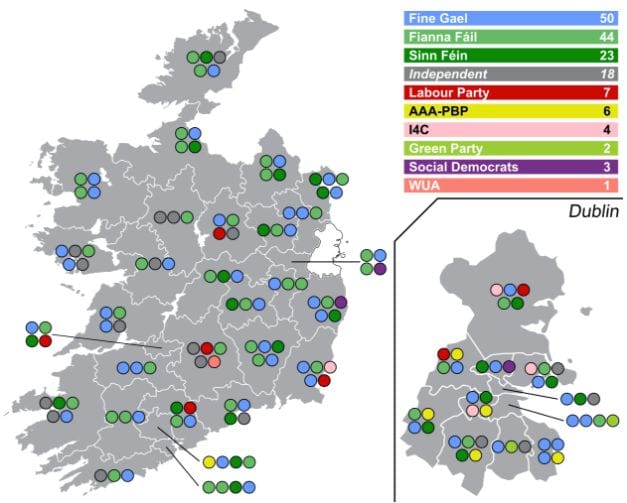
In Ireland, therefore:
- Everyone has representatives from multiple parties, which makes it far more likely that your own views are more accurately and completely represented in legislature
- It’s easy for many parties to exist, because there’s no winner-take-all system
Ireland is set up to have many parties, and have a higher level of representation of the multiplicity of political viewpoints of its people. Sounds pretty good, eh?
The United States doesn’t have to be a two-party system, and we don’t have to vote the way we currently do.
My favorite organization working on this is FairVote; if you want to help the United States’ democracy become more representative and less captured by only two parties, they’re a great group to work with.