
 Shawn Griffiths
The National Association of Nonpartisan Reformers (NANR) held its 9th annual summit in Miami this week following a year of political chaos and partisan machinations that put power before representation, accountability, and fairness.
What’s more, the U.S. is headed full speed into the 2026 midterms, giving an already exhausted electorate little reprieve from the hyper-partisanship and division that constantly dominates the airwaves and headlines.
But while independent reformers carry the weight of everything that has transpired in 2025 like the rest of the country, they see an opportunity to stand out and build on the growing momentum that is shaping efforts to make U.S. elections better for voters.
“When I look at 2025 into 2026, I see enormous opportunity for reform,” said Andy Moore, executive director of NANR.
When else in history has gerrymandering been on the evening news, which is happening overtly in multiple states? When else have people paid this much attention to elections and the heightened interest in election security and administration?”
NANR is a coalition of organizations and individuals dedicated to structural electoral reforms that put the public interest first and foster more robust competition among many political parties and independent candidates.
Its members may focus on different initiatives and ideas, but they are united by a shared goal: Level the playing field for all voters and candidates who want to participate in a truly democratic process.
The coalition was founded in 2017 by reform champions like the Independent Voter Project, FairVote, Unite America, Open Primaries, and it has grown to include groups that focus on a broad array of proposals and issues, like:
- Ranked choice voting
- Other new voting methods
- Independent voting rights in primaries
- Campaign finance
- Gerrymandering
- Fair and competitive treatment of independent candidates
- Vote at home
- Third party empowerment
- And more
NANR’s summit was an opportunity for these reformers to meet, celebrate successes, find areas of collaboration, debate, hear what is going on in the independent reform space, and learn about ways to expand and empower this movement.
‘No Man Is an Island’
While many expect odd-numbered years to be a mostly uneventful transition between one election cycle and the next, 2025 was anything but uneventful. This includes the chaos of the ongoing mid-decade gerrymandering fight between Republicans and Democrats covered extensively on IVN.
But it is not just gerrymandering. There is also the way both parties have shut out millions of independent voters from critical primary elections and have applied political pressure to block or stall more choice reforms passed by an overwhelming majority of voters.
In fact, along with the mid-decade gerrymandering fight, 2025 was a busy year for reformers – with a mix of good news and bad:
- New Mexico adopted semi-open primaries
- A similar system passed the Nevada legislature, but was vetoed by the governor
- Nevada Democrats blocked an independent redistricting initiative, but an initiative to enshrine equal independent voting rights in the state constitution advanced to the petition gathering phase
- Maine Question 1 from 2024, which reins in super PACs and was approved by 75% of voters, has been challenged in court
- Maine Question 1 of 2025, which proposed a new voter ID law and restrictions to absentee voting, was rejected by voters
- The city council in Washington, DC, refused to fund open primaries approved by voters and dragged its feet to fund ranked choice voting passed under the same initiative
- 18 local jurisdictions used ranked choice voting in 2025 elections (outside a major election cycle), more cities approved its usage, and new campaigns emerged
- A lawsuit challenging closed primaries in Florida was discussed by the U.S. Supreme Court – the furthest such a lawsuit has moved to date
- Additionally, lawsuits have been filed challenging the use of closed primaries in Maryland, Oregon, Pennsylvania, and Wyoming
And this doesn’t cover everything.

Independent reformers know there is no such thing as an off-season, which is why many of them gathered in Miami this week to discuss, debate, and propose pro-voter ideas to promote more inclusion, more choice, and more accountability in elections.
“We have to use this moment to find ways to help the public understand that how elections are structured results in the policy outcomes that affect their daily lives,” Moore said, acknowledging that there can be a disconnect between kitchen table issues and election reform.
Many people would say the system is broken, but those in attendance at the NANR summit collectively understand the truth: The system is not broken. It is functioning the way it was designed to function – and that is the problem.
One of the biggest challenges reformers continue to face is making that connection to voters. However, the NANR summit offered them a chance to engage with each other and learn what messaging works and what doesn’t.
Moore believes this is one reason NANR as a coalition and its summit are so important. The disorientation caused by 2025 is felt by those who have committed their time and careers to structural political reform, but Moore said despair wasn’t the mood in Miami.
“I noticed a vibe shift,” he said during the opening plenary on Thursday. “It was a different tone in a very welcomed way. There is something that changes when we gather in person. Being here reminds us that we are not alone.”
Up until NANR’s creation, many reformers existed in their own isolated silos. But the more they saw what was possible with reform, the more they realized how much they could accomplish through joint collaboration, dialogue – even civil debate when they disagreed.
“We do this work because there is someone out there who believes politics isn’t working for them – and we want to prove them wrong,” Moore said. “This work does not happen in isolation.”
Reform Roundup
Ranked Choice Voting Survives Stalling Tactic in DC City Council
Nearly three-quarters of DC voters approved Initiative 83 in 2024, which calls for the use of semi-open primary elections and ranked choice voting in all District elections. Earlier this year, the DC City Council chose only to fund RCV.
However, even then there was reluctance among some of the council members. Political insiders looked for procedural hurdles to stall RCV implementation past the 2026 elections, suggesting that there was no rush to honor the will of voters.
Councilmember Wendell Felder (D-Ward 7) offered emergency legislation that would have required a comprehensive needs assessment from the D.C. Board of Elections (DCBOE) before the city moved forward with RCV.
Notably, DCBOE Director Monica Evans told the Council, “I feel like I’m being set up to be the fall guy,” because of the political pressure she was receiving from opponents of DC ranked choice voting who want to halt the system as well as advocates who want immediate implementation.
In the end, Felder withdrew his legislation after he failed to get enough support.
IVN author Cara Brown McCormick writes:
After withdrawing the measure, Felder told colleagues there were 'a lot of questions that the Board of Elections couldn’t answer.' He said the agency 'doesn’t have the proper equipment' and raised 'concerns about things like staff overtime.'
Felder said he plans to introduce the emergency legislation again in January.”
McCormick added in her report:
Ward 6 Councilmember Charles Allen told WUSA9 that “the legislation before the council is just a delay tactic.” At the same time, Ward 5 Councilmember Zachary Parker added that the council’s focus should be on helping with implementation.”
Maine’s Matt Dunlap Raised Doomsday Alarms about RCV – Now He’s Using It for His Campaign
RCV faced similar challenges from political insiders in Maine from both sides of the aisle. In fact, Mainers approved its statewide use twice, once in 2016 and again in 2018 via a people’s veto after the legislature passed what was essentially an RCV repeal.
Then-Secretary of State Matthew Dunlap (now state auditor), a Democrat, argued that RCV implementation was impossible (even though it is broadly used in the U.S.) and that the reform would lead to “cars burning in the streets.”
Since its passage, Maine has conducted RCV elections without issues – and Dunlap is using it as a talking point for his congressional campaign in the state’s 2nd congressional district. He wrote in an op-ed for The Piscataquis Observer:
Over the course of the ensuing months, a number of people approached me about that future and my history of taking on tough challenges — everything from the transparent administration of elections, to opposing REAL ID, to the Wabanaki-State Child Welfare Truth and Reconciliation Commission, to the implementation of ranked-choice voting and the Help America Vote Act, to taking on President Donald Trump’s bogus Presidential Advisory Commission on Election Integrity. Likewise, they argued, my record of helping people in countless scenarios — administering driving exams, serving with community nonprofits, promoting accountability in government, moderating town meetings, and helping people navigate state bureaucracies, among many other examples — shows I’m someone who stands up to be counted when challenges emerge.”
Dunlap could face former Gov. Paul LePage in the 2026 general election, who is a vehement opponent to RCV. In their own ways, both tried to block RCV implementation, despite the reform’s support with a majority of Maine voters.
Costly, Delayed Runoffs Rally Ranked Choice Voting Supporters in New Mexico
Delayed runoff elections were held in Miami, Florida, Jersey City and Hoboken, New Jersey, and other places. Albuquerque, New Mexico, is slated to vote for their next mayor in a runoff on Tuesday, December 9, and Santa Clara County, California, will have its polls open the week of Christmas for its own special election runoff on December 30.
How many voters will turn out to vote in these late runoff elections in an odd-numbered year? Especially so close to or even over the holidays?
According to a 2024 report from FairVote, runoff turnout falls by an average of 40% (that is the average!), while these elections end up costing taxpayers millions of dollars. Ranked choice voting advocates say their reform can solve this issue by promoting majority rule without needing another election.
Several runoff cities have taken steps to implement RCV. The Jersey City and Hoboken councils will allow RCV ballot measures to go before city voters if the state legislature allows them to use the reform.
Ranked Choice Voting ABQ, a joint effort by Common Cause New Mexico and NM Voters First, is pushing RCV in Albuquerque – New Mexico’s largest city. Las Cruces and Santa Fe, its next largest cities, have already adopted RCV.
On Monday, December 1, the Albuquerque Journal published a piece titled, “Price tag of Albuquerque's runoff election reigniting ranked-choice voting debate,” which puts the estimated price tag for the city’s runoffs at $1.6 million.
Florida Joins ‘Race to the Bottom’ Mid-Decade Gerrymandering Fight
On Thursday, the Florida House Select Committee on Congressional Redistricting met to discuss redrawing the state’s congressional map with less than a month until 2026. If Florida moves forward, it will join a chaotic gerrymandering fight between the two major parties.
This “race to the bottom,” as reformers have come to call it, now includes Texas, California, Indiana (after it initially wasn’t going to join), Missouri, North Carolina, Maryland, Virginia, and other states could still try before midterm election deadlines.
“We may ultimately decide to propose a new congressional map based on our exploration or we may not. But if we do, we will do so in a timely manner,” said Republican State Rep. Mike Redondo of Miami.
President Donald Trump called on Republican states to redraw their congressional maps to protect the GOP’s slim majority in the U.S. House. California Gov. Gavin Newsom then called on Democrats to “fight fire with fire,” leading his state to make this a bipartisan fight.
Gallup: More Voters Than Ever Say The Parties Have Gone Too Far with The Rhetoric
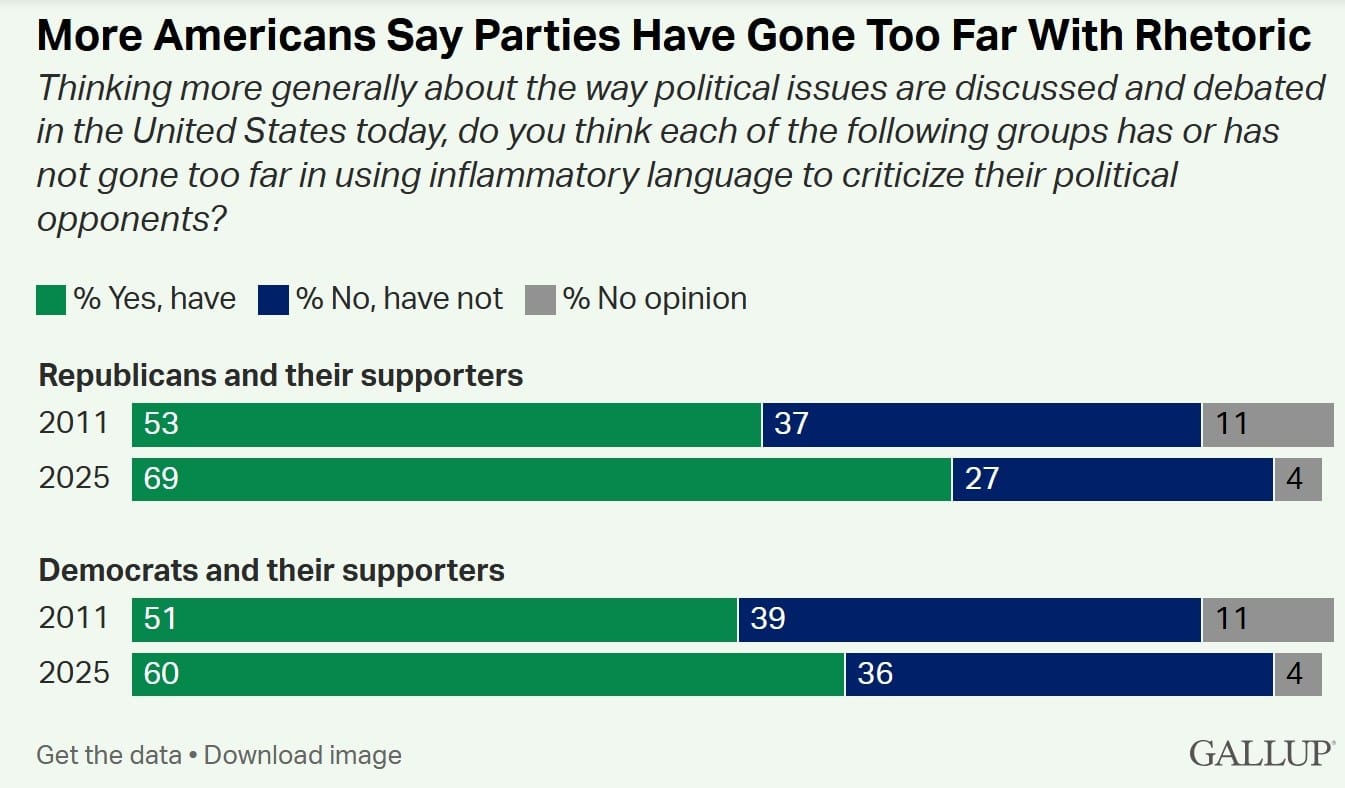
According to Gallup, “Larger majorities of Americans than in the past believe that both the Democratic and Republican parties and their supporters have gone too far in using inflammatory language to criticize their opponents.”
Sixty-nine percent now say this about the Republican Party and Republicans, a 16-percentage-point increase from 2011, and 60% currently believe this applies to the Democratic Party and Democrats, which is nine points higher than 14 years ago.”
So, when people say this is a “both sides” issue, the data supports it. This is a consequence of an election system that not only incentivizes partisanship, but also encourages both parties to raise infinite stakes in order to win.
And when the stakes are infinite, so is what a candidate will say on the campaign trail – and inevitably the loyal opposition becomes a bitter enemy.
For example, it is how we go from nuanced perspectives on issues like illegal immigration to “they’re nothing but criminals.” Check out this video of former Presidents George H.W. Bush and Ronald Reagan when they debated the issue in 1980:
There are people alive today who are old enough to vote, but do not remember a time when the U.S. had better political discussions because hyper-partisanship continues to push both sides further and further toward ideological extremes.
Maryland Delegate Qi: It is Undemocratic to Deny Independents Access to Taxpayer-Funded Primaries
Maryland Delegate Lily Qi penned an op-ed in the Baltimore Sun, calling on the state to give independent voters equal voting rights and allow them to participate in taxpayer-funded primary elections.
She wrote:
“Maryland is now home to nearly a million independent voters, about one in four voters. This reflects a national trend. Many are party-averse immigrants from countries where politics often evoke fear and distrust. In fact, immigrant-heavy Hispanic and Asian communities top the list, with 52% and 41% of registered voters identifying as independents, respectively. Another fast-growing cohort of independent voters is young people, who are significantly more diverse than their parents’ generation and less likely to be party loyalists.”
Often, independent voters are unaware that in a state like Maryland, they can only vote for the non-partisan school board positions, with all other options intentionally left blank.
This is undemocratic.”
Qi noted that the state has done a lot to expand access to elections, including expanding voting centers, voting hours, drop box access, and vote-by-mail permissions. Yet, these benefits don’t apply to independent voters in taxpayer-funded primary elections.
“As more Americans are turned off by political divisions, we should use every tool to bring our politics to the middle, where most Americans are. The best way to achieve this is by bringing the middle into politics,” she concluded.