
 Cara Brown McCormick
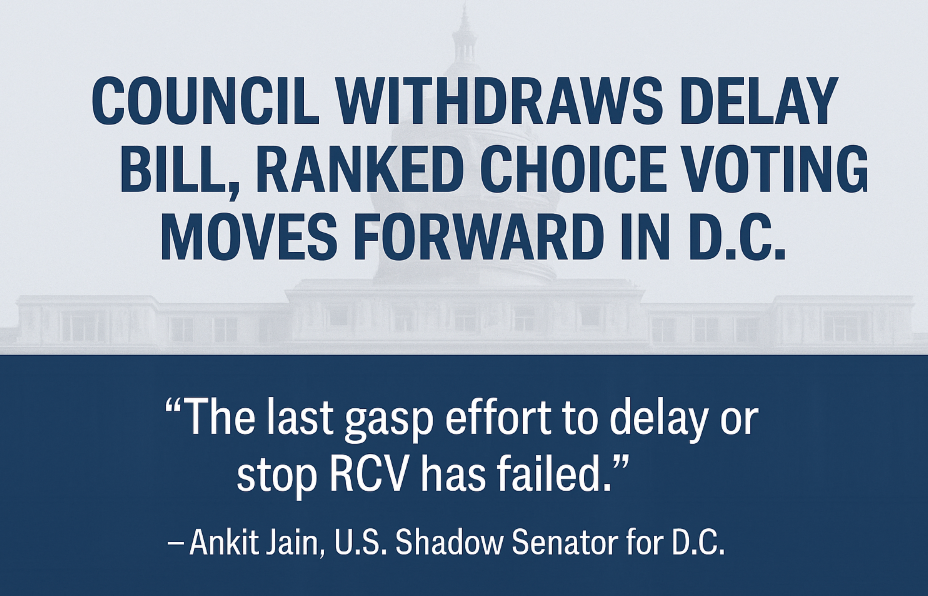
Editor’s Note / Update, December 4, 2025: According to reporting from The Washington Informer and WUSA9 (CBS), D.C. Councilmember Wendell Felder (D Ward 7) has withdrawn his emergency legislation that would have required the D.C. Board of Elections (DCBOE) to conduct a comprehensive needs assessment before implementing ranked choice voting (RCV) in 2026.
His proposal did not receive enough support from his colleagues during the council’s December 2 legislative meeting, following a breakfast discussion earlier that morning.
Felder said his needs assessment would “analyze voter awareness and public perceptions of the ranked choice voting system,” “assess the equity and access implications of ranked choice voting for historically marginalized communities,” and “review best practices and implementation experiences from other jurisdictions.”
It also would have required DCBOE to submit a full report to the mayor and council, including “a cost model, an operational timeline with critical milestones, and a comprehensive voter outreach and education plan,” according to Felder’s office, as provided to CBS.
After withdrawing the measure, Felder told colleagues there were “a lot of questions that the Board of Elections couldn’t answer.” He said the agency “doesn’t have the proper equipment” and raised “concerns about things like staff overtime.”
Felder said he plans to introduce the emergency legislation again in January.
In a statement to WUSA9, he said:
I’m disappointed that the Council was unable to vote on the Board of Elections Ranked Choice Voting Needs Assessment Amendment Act of 2025 today. Despite this delay, my team is committed to our vision and will put in the work necessary for moving this bill forward at a future legislative meeting. My opinion holds firm in that I do not feel confident the DC BOE is ready for a responsible and successful implementation of RCV in June 2026. More work is still required to ensure that RCV is implemented responsibly, equitably, and in a way that strengthens our democracy. We remain fully engaged in supporting the BOE in achieving the level of readiness needed to get this right.”
Ward 6 Councilmember Charles Allen told WUSA9 that “the legislation before the council is just a delay tactic.” At the same time, Ward 5 Councilmember Zachary Parker added that the council’s focus should be on helping with implementation.
“I don’t know if it is the best use of the council’s time and resources to continue to relitigate that matter; however, there are legitimate concerns that many residents have voiced that I think we should pause and take to heart,” he said.
At-large Councilmember Anita Bonds (D) also voiced caution during Tuesday’s meeting, saying:
I’ve tried my very best to remain neutral in the hearings and the public presentations, but I can tell you, if I had to gamble on this, I wouldn’t do it quite yet. They would need to do so much outreach, which hasn’t even been planned.”
Still, Bonds acknowledged that “D.C. will have ranked choice voting next summer.” While the city will have RCV, it will not have open primaries, which was paired with RCV under Initiative 83 in 2024.
The ballot measure was one of the biggest success stories from reformers, as it passed with 73% support.
Ankit Jain, an American voting rights attorney who serves as the junior United States shadow senator from the District of Columbia, celebrated the outcome. Jain, elected in 2024 after serving as a Ward 2 Advisory Neighborhood Commissioner, wrote on X: