
1939: The Year Thanksgiving Ignited a Partisan Firestorm

 Shawn M Griffiths
Today, most families are worried about discussing politics at the Thanksgiving dinner table. In a heated partisan environment, people have been uninvited from family gatherings over who they voted for.
However, did you know there was a year when Thanksgiving itself was the subject of a heated, partisan firestorm? In 1939, Franklin D. Roosevelt changed Thanksgiving tradition in a significant way, and it didn't go over well.
Altering Tradition
Many people probably don't know that Thanksgiving wasn't always set specifically to the fourth Thursday of the month. Starting with Abraham Lincoln, it was declared that Thanksgiving would be celebrated on the last Thursday in November.
Last Thursday... fourth Thursday... semantics, right?
In most years, the two would be one in the same. However, if we still observed Thanksgiving the way Lincoln wanted, we wouldn't be gathering together on Thursday, November 23, this year. We would be celebrating the holiday next week -- on November 30.
So when was the tradition altered?
Well, 1939 was another year with 5 Thursdays. But retailers had a problem with this, because Thanksgiving would interfere in a peak time for holiday shopping. In their eyes, they would lose an entire week of Christmas shopping.
So, in August of that year, President Franklin D. Roosevelt agreed to change the date of Thanksgiving from November 30 to a week earlier.
Partisan Backlash
Republican leaders were outraged by the move, denouncing the president for destroying a long-held tradition. Governors in several states refused to accept the new date. Football teams decried the move as well, fearing that their stadiums would only be half full for the holiday games.

The public was divided by the move, as well. According to a Gallup poll, 50 percent of the public rejected Roosevelt's decision, while 30 percent approved and 20 percent had no opinion one way or another.
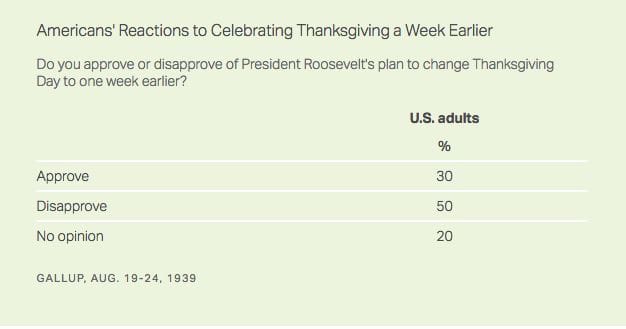
Just over half of Democrats approved of the decision, while 4 out of 5 Republicans disapproved.
George Gallup reported the reactions of several Republicans. "Dictatorship," "whimsy," and "just upsetting everything he can" were among the charges levied against President Roosevelt.
Sound familiar?
Democratic politicians mostly shrugged their shoulders at the decision, saying things like, "The business men asked for it," and "One date's as good as another."
It was not until two years later, in 1941, that Roosevelt signed into law a new bill that established the fourth Thursday of November as the official date of Thanksgiving Day. Businesses got what they wanted, and many traditionalists ultimately accepted that little would change for most Thanksgivings.
The rest, as they say, is history.
You Might Also Like


