Skip to content
Sign up free
News

Poll: Majority of All Voters Disapprove of Congress

By Griffin Edwards

2-minute read

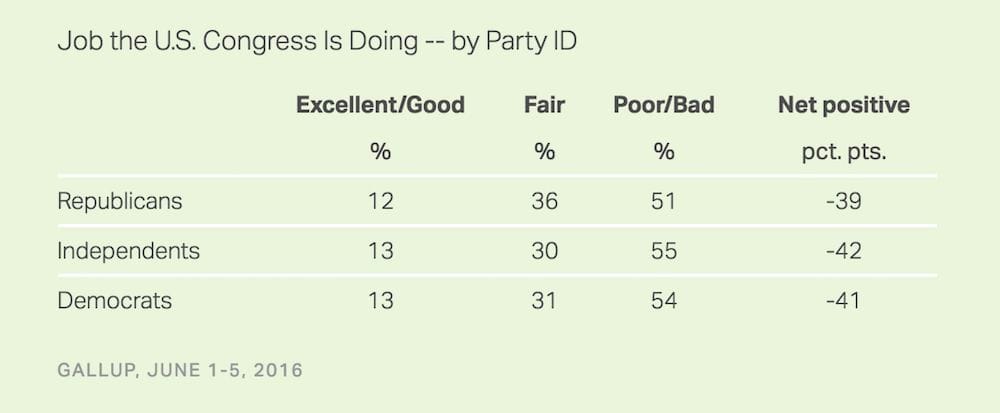
Independents are more likely to disapprove of Congress than voters who identify as Republican or Democrat according to a June Gallup poll.

Fifty-five percent of independents say Congress is doing a "poor" or "bad" job, compared to 54 percent of Democrats and 51 percent of Republicans. Overall, 53 percent of Americans view Congress' performance negatively, according to the poll.

However, when asked about elected representatives of certain parties, independents appear disgruntled. Sixty-four percent of Republicans characterized congressional Democrats' job as "poor/bad," compared to 13 percent of Democrats and 45 percent of independents.

On the other hand, 30 percent of Republican respondents disapproved of their own party's performance, compared to 75 percent of Democrats and 55 percent of independents.

The party distinction draws an extremely understandable line between independents and party-affiliated voters. Very few independents view Congress positively, regardless of party. That is, although Republicans disapprove of Democrat congressmen, and vice versa, independents tend to have negative views of both Republican and Democratic congressional representatives. Sometimes, as this study found, to an even greater extent than either party.

Perhaps this is due to independents' interests being underrepresented or overlooked. If a voter feels that one of the two main parties has ignored his or her interests, he or she may reposition themselves as an independent, which would then fuel this skeptical view of a bipartisan Congress.
gallup-poll-party-approval-of-congress

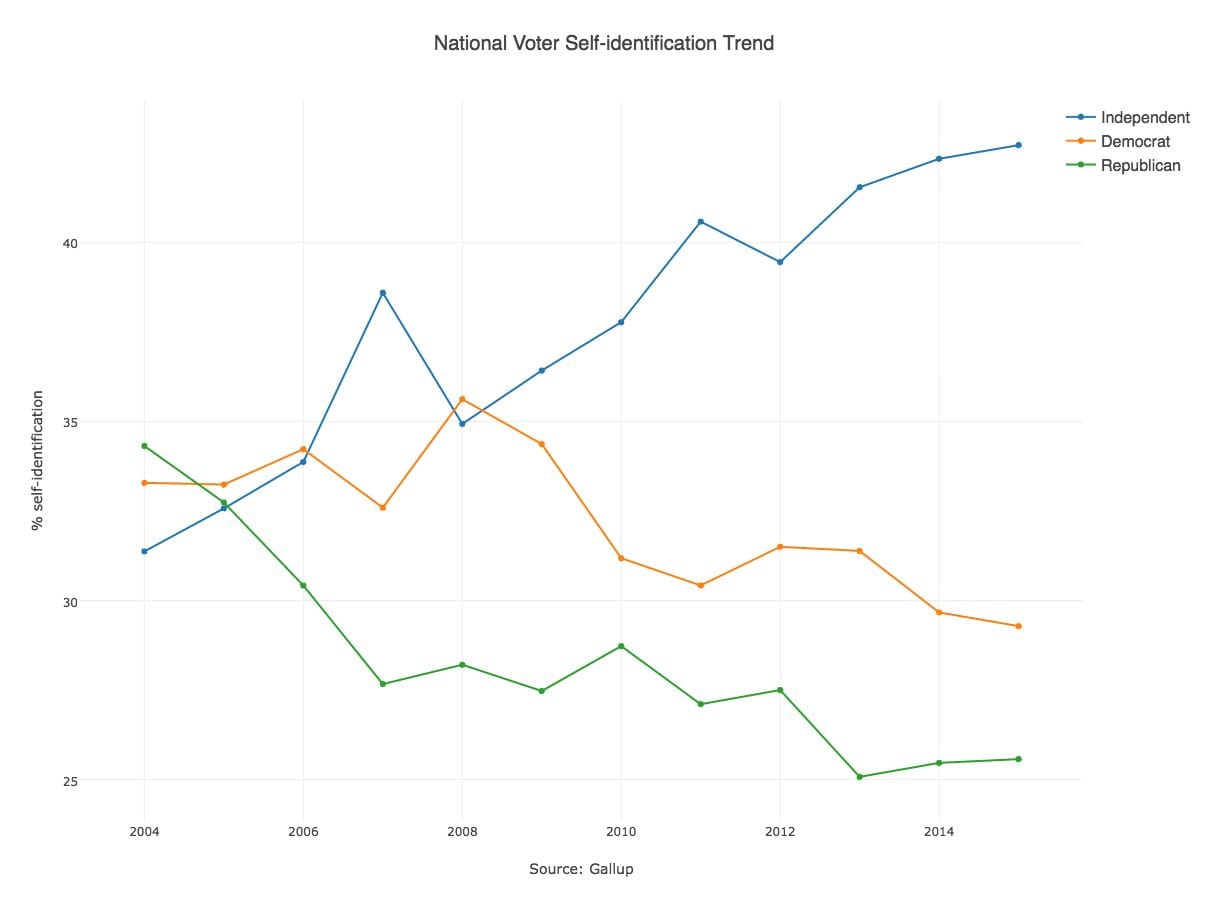
Indeed, fewer and fewer Americans are choosing to affiliate themselves with a major party. According to another Gallup poll from 2015, in 2011, the percentage of independents exceeded 40 percent of the American electorate. In 2014, 43 percent of voters identified as independent.

These statistics follow longtime trends, stretching back more than a decade and are continuing to grow. What's more, it's important to keep in mind that newly independent voters are largely coming from the two major parties.

The Republican Party has seen a larger exodus, with a decline greater than that of those still registering as Democrats: only 26 percent of Americans now identify as Republican, compared to 30 percent for Democrats.
National Voter Self-identification Trend (4)

However, the large segments of both Republicans and Democrats finding themselves outside party lines in the 2016 elections could bolster the ranks of independents, as Bernie Sanders' supporters hesitate to support Hillary Clinton, and many Republicans shy away from Donald Trump.

It's possible that the growing population of independents will propel their interests onto the public stage, such as increasing voting accessibility for those unaffiliated with either major party. After all, it's in the legislator's best interests to serve the growing bloc of independent voters.

Photo credit: Shutterstock.com / Orhan Cam

Tags: News

Adhere to the IVN etiquette

By posting a comment, you agree to adhere to our etiquette rules: No partisan attacks, no personal attacks, substantiate your sources, no self-promotion.

Get IVN’s Free Weekly Newsletter:Get IVN’s Free Newsletter

Get IVN’s Free Weekly Newsletter:Get IVN’s Free Newsletter

Nonpartisan Issues. Diverse Perspectives.

Check your inbox and click the link to confirm.

Republish this article

Republishing guidelines

Republish IVN articles for free. Independent Voter News articles may be republished online or in print under a Creative Commons BY-NC-ND 4.0 license, on these terms:

  1. Credit the author and IVN. Keep the byline ("By Author Name, Independent Voter News") and the attribution note at the end, which links to the original.
  2. Point search engines to the original. Set the canonical URL of your copy to the original IVN article (the HTML we give you includes the tag).
  3. Keep the meaning. You may update time and place references and apply your house style. You may trim for length, as long as the cuts don't change the meaning or misrepresent the author. Keep the headline. Mark any additions as your own (for example "Additional reporting by ...").
  4. Translations are welcome. Translate faithfully, add "Translated from English by [your outlet]", and tell us at editor@ivn.us.
  5. Keep the links, including the link to the original article.
  6. Keep the tracking image. The HTML includes a 1-pixel image that counts readers on your page. It collects no personal information.
  7. Photos and illustrations. Images credited to IVN may be used with this article only. Images credited to others (AP, Getty, Unsplash, Wikimedia and so on) stay under their owners' terms. Secure the rights or switch "Include images" off.
  8. Don't sell it. You can't sell our articles or sell ads specifically against them. Your normal site advertising is fine.
  9. No implied endorsement. Don't suggest that IVN or the author endorses you, your candidates or your causes, or that donations to you support IVN.
  10. Keep labels. Opinion or analysis pieces keep that label.
  11. No bulk or automated republishing, and don't submit our articles to aggregators (Apple News, Google News, MSN) as your own.
  12. Corrections and removals. Update your copy when we correct it, and remove it promptly if we ask. We'll contact you at the email you give us.
  13. Questions or print republication: editor@ivn.us.

IVN staff: fill in who you're inviting above, then create the invite.

Preparing the article

Poll: Majority of All Voters Disapprove of Congress

Choose a format
  • HTML
  • Email HTML
  • Markdown
  • Formatted (.docx)
  • Plain text
  • WordPress blocks
  • PDF
Choose a platform

Photos credited to others need their owners' permission.

To for

Republishing somewhere else? Questions? editor@ivn.us