Skip to content
Subscribe

Pesticides May Threaten Global Food Supply

Published:

Most people have heard about the old practice of the canary in the coal mine. Before humans went down in a new mine, a canary in a cage would be lowered down with rope and raised back up. If the canary was alive then there was sufficient oxygen for the miners. If the canary was dead—it was not safe.

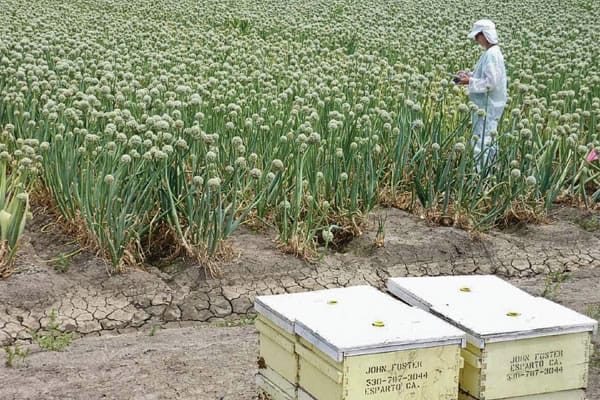
Bees, among other things, serve this purpose with regard to our food supply. And many bees are coming up dead. Bees pollinate a huge number of crops including California’s almond trees. It is estimated that a majority of the 100 largest crops worldwide depend on pollinators. It’s fairly clear the fate of bees and humans are inexorably linked.

Some beekeepers are experiencing hive losses of 90%, others 40% to 80%. The phenomenon is called Colony Collapse Disorder. There are a couple of theories for what is causing it. A certain class of pesticides called Neonicotinoids have been temporarily banned in Europe. Not so in the US. China is a big manufacturer.

Some genetically modified foods have insecticides spliced into their genomes. Insecticides kill insects. Bees are insects. It doesn’t take a rocket scientist to make these connections. Right now we are depending on pesticide manufacturers to decide if there are any unintended consequences to the use of their untested chemicals. If miners sent bees down into a mine, and 40% to 90% came back up dead I doubt they’d consider it safe for humans.

In an aGREATER.US poll where the ratings of Liberals, Independents, and Conservatives are given equal weight, the tripartisan score for the No Bees-No Humans Act (which would ban the use of neonicotinoids until they were proven safe for use around bees) was 91% positive. This sends a rather clear message. Is this poll reflective of society’s opinions? I couldn’t find any other polling data either way.

What do you think about government(s) being involved in bee protection?

Adhere to the IVN etiquette

By posting a comment, you agree to adhere to our etiquette rules: No partisan attacks, no personal attacks, substantiate your sources, no self-promotion.

Contact IVN

Questions about this article or our coverage? Send us a message. A free IVN member account is required.

Message sent

Thanks, we’ll review it and get back to you if needed.

Message not sent

Sorry, something went wrong. Please try again.

Sign in to send a message

Messages are tied to your IVN member account. Signing in is free and takes a few seconds.

Republish this article

Republishing guidelines

Republish IVN articles for free. Independent Voter News articles may be republished online or in print under a Creative Commons BY-NC-ND 4.0 license, on these terms:

  1. Credit the author and IVN. Keep the byline ("By Author Name, Independent Voter News") and the attribution note at the end, which links to the original.
  2. Keep the meaning. You may update time and place references and apply your house style. You may trim for length, as long as the cuts don't change the meaning or misrepresent the author. Keep the headline. Mark any additions as your own (for example "Additional reporting by ...").
  3. Translations are welcome. Translate faithfully, add "Translated from English by [your outlet]", and tell us at editor@ivn.us.
  4. Keep the links, including the link to the original article.
  5. Keep the tracking image. The HTML includes a 1-pixel image that counts readers on your page. It collects no personal information.
  6. Photos and illustrations. Images credited to IVN may be used with this article only. Images credited to others (AP, Getty, Unsplash, Wikimedia and so on) stay under their owners' terms. Secure the rights or switch "Include images" off.
  7. Don't sell it. You can't sell our articles or sell ads specifically against them. Your normal site advertising is fine.
  8. No implied endorsement. Don't suggest that IVN or the author endorses you, your candidates or your causes, or that donations to you support IVN.
  9. Keep labels. Opinion or analysis pieces keep that label.
  10. Point search engines to the original. Where your CMS allows, set the canonical URL to the original IVN article.
  11. No bulk or automated republishing, and don't submit our articles to aggregators (Apple News, Google News, MSN) as your own.
  12. Corrections and removals. Update your copy when we correct it, and remove it promptly if we ask. We'll contact you at the email you give us.
  13. Questions or print republication: editor@ivn.us.

IVN staff: fill in who you're inviting above, then create the invite.

Preparing the article

Pesticides May Threaten Global Food Supply

Choose a format
  • HTML
  • Email HTML
  • Markdown
  • Formatted (.docx)
  • Plain text
  • WordPress blocks
  • PDF
Choose a platform

Photos credited to others need their owners' permission.

To for

Republishing somewhere else? Questions? editor@ivn.us