 Shawn Griffiths

New polling data shows most young Americans don't believe their voices carry nearly as much weight as the wealthy donors funding political campaigns. And that perception is discouraging some from participating in elections altogether.
A poll released Friday by American Promise and public opinion research firm SocialSphere found that 83% of Americans ages 18 to 29 believed money in politics was a big problem, including 58% who described it as a “very big problem.”
But in an election cycle in which candidates are trying to energize younger voters ahead of November, the more troubling finding was that 43% said the influence of money made them less motivated to participate in politics.
Only 24% said it motivated them to get more involved.
This stems from the perception that their vote doesn’t matter as much as the cash candidates receive. When respondents were asked who holds the most influence over decisions in Washington, 38% said wealthy individuals and billionaires.
Only 4% said ordinary voters.
“Today’s broken campaign finance system, in which political spending has had virtually no limits, is the only one that young Americans know,” said American Promise CEO Jeff Clements.
“It’s no wonder that young people question whether their voices matter, because they understand how today’s political system works. However, what this survey shows is that candidates who make campaign finance reform a central tenet of their campaigns can earn back the trust and remotivate the next generation.”
This is not an issue that divides voters. Majorities across the political spectrum believe members of Congress are more influenced by their campaign funders than by their constituents:
- 67% of Democrats
- 54% of Republicans
- 50% of independents
More than half of all respondents (52%) said that when people like them vote, organize, contact elected officials, or otherwise speak up, it makes little or no difference.
American Promise notes that the poll measures perceptions and self-reported motivation, not actual voting behavior. Still, the findings indicate that concerns about political money may be contributing to a broader sense of political powerlessness.
The poll was conducted online between September 8-13 and includes responses from 2,026 young adults.
An Issue That Unites Democrats, Republicans, and Independents
There is consistent data that show broad agreement on this issue. In this poll, 95% of young Democrats described money in politics as a big problem. The same was true for 83% of young Republicans and 78% of independents.
Additionally, 70% of respondents agreed that Congress and state legislatures should have the authority to reasonably regulate and limit money spent on elections and campaigns.
This has been the sole mission of American Promise: To pass a constitutional amendment that allows state and federal lawmakers to establish limits on political spending that won't immediately be struck down by the courts.
This could mean different rules for individuals and entities such as corporations and unions.
 Shawn Griffiths
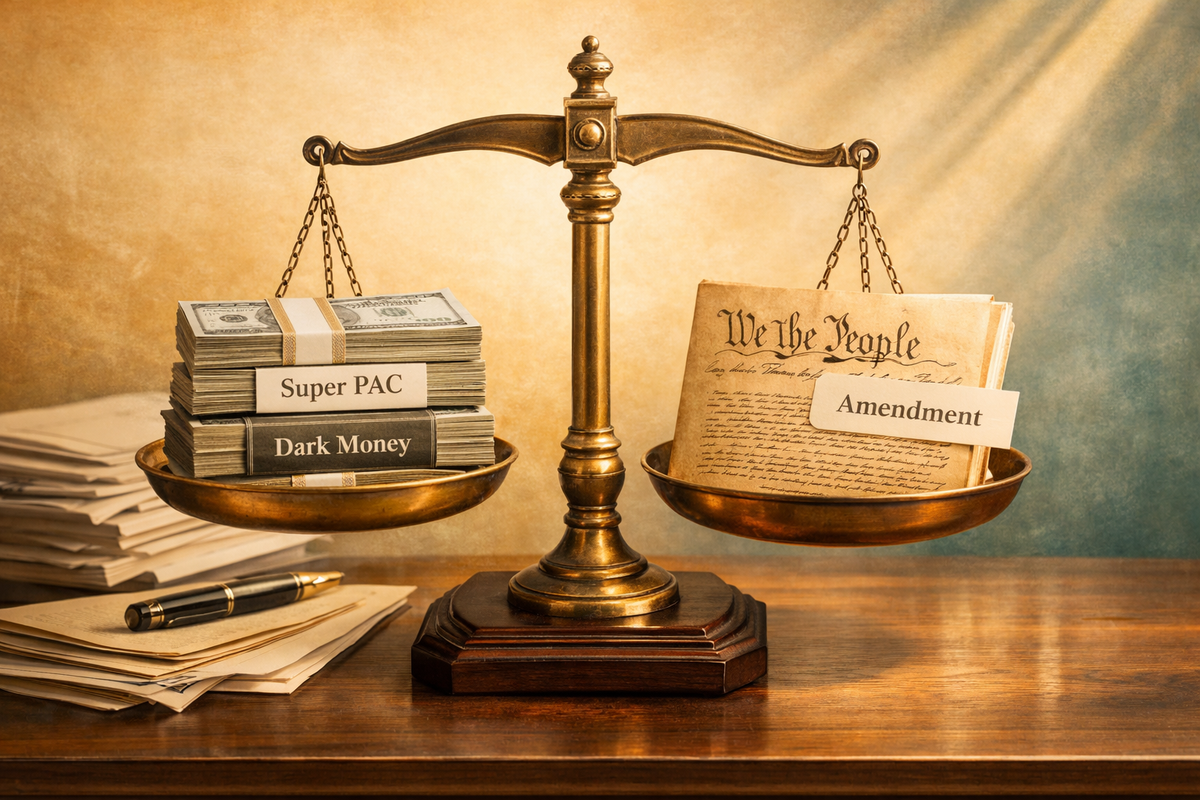
The amendment would not itself impose specific spending limits. Instead, it would restore legislative authority to adopt rules currently constrained by constitutional interpretations of political spending and free speech.
American Promise says 25 states have passed resolutions calling for a constitutional amendment addressing money in politics, including recent action in Idaho, Oklahoma, and Utah.
Will Candidates Listen?
Young voters were also surveyed on what impact a commitment to campaign finance reform would have on their candidate preferences in the November midterms.
Overall, 70% said a candidate's position on reducing the influence of money in politics would be important to the choices they make. This included 84% of Democrats, 75% of Republicans, and 61% of independents.
Another 68% agreed that limits on political spending would make them more confident that government represents people like them.
“Every candidate on the ballot this November should take that seriously,” said John Della Volpe, founder and CEO of SocialSphere.
“If we want young people to vote, we have to show them that their voices can shape what Washington does.”
The survey cannot establish whether campaign finance reform would increase turnout. But it does identify a significant disconnect between young Americans' desire for political influence and their perception of who actually holds power.