Skip to content
Sign up free
News

Google Refuses to Take Down Inflammatory YouTube Video

By Bianca Ciotti

2-minute read

Photo: Wikimedia Foundation / Author: Mohamed CJ
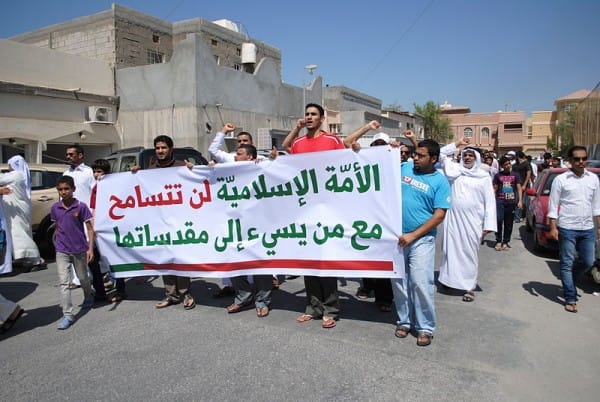
A wave of violent riots has spread throughout the Middle East, from Libya to Afghanistan, incited by an inflammatory YouTube video about Islam. After the death of a US ambassador in Libya, the White House reached out to Google, YouTube's parent company, to review the video and remove it for offensive content. Google responded Friday that it would not be removing the video from YouTube, as it felt the video did not violate its terms of service.

YouTube released a statement regarding the video, titled "The Innocence of Muslims":

"We work hard to create a community everyone can enjoy and which also enables people to express different opinions. This can be a challenge because what's OK in one country can be offensive elsewhere. This video — which is widely available on the Web — is clearly within our guidelines and so will stay on YouTube."

Google's controversial decision sparked a debate about the limits between free speech and safety. The video has been directly blamed for the violent rioting spreading throughout the Middle East that has killed a number of people, some of them American citizens. However, Google feels that the video, while distasteful, is within its submission guidelines. Google is supporting the right of free speech of the filmmaker, while the White House is more concerned with the safety of Americans and innocents abroad.

The debate has continued among news outlets and online communities. Those who support Google's decision cite the First Amendment as their reason. The video is extremely offensive, but does not use racial slurs or inappropriate imagery. Some agree with its message, but most simply respect the right of the filmmaker to express his differing opinion.

Those who support the removal of the video are divided into two camps: those who feel the video is excessively offensive, and those who feel that the video endangers innocents who become casualties of the riots. The video depicts Muhammad, a prophet of Islam, as a pedophile and a womanizer. Many feel the video debases and defames a religious figure in such a way that makes it removable under YouTube's submission guidelines. Others believe that the video itself is a security risk, and should be removed to preserve peace in the Middle East and other Islamic nations.

The reaction to the video took a serious turn last week when US Ambassador J Christopher Stevens was killed during a riot in Benghazi, Libya. The White House has not yet responded to Google's statement or decision regarding the video.

Tags: News

Adhere to the IVN etiquette

By posting a comment, you agree to adhere to our etiquette rules: No partisan attacks, no personal attacks, substantiate your sources, no self-promotion.

Get IVN’s Free Weekly Newsletter:Get IVN’s Free Newsletter

Get IVN’s Free Weekly Newsletter:Get IVN’s Free Newsletter

Nonpartisan Issues. Diverse Perspectives.

Check your inbox and click the link to confirm.

Republish this article

Republishing guidelines

Republish IVN articles for free. Independent Voter News articles may be republished online or in print under a Creative Commons BY-NC-ND 4.0 license, on these terms:

  1. Credit the author and IVN. Keep the byline ("By Author Name, Independent Voter News") and the attribution note at the end, which links to the original.
  2. Keep the meaning. You may update time and place references and apply your house style. You may trim for length, as long as the cuts don't change the meaning or misrepresent the author. Keep the headline. Mark any additions as your own (for example "Additional reporting by ...").
  3. Translations are welcome. Translate faithfully, add "Translated from English by [your outlet]", and tell us at editor@ivn.us.
  4. Keep the links, including the link to the original article.
  5. Keep the tracking image. The HTML includes a 1-pixel image that counts readers on your page. It collects no personal information.
  6. Photos and illustrations. Images credited to IVN may be used with this article only. Images credited to others (AP, Getty, Unsplash, Wikimedia and so on) stay under their owners' terms. Secure the rights or switch "Include images" off.
  7. Don't sell it. You can't sell our articles or sell ads specifically against them. Your normal site advertising is fine.
  8. No implied endorsement. Don't suggest that IVN or the author endorses you, your candidates or your causes, or that donations to you support IVN.
  9. Keep labels. Opinion or analysis pieces keep that label.
  10. Point search engines to the original. Where your CMS allows, set the canonical URL to the original IVN article.
  11. No bulk or automated republishing, and don't submit our articles to aggregators (Apple News, Google News, MSN) as your own.
  12. Corrections and removals. Update your copy when we correct it, and remove it promptly if we ask. We'll contact you at the email you give us.
  13. Questions or print republication: editor@ivn.us.

IVN staff: fill in who you're inviting above, then create the invite.

Preparing the article

Google Refuses to Take Down Inflammatory YouTube Video

Choose a format
  • HTML
  • Email HTML
  • Markdown
  • Formatted (.docx)
  • Plain text
  • WordPress blocks
  • PDF
Choose a platform

Photos credited to others need their owners' permission.

To for

Republishing somewhere else? Questions? editor@ivn.us