
The U.S. District Court in Washington, D.C. heard oral arguments today in the lawsuit filed by Level the Playing Field (LPF) challenging the nonprofit status of the Commission on Presidential Debates, just under two weeks before President-elect Donald Trump will be sworn into office.
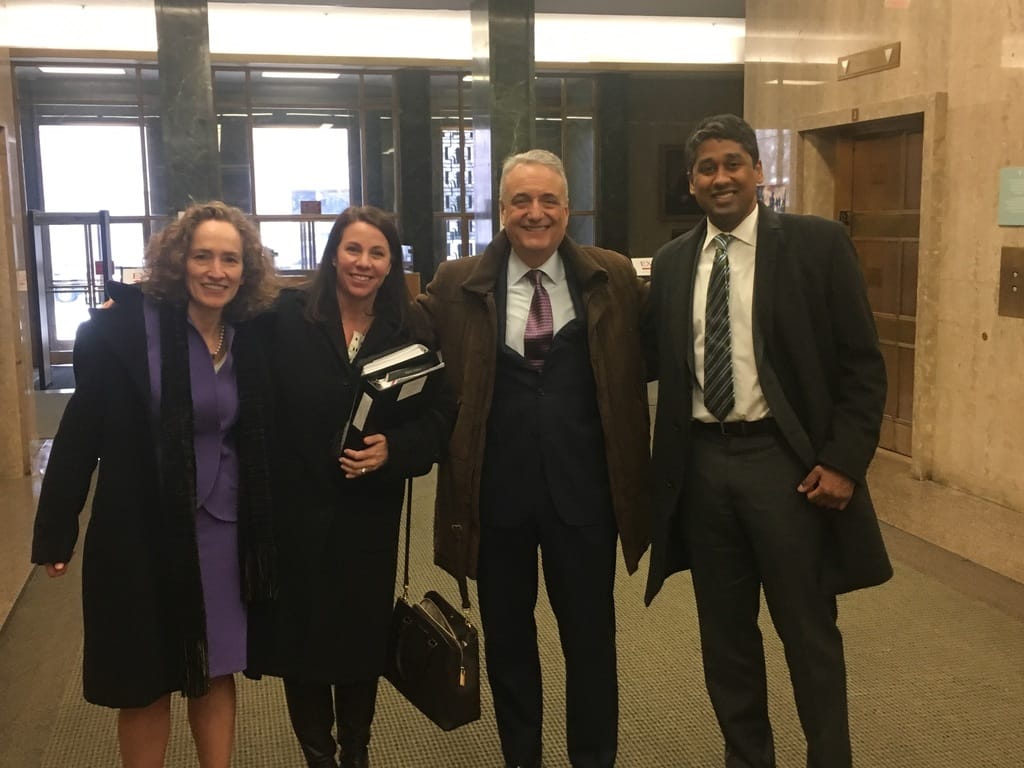
Level the Playing Field's legal team, including lead attorney Alexandra Shapiro (far left), LPF Executive Director Cara McCormick (middle), LPF CEO Peter Ackerman (middle), and attorney Chetan Patil (far right).
LPF’s lead attorney, Alexandra Shapiro, provided extensive evidence, analysis, and historical background to support the plaintiffs’ claim that the Commission on Presidential Debates uses unfair criteria to keep competitive voices outside the two major parties out of presidential debates.
Specifically, LPF takes issue with the 15% rule that requires candidates outside the Republican and Democratic Parties to poll at 15% in 5 national polls selected by the debate commission to gain entry into the debates.
“The two parties have rigged the system… CPD board members are big funders to candidates and campaigns… and the 15% is an impossible threshold,” Shapiro said.
The judge seemed open to the plaintiffs’ case. However, she did not let either the plaintiffs or the FEC (the defendant) off easy. The FEC suggested that the federal commission is the expert on these matters and the plaintiffs, judge, and the American people should simply accept that, a defense that was met with rebuke by Judge Chutkan.
Chutkan, remarking on the indifference of the FEC, asked how she could determine whether or not the defendant had considered the evidence that the current criterium is not arbitrary or capricious if they did not even mention the evidence.
While it is not clear how the judge will side in the case, the plaintiffs left the courtroom optimistic.
The Commission on Presidential Debates (CPD) faced a lot of heat from third party supporters during the 2016 presidential election cycle for excluding third party options from the debates. The two major contenders for the stage were Libertarian Party candidate, Gary Johnson, and Green Party candidate, Jill Stein.
Neither candidate was able to meet the rigorous criteria set in place by the CPD. Along with the 15% polling threshold, candidates have to maintain ballot access in enough states to have a mathematical chance at an electoral majority.
Of note, Gary Johnson was polling as high as 12% in some polls prior to the first debate. And given the overwhelming inaccuracies that pollsters had this election, combined with some polls showing that as many as 78% of the American people wanted to hear a third voice in the debates, the CPD served to relegate third party candidates as “fringe” options.
In fact, major pollsters, including Quinnipiac, USA Today, and CNN, often excluded third party candidates altogether. And when third party candidates were included in the polls, they were most often mentioned only after a series of questions focused on the two major party candidates.
LPF filed the lawsuit in June 2015 in federal district court against the Federal Election Commission. LPF was joined in the lawsuit by the Green Party and the Libertarian Party. Amicus briefs in support of the plaintiffs were filed by the Independent Voter Project and FairVote, two organizations that have been involved in a number of successful election reform efforts.
The LPF lawsuit charges that the CPD and certain of its directors have violated federal election law, including a Federal Election Commission (FEC) regulation requiring organizations like the CPD to be “nonpartisan” and to use “objective criteria” to determine who can be in their debates. In fact, the CPD is a de facto partnership between the Republican and Democratic Parties and the pollsters for the CPD-sanctioned polls are the same firms that make a lot of money doing polling for the Democratic and Republican Parties.
Bipartisan, some say, is the opposite of nonpartisan. And because IRS tax laws only allow organizations like the CPD to enjoy a tax-deductible status if they are nonpartisan, LPF wants the American people’s money back, so to speak. They also want to ensure that a third voice is on the stage next election.
The complaint filed by LPF focuses a lot of attention on the debate criteria, which were put in place after Ross Perot was able to make the debate stage in 1992 and skyrocketed into major contention. Today’s rules, the plaintiffs argue, are intentionally designed to make it impossible for a third party candidate to make it to the debate stage.
A federal judge dismissed a separate lawsuit filed by Gov. Gary Johnson, Dr. Jill Stein, their parties, and several affiliated organizations in August 2016 on grounds that the CPD violates antitrust law. The D.C. District Court’s decision to hear oral arguments in the LPF lawsuit is a substantial win for election reformers -- regardless of the result.