credit: University of Georgia
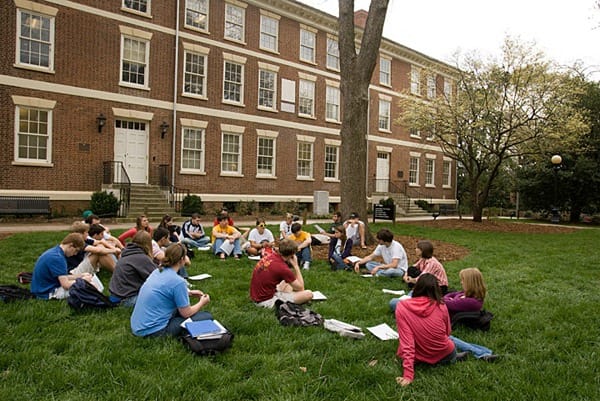
If states are to rebuild and retool their economies, they must establish innovative and cost-effective solutions to increase student access to public colleges and universities, according to a recent report.
Researchers at the nonpartisan think tank, the American Enterprise Institute, released a study titled, “Taking Charge: A State Level Agenda For Higher Education.” In it, the organization argues that governors and state legislatures must leverage the two-year and four-year public institutions to increase state workforces and mend tight state budgets that took a financial beating from the recession a few years ago.
AEI researchers Andrew P. Kelly and Daniel Lautzenheiser say that the problem lies within the structure of what they call brick-and-mortar campuses that only serve “traditional” students — those 18-22 recent high school graduates who are first-time college students.
“Instead, higher education is increasingly serving so-called “nontraditional” students—learners over the age of 25 who are attending part time and juggling multiple commitments such as work and family. One-third of college students are over the age of 25. Nearly 40 percent of undergraduates attend part time, and one-third of part-time students report working more than 35 hours per week. These shifting demographics, combined with the technological advances that allow for distance learning, suggest a need to revisit many of the assumptions underlying the traditional place-based model.”
Couple this with the fact that many question the value of a college education, the need for innovative models to tackle an ill-prepared labor market and recovering state economies has become an emerging problem that warrants an urgent solution.
Starting with accountability measures, researchers believe that post-secondary institutions must establish comprehensive data reports that take into account factors including administrative costs, space utilization, and operating budget costs per full-time student. Productivity analysis should become a main priority to determine which colleges and universities are making gains in student achievement while maintaining a path for attaining a degree. Those colleges should then be rewarded for their strides.
Kelly and Lautzenheiser point to a state like Indiana, which already looks to implement a similar strategy through their “Reaching Higher Achieving More” agenda that takes into account cost per degree and total completion time as measures of productivity.
Additionally, AEI researchers join many other analysts in the belief that degree attainment should coincide with the realities of the economy. Specifically, they believe states should find ways to better measure student learning and graduate labor market outcomes, so students can effectively make a decision on which degree they should pursue based on what the wage and employment outlook indicates for a particular career field.
Linking labor statistics to degree attainment puts students in the best position to measure their return on investment.
As of right now, according to Kelly and Lautzenheiser, Texas, Florida, Tennessee, Virginia, and Colorado are leading the way by releasing reports that detail employment numbers based on programs of study.
In the area of innovation, the researchers looked at universities in Georgia and California, which are leveraging digital media to offer online and hybrid learning models. California State University implements an early assessment program that pinpoints high schools students’ college readiness and offers low-cost remedial courses online to prepare academically-challenged students.
Georgia Tech has partnered with the online learning company, Udacity, to develop an online master’s degree in computer science that would cost roughly $7,000 to $10,000. Additionally, Georgia has established an E-core initiative which allows students that attend University System of Georgia institutions to take the required core coursework entirely online.
With some of these approaches, researchers hope that college and university administrators, along with states, find common ground in advancing student access to higher education while ensuring a strong future for state economies.