Photo: facebook.com/greggimus
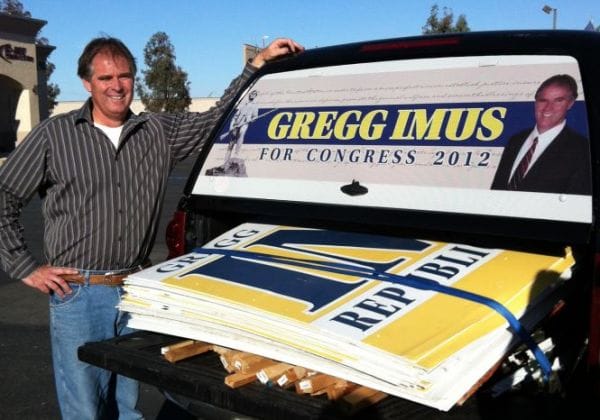
Whichever candidate wins in the November top two runoff, California's 8th Congressional District will have a Republican representative in the US House for the 113th Congress. Republican voters, however, may not decide this election. The race for the seat comes down to State Assembly staffer Gregg Imus and Assemblyman Paul Cook, and to win, Cook and Imus must each appeal to Democrats and independents.
As a result of California's new open primary this year, it is not only possible for the two candidates running for office in the general election to be from the same political party, but in numerous districts, it has happened. In races such as the California 15th Congressional District, where Pete Stark and Eric Swalwell-- two Democrats are facing off-- it is not the party of the candidates which necessarily holds all the cards. Independent voters will have a significant impact on the election outcome.
California's 8th Congressional District is currently represented by Republican Jerry Lewis, who announced that he would not be seeking reelection. Lewis endorsed Paul Cook in late August.
The 8th district covers much of San Bernardino County and while the area has historically leaned Republican, it is very much a competitive district, with registration figures showing the combined total of Democrats and independents (101,645) not far off from the total number of Republican voters (114,981).
Furthermore, independent voters have a major role to play in the November runoff, with more registered independents in the district (12,460) than total June primary turnout for either Cook (12,243) or Imus (12,364). With such a close primary result, a hefty turnout of independent voters for either Cook or Imus in the runoff election could very easily close any margin of difference between them.
Interestingly, even though the numbers suggest that Cook and Imus must appeal to Democrats and independents, neither candidate seems to be working very hard for the Democratic or independent vote in the district. Both are pursuing very similar, very conservative campaign platforms, and seem to be competing for their Republican base rather than independent voters or voters across the aisle.
Currently, the major issues listed on Paul Cook's campaign website include several conservative stances, such as a pro-life platform and an aggressive, interventionist foreign policy, with Cook, a retired Marine Colonel, writing:
"Congress should give the tools necessary to thwart Iran's nuclear ambitions, face down extremists and fanatics worldwide, and stand strong with Israel."
Cook's website includes a pledge to "oppose any increases in taxes, and... any new tax." He also includes a statement of strong support for the Second Amendment, writing, "I will fight against any attempts to curtail this right."
Gregg Imus, who narrowly took first place over Cook in the June primary, is also a staunch conservative, who describes himself as the "Tea Party backed Republican." On his website, he says that, "the second amendment secures all other rights," avers that, "Less Government + Less Taxes = Economic Recovery," and lists hardline immigration policies for an entire three out of just eight bullet points in a list of his core political beliefs.
In mostly competing with each other for their own party's voters, the two Republican candidates are clearly expecting or hoping for low voter turnout among independents and Democrats. Should their expectations fail in November, the candidate who was most successful at this partisan strategy for the runoff election might find he has unwittingly also been most successful at alienating nearly half of the district's voters.
In order for the partisan strategy to succeed in this election, the math says that all three of the following things must happen: 1) Republican turnout must be very high; 2) Democratic and independent turnout must be low; and 3) the candidate most successful at rallying the Republican base must be very successful at it and manage to pull off a massive landslide victory over his opponent among Republican voters.
If all three conditions aren't met, the most "successful" campaign in this election might find itself with a majority of the Republican half of the votes and very little of the other half. The opposing campaign will have a minority of the Republican half of the votes, but a bigger majority of the other half.
This scenario in California's 8th Congressional District shows how even if candidates don't choose to follow the natural logic and incentives resulting from California's new top two open primary, the system inherently tends to punish unyielding partisanship and reward transpartisanship. These results will be instructive to candidates in future elections in California's new electoral landscape, and will have an impact on how they campaign and on how both future candidates and this year's winners legislate and collaborate with other policymakers.
---
Susannah Kopecky wrote this article in collaboration with Wes Messamore.