
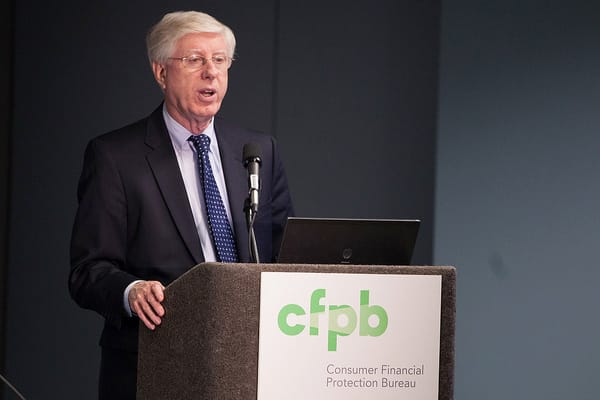
Iowa Attorney General Tom Miller discussed how the work of the CFPB and the consumer complaints we receive help his office serve consumers in Iowa. // Credit: CFPB flickr
In the wake of the 2008 financial crisis, legislators scrambled to pass comprehensive financial reform. With the economy in shambles, Congress was under tremendous pressure to not only fix the situation, but make sure it didn't happen again.
Efforts culminated in the 2010 Dodd–Frank Wall Street Reform and Consumer Protection Act, which was signed into law by President Obama. The bill had a number of provisions, including Title X, which established the Consumer Financial Protections Bureau (CFPB).
The CFPB is an independent regulatory agency tasked with financial oversight and regulation. Its mission, as stated on its website is “...to make markets for consumer financial products and services work for Americans — whether they are applying for a mortgage, choosing among credit cards, or using any number of other consumer financial products.”
The idea was first conceived by then-Harvard Law professor Elizabeth Warren -- currently the senior senator of Massachusetts. Warren first argued for it in 2007 in a paper titled, “Making Credit Safer: The Case for regulation,” prepared for the Tobin Project Risk Policy Working Group.
Despite facing overwhelming opposition and an army of lobbyists, the Consumer Financial Protection Bureau began operation in 2011. So, what lessons can other groups looking to reform Washington learn from the creation of the CFPB?
Be Opportunistic
Opportunism often gets a bad rap. While it can be used for nefarious purposes, such as restricting constitutional rights after a national crisis, it does have its place.
Warren took advantage of an economic crisis where established politicians were obligated to respond, lest they lose their seats. This, in tandem with her tireless advocacy, put enough pressure on officials to respond. Campaign finance advocates shouldn't be afraid to do the same.
Don't Appeal to One Party
Warren won popular support not by trying to appeal to Democrats or Republicans, but made the case to the public at large. She often references the middle class in her speeches and makes common sense arguments that anyone can follow. By focusing on things that resonate with voters regardless of party affiliation, she's been able to gather a base that spans across demographics.
Persist
Nothing comes easy in politics. Warren was often criticized for being idealistic and even chastised by many political watchers that she would never succeed. She was often told that the chances of the bureau being established were slim to none. She responded by saying, “If you don't fight for it, the chances of it passing are zero.”