

Photo Credit: Gage Skidmore / Flickr
Are US voters ready for a madam president? How willing are they to vote for women at the federal level? Citizen Data looked at these questions and what voters' responses might mean for the 2024 election cycle and beyond.
Citizen Data, a nonpartisan research and data group, didn't just ask the question, "Are you willing to vote for a female candidate at the federal level?" Voters were also asked if they thought their neighbors were willing as well.
The gap between the two perceptions, according to Citizen Data's Cindy Mays, Melanie Phillips, and Grayson Wormser, "likely provides a more accurate reflection of the true sentiment."
And the gap is notably wide. Citizen Data found that 85% of respondents said they were willing to vote for a female candidate for federal officer, but only 61% believed their neighbors shared the same willingness.
The separation between the numbers was even more pronounced when voters were asked if they and their neighbors were "very willing." 68% of respondents said this applied to them, but only 32% said the same of their neighbors.
Mays, Phillips, and Wormser noted that these results highlight "the general skepticism surrounding prominent women politicians competing in the current American political arena."
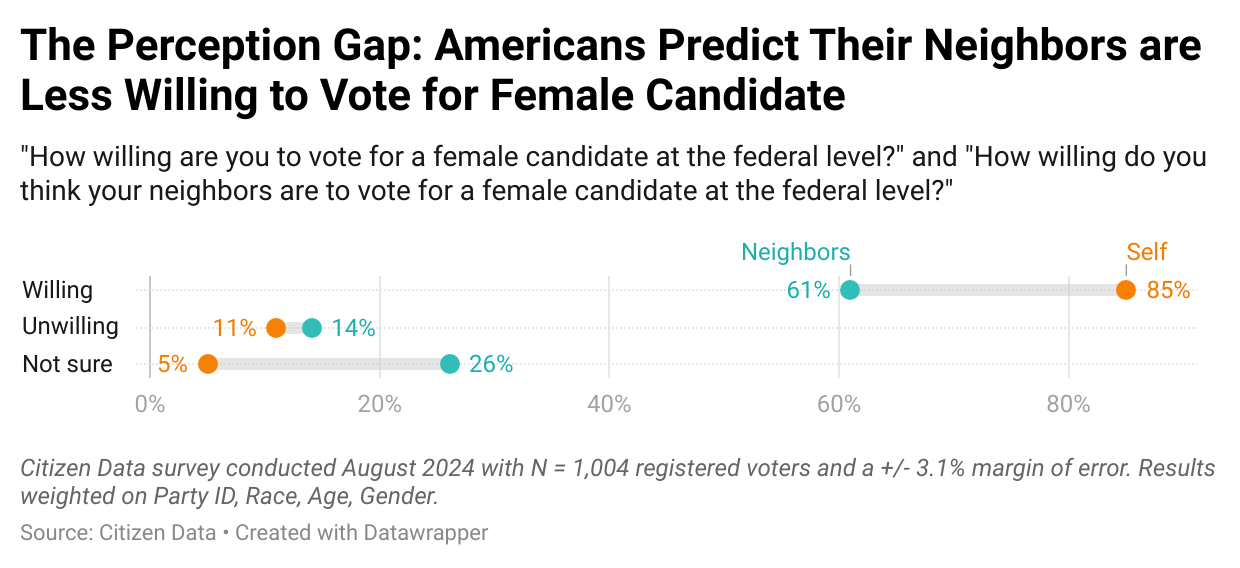
To simply ask voters of their own willingness would lend itself to what researchers call social desirability bias -- or the desire to say the "right" thing. This, according to Citizen Data, "plays a significant role in how we respond to questions on surveys."
What Does This Mean for 2024?
Vice President Kamala Harris made history this year as the first woman of color to be nominated by a major political party for the office of President of the United States. How this factors into her chances remains to be seen.
However, Mays, Phillips, and Wormser write that their group's findings support long-standing research that candidates in "out-groups" (i.e. social minority groups) "are more likely to be perceived as less qualified."
Citizen Data's research wasn't explicitly about support or opposition to Harris. The group sought to better understand what biases exist when a female candidate pursues a high office for state or federal government.
Especially, when that candidate has a resume that on paper would make her over-qualified. This, in turn, gives researchers insight into the difficulties women still face when pursuing high office.
The group's researchers conducted a survey experiment. They introduced a hypothetical female candidate who had been a US senator, graduated from a prestigious law school, and was a successful business owner, among other qualifications.
The test was to see if potential support for this candidate changed depending on the level of office (i.e. statewide office vs US president).
Just over half of respondents (51%) said they would likely vote for the candidate in a presidential election looking at her qualifications compared to 55% who said they would likely vote for her in a state-level race.
Researchers noted that this was a stark contrast to the 68% who indicated a general approval for voting for a woman.
More than a third of voters surveyed said they were unsure whether they would support the hypothetical candidate. What stood out to Citizen Data is that most of these voters were '‘skeptical about her ability to win."
It's not just a matter of qualifications, which are much more likely to be called into question when the candidate is a woman of color, but an overall skepticism that a woman can win -- which can affect the willingness to support female candidates.
Would A Harris Win in 2024 Change Voters' Perceptions?
The survey results gathered by Citizen Data suggest that simply breaking through the proverbial glass ceiling may be enough to alleviate skepticism over qualifications and winnability for women in future elections.
In fact, the group found that "60% of American voters believe Harris’s campaign will have a positive effect on Americans’ willingness to vote for female candidates in other elected offices."
About half of voters (51%) believe that Harris winning would bolster not just willingness among voters to vote for a woman, but overall support for female candidates in future elections.
"Harris’s candidacy has already begun to shift the conversation," Mays, Phillips, and Wormser write.
"While not all voters are convinced, the presence of a woman of color at the top of the ticket is sparking new discussions and may slowly erode the barriers that have kept women from achieving the highest offices."
Researchers further note that regardless of the outcome of the 2024 election, the road to proportional equity for women in the political arena "remains long." Under a third of all elected positions are presently held by women despite making up half the population.