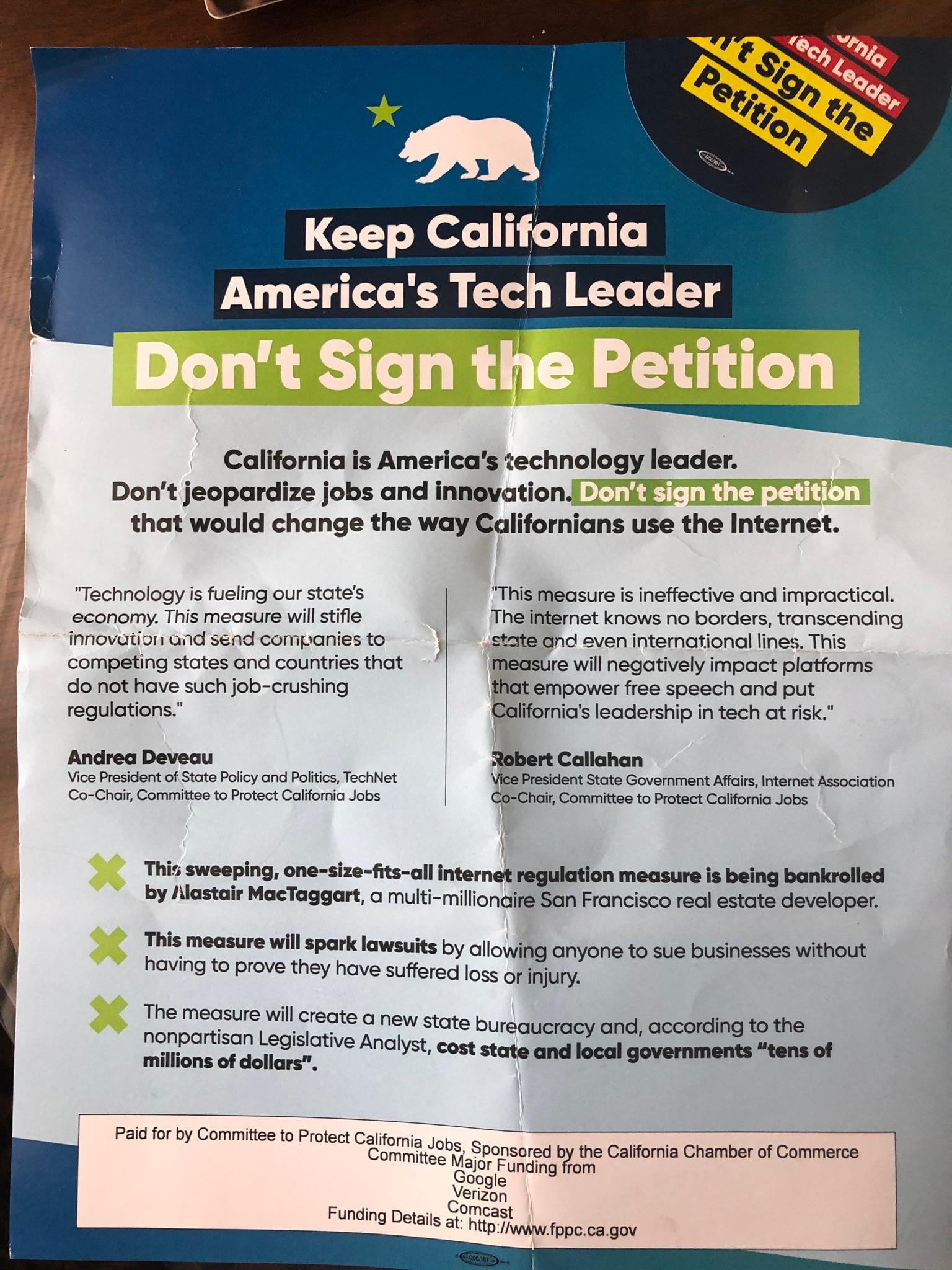
Update: Facebook has announced that it will no longer channel funds into an effort that opposed giving social media users more control over their personal data. The Consumer Right to Privacy Act of 2018, the California ballot measure would allow consumers to learn about the types of personal information businesses are collecting, selling and disclosing on them – in addition to whom that information is being sold or shared. If the measure passes in November, consumers in California could sue both digital and brick-and-mortar businesses for security breaches of data, even if they couldn't prove they were harmed by the breach.
What do Verizon, Comcast and Google have in common? Aside from being highly successful tech giants, they are all gearing up to fight the California Consumer Privacy Act.
What is the California Consumer Privacy Act? It's a grassroots initiative funded by business, legal and political groups working to educate voters about the risks of their sensitive data being sold by corporations.
It also aims to change the law, giving consumers whose data has been stolen, more legal protections.
Representatives from the California Consumer Privacy Act aim to get the initiative on the ballot in November.
According to the group, more and more corporations are collecting your and your children's personal, private data without your knowledge and then spinning off that data to other companies for profits.
What's worse, they say, is the companies who collect the data are not using reasonable security measures to keep your data safe.
PUBLIC OUTREACH BEGINS
Mary Ross is the president for Californians for Consumer Privacy. The group must submit approximately 365,000 valid signatures by the end of April to officially qualify for the November ballot.
If enough valid signatures are collected, the initiative will need 50%+1 to pass in November.
Ross connected with IVN to chat about the effort.
"This is just a common sense initiative that gives Californians the right to find out what information companies are collecting about them, to find out if they're selling that information, and then also gives them (consumers) the power to say if you're selling my information I can tell you to stop selling it," says Ross.
I asked Ross who will oppose the CCPA.
"Well we know already the opposition is starting to congregate," she said. "Verizon, Comcast, Google which actually shouldn't be fighting this if you look at their policy they don't sell any personal information so this shouldn't affect them, but yet they've already put in money to sponsor the opposition."
https://youtu.be/k8UGhFpq4bg
The initiative, if it collects enough signatures and passes in November, will do a number of things:
- Gives consumers the right to find out if their information is being sold and whom is collecting
- Gives consumers the right to prevent businesses from selling personal information
- Prohibits businesses from discriminating against consumers who exercise these rights
- Allows consumers to sue businesses if data is stolen, and even if consumer cannot prove injury
- Applies to online and brick-and-mortar businesses alike
- Costs to enforce these measures would be offset from penalty revenueAssemblyman Ed Chau (D-Monterey Park) has attempted to institute some of these protections for Californians through pending legislation.His bill would require Internet service providers, such as Verizon, Comcast and AT&T, to get permission from customers before using, selling, or permitting access to data about their browsing history.The California Consumer Privacy Act goes much further though and would apply to all businesses that collect and deal data for commercial purposes.
TECH GIANTS FIRES BACKGoogle, Verizon, Comcast and other high tech giants are funding their campaign to the tune of what some estimates say could be as high as $100 million."Keep California America's Tech Leader" is the name of the group opposed to the privacy initiative. A handout from the group expressly asks voters not to sign the Consumer Privacy Act Initiative.Co-Chair Andrea Deveau is quoted, "Technology is fueling our state's economy. This measure will stifle innovation and send companies to competing states and countries that do not have such job-crushing regulations."The group states the Consumer Privacy Act will also spark lawsuits by allowing anyone to sue businesses without having to prove they have suffered loss or injury.For a complete list of the firms funding the effort visit: fppc.ca.gov