Now is a historic moment in American politics. Not only are we seeing a swell of support for fundamental political reform, but reform organizations and grassroots supporters are joining forces.
The Bridge Alliance is the largest coalition of civic action groups in the United States, with over 85 “member” organizations. These groups are united in the understanding that our political system is plagued by a myriad of problems, and the best way to solve them is by working together.
Over the last several months, the Bridge Alliance sponsored three outreach efforts and reached half a million people across the nation:
- Reduce partisan politics and special interest control in politics;
- Foster healthier political conversations; and
- Bridge the trust and communications gap between voters and elected officials.
1. How Do We Reduce Hyper-Partisan Politics?
It’s no secret that Americans want to change the political status quo. A large part of that grievance is a common belief that representatives from both parties have become tribal -- treating government like a game between two teams.
A plurality of Americans no longer wish to identify with the establishment parties in the U.S., and many Americans think government dysfunction is the nation’s biggest problem.
The Bridge Alliance, joined by six of its member organizations, launched a survey to help make sense of what Americans thought was needed to create a healthier political ecosystem. Nearly 4,500 participated in the survey.
Respondents said:
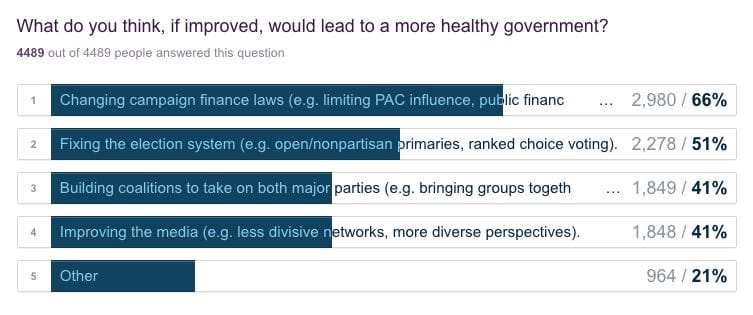
Participating organizations included Unite America, Represent.us, Open Primaries, FairVote, Take Back Our Republic, and the Participatory Budgeting Project.
This outreach effort informed ten thousand Americans about partisan politics, and the growing number of organizations that seek to cure it. As a result, thousands of voters have been connected and are now actively pursuing positive solutions to cure the divide.
2. How Do We Foster a More Productive Political Conversation?
April 20-28 marked the first-ever National Week of Conversation, an effort organized by the Bridge Alliance and 100 sponsoring organizations to foster healthier political discussions across the nation.
The week included hundreds of events -- public and private -- in cities throughout the U.S., and involved thousands of people, community and faith leaders, and elected officials who gathered together with a simple goal in mind: Put partisan bickering aside, mend divides, and have meaningful conversations about the biggest issues facing the country.
IVN interviewed the Bridge Alliance co-directors to get the full rundown of the April event, in a Facebook Live video:
After the National Week of Conversation, T.J. O’Hara interviewed organizers Debilyn Molineaux and Cheryl Graeve on his IVN podcast, Deconstructed, to get the post-event rundown:
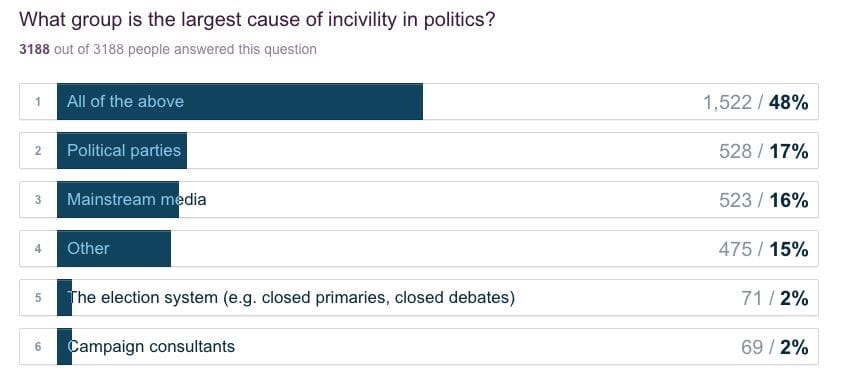
Additionally, more than three thousand participants took part in an online survey following the NWOC. Unsurprisingly, 95% of respondents said our political conversations are largely uncivil.
The two largest culprits of incivility according to respondents? Mainstream media and political parties.
More surprisingly, 84% of respondents said they would watch or read a news service that offered viewpoints from across the political spectrum.
Six members of the Bridge Alliance organized the event, including AllSides, the Listen First Project, the National Coalition for Dialogue & Deliberation, Living Room Conversations, Big Tent Nation, and the National Institute for Civil Discourse.
This coalition can be credited with engaging thousands of people all over the country in real, offline, in-person political conversations that are missing, but necessary, for a more functional democracy.
3. How Can Congress Better Represent Voters?
The growth of independent voters is evidence that a large part of America feels like neither party represents them.
In the third online survey conducted by the Bridge Alliance, nearly 4,000 respondents agreed that Congress is not doing a good job representing people. And 0% were willing to say, “Congress rocks!”
Respondents also ranked how effective they thought various factors be would be to improve Congress:
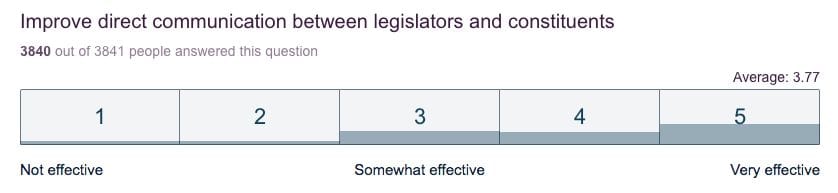
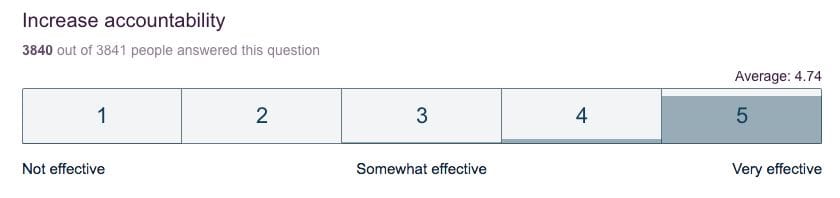
That is why a number of civic action groups and nonpartisan reform organizations in the Bridge Alliance are focused on improving how Congress functions.
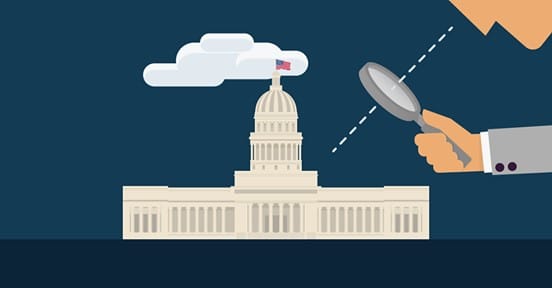
These organizations include the Congressional Management Foundation, OpenGov Foundation, U.S. Association of Former Members of Congress, Convergence, and others. Bridge Alliance brought all of these groups together to engage with people around the nation to discuss how to #MakeCongressWork again.
IVN Editor Shawn Griffiths spoke to leaders from each organization, asking them how to bridge the divide between elected officials and their constituents. In each case, a common perspective was articulated: the best way to effect change is to join forces and combine resources with other organizations that are trying to cut through partisan politics.
Peter Weichlein, CEO of the US Association of Former Members of Congress said:
“This is a real opportune time and there are more organizations doing great work than I have ever seen in the 20 years I’ve been in this space. Overall, I have seen more and more organizations that are committed to improving our process, and realizing that there are all these different wheels that together can form a much more powerful group that has true impact and true outreach.”
The Bridge Alliance is at the center of bringing these groups together. For this outreach effort alone, they connected thousands of voters to nonpartisan member organizations that are working on the front lines to bridge the divide between our representatives and everyday voters.