
 Shawn Griffiths
On Wednesday, May 6, the Republican-aligned group Reform California sent an email to supporters claiming new polls show Republicans will be shut out of the governor’s race and other contests across the state, so people need to send money.
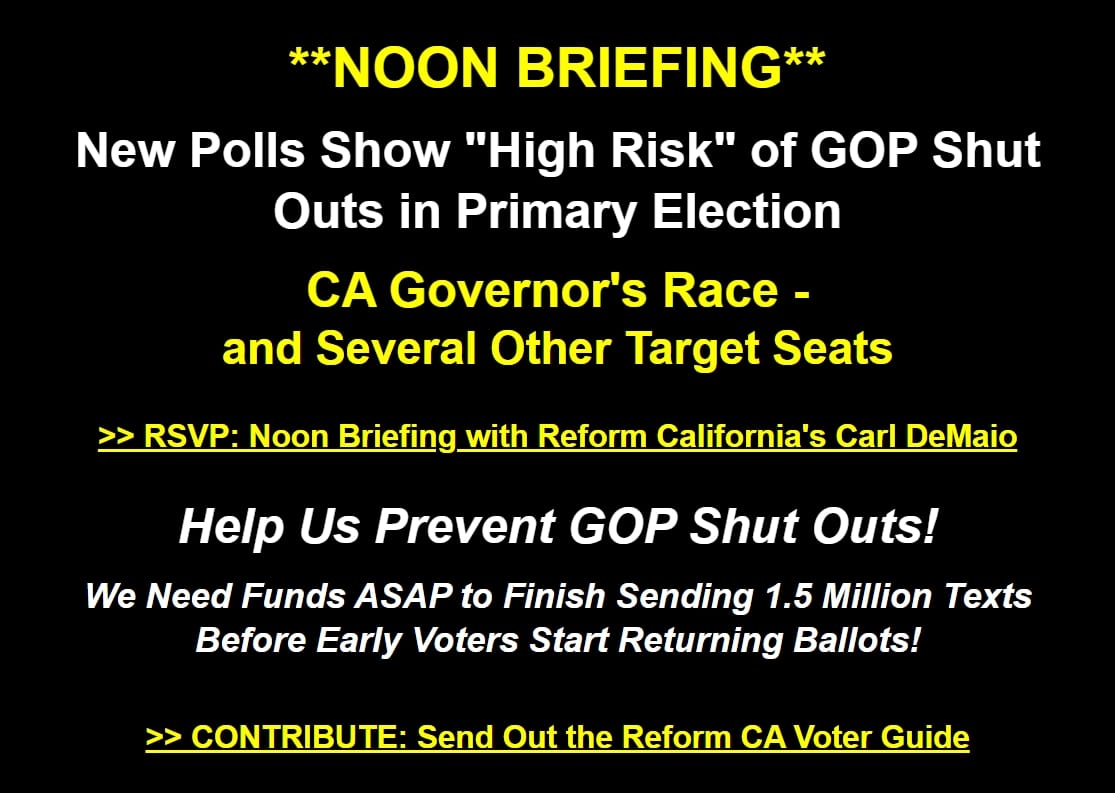
It is unclear what polls the email is talking about. Even recent ones sponsored by the Democratic Party and Democratic candidates like Matt Mahan show Xavier Becerra and Steve Hilton in the top two spots – a Democrat and a Republican.
In fact, the Mahan poll – conducted by Impact Research between April 20 and May 3 – shows Hilton and Becerra with commanding leads (tied at 23%). The next candidate is Democrat Tom Steyer, who is 9 points behind, followed by Republican Chad Bianco.
The polls fluctuate slightly depending on who commissions them and how the polling group samples the California electorate. However, not a single recent poll shows either party getting locked out of the general election.
And if Republican fears sound familiar, it is because Democrats have relied on a similar tactic for months: asserting that they will be locked out of the governor’s race because the large Democratic field was splitting the party’s base.
 Shawn Griffiths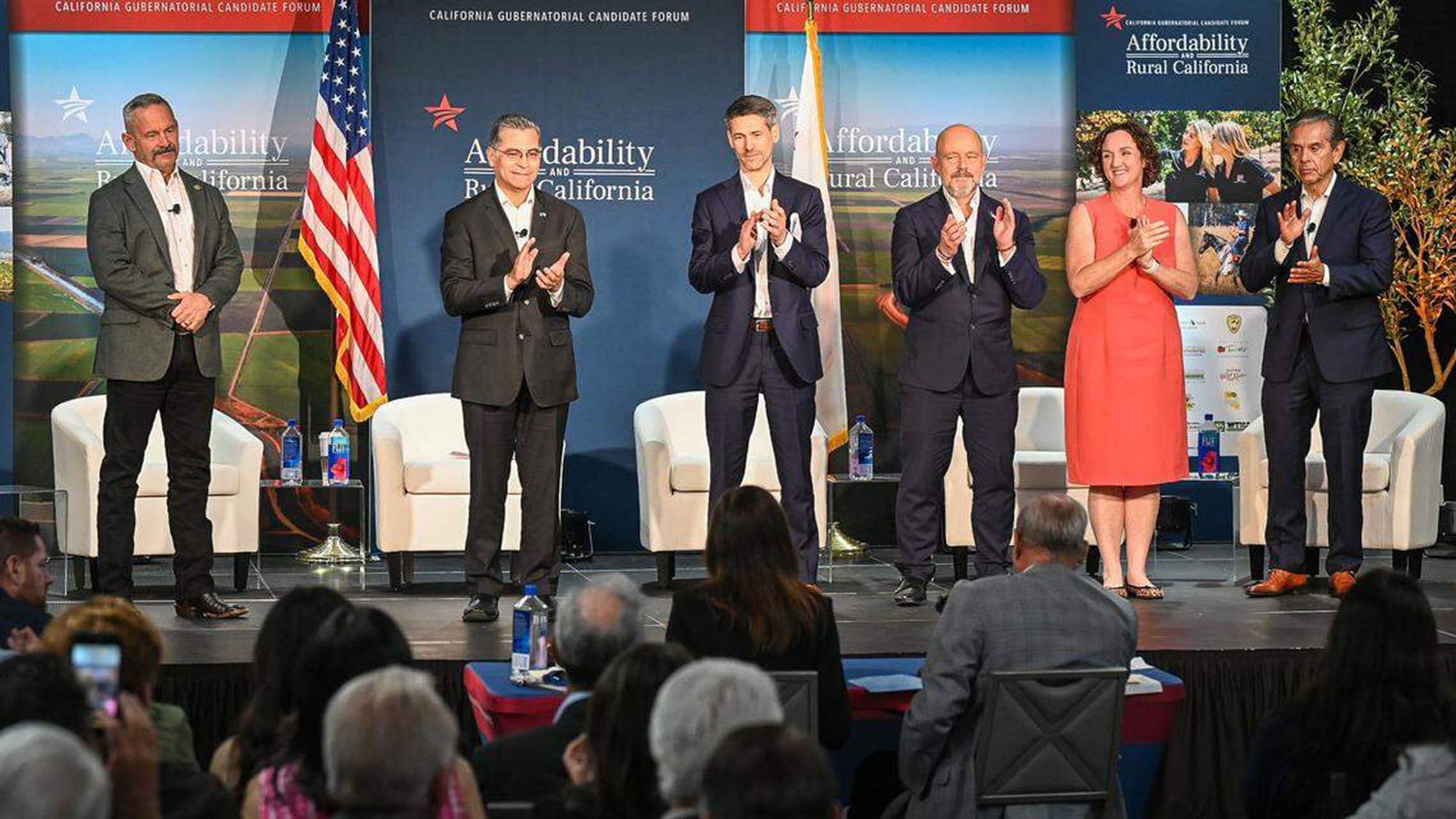
The message from party leaders on both sides is predicated on a hypothetical – a “doomsday scenario” that will scare their voters into thinking the worst possible outcome will happen if they don’t “chip in.”
And party leaders argue that if such a scenario happens, and one side is locked out, it will be the fault of a nonpartisan Top Two primary system that gives all voters and candidates, regardless of party, a level playing field.
They assert that this is a “flawed system” and “it does not work” – something California Democratic Party Chair Rusty Hicks explicitly said, while adding that Top Two needs to be “revised or repealed.”
The Guardian: The chair of the California Democratic party says he wants to get rid of the state’s idiosyncratic “jungle primary”, calling it a failure that risks pitting a crowded field of Democratic candidates against each other to the point where a Republican can be elected…
— Politics & Poll Tracker 📡 (@PollTracker2024) May 1, 2026
The Guardian article in which Hicks was quoted mentioned that “California Democrats enjoy a two-to-one registration advantage over Republicans, hold supermajorities in both houses of the state legislature, and have not lost an election for statewide office since 2006.”
Notably, the nonpartisan Top Two open primary system was adopted by voters in 2010 under Proposition 14, which was sponsored by the Independent Voter Project (IVP). Under this system, all voters and candidates participate on a single primary ballot.
No one is locked out. No one is denied a vote. And the top two vote-getters advance to November.
According to findings by the Public Policy Institute of California, the 23% of voters registered “No Party Preference” (independent voters) in the state are more likely to support a statewide Democratic candidate than a Republican.
The data shows nearly 40% of independents “lean Democrat,” while 34% lean toward neither party. So given that Democrats have a super majority in the legislature and given that Democrats haven’t lost an executive seat in 20 years, the question to Hicks is:
How exactly is the nonpartisan primary system not working in California? How are voters in the state not getting the outcome they want?
The question readers may have is, why have media pundits and party leaders been so adamant that California could get a two-Republican general election? (Or, that one party could be locked out of the election entirely?)
The answer is simple: They ran with early polling figures that showed Hilton and Bianco ahead of a crowded Democratic field when a quarter of survey respondents said they were undecided.
It made for good fundraising fodder (as we now see from Republicans). Republican candidates even used it to claim frontrunner status.
When IVP first conducted a statewide poll on this race in February, it looked deeper into voter preferences. The data not only showed which candidates would gain if any Democrat dropped out of the race, but it showed that Hilton and Bianco were approaching their support ceiling.
Again, a quarter of the electorate remained undecided, many of whom were independent voters, and voter data shows independents in California are more likely to pick or settle on a Democrat than a Republican.
This is why, even back then, IVN reported that the odds of a two-Republican general election were incredibly slim.
Once Eric Swalwell dropped out, the governor’s race saw a seismic shift. Xavier Becerra jumped to the frontrunner spot and both Republicans have not been in the top two together since mid-April.
IVP was the first to show this shift following Swalwell’s exit.
Now, polls are reflecting what research and datapoints say about California voters when they make their choices. And this election will be decided by voters – all voters, not just party insiders or aligned special interest groups.
Hicks said the Top Two system needs to be revised or repealed. IVP has come out in support of changing the system, but instead of moving backward, the group now advocates advancing 4 candidates to the general election, instead of two.
Under this more choice voting system, Californians would use a ranked choice ballot in November to determine a majority winner. This type of system is already in place in Alaska.
Is it possible that the governor's race could come down to two Democrats? It is much more likely than two Republicans, but Hilton continues to poll high enough to fill one of the two spots.
So here are 3 possible scenarios for November (assuming recent surveys are not far off):
- Hilton faces Becerra in November
- Hilton faces Steyer in November
- Steyer faces Becerra in November (this one is the least likely outcome)
Only one of these scenarios will not result in the election being called immediately after polls close and that is if Steyer and Becerra advance – because they will need to compete for a much broader segment of the electorate in order to win.