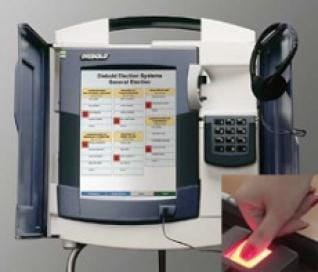
With a lot of discussion as of late on issues surrounding voter registration laws and voter suppression in the U.S., the discussion of alternatives to improving the voting process becomes a relevant topic. On the more intensive side of the spectrum, the idea of Biometric Voter Registration (BVR) can be considered. Although most likely not a viable option for the U.S., it is nevertheless an interesting subject that has growing prevalence in Africa.
Biometric Voter Registration is the process of requiring eligible voters to go through some kind of biometric analysis for recording, be it fingerprint or iris scanning technology. Doing so allows them to be a registered voter and prove their identity when they go to vote. The goal is to reduce and even eliminate unfair voting practices and promote free, fair, and transparent (FFT) voting.
As Dr. Samuel Chindaro, an electronics engineer involved in a research group on biometrics technology at the University of Kent exclaims,
“Biometric identifiers cannot be shared, misplaced, and they intrinsically represent the individual’s identity. In general and which is important for our present purposes, biometrics can be used for positive identification, that is, to prove that an individual is who they claim to be.”
Within the past year, BVR through finger print scanning has been implemented throughout much of Africa, including regions and countries such as Nigeria, Kenya, and the Democratic Republic of the Congo. Not long ago, Sierra Leone registered 2.5 million voters across the country in their latest election and Zambia, Nigeria, Namibia, and Mozambique have all either already started BVR or are planning to.
Ghana, which has been most highlighted in association with the new type of voter registration has faced many challenges regarding its implementation yet the idea still holds value within the country. 45 million was invested in BVR in Ghana and with this, the creation of Ghana Decides, a non-partisan project, was started in March 2012. The use of social media by this project though is something to be noted. Ghana Decides utilizes various social media sites to reach voters including Storify, Google+, Youtube, Facebook, Flickr, and Twitter. They also work to dispell common concerns that BVR causes cancer and promote the technique as a safe and accessible process.
Of the 24.4 million population of Ghana according to the World Bank public records, only around 1.2 million are on Facebook. So not only did Ghana Decides have to follow through on an impressive social media outreach, but also work on the ground to promote BVR. It has apparently paid off with an estimated 12 million Ghanaians registered in the Biometric Voter Registration system as of early May, according to the Electoral Committee (EC).
The actual effectiveness of BVR is a subject that can not be justifiably summarized in a short article and deserves far more time to analyze, but from short hand, there are some noticeably negative aspects that severely diminish its integrity.
The process of BVR in many cases cannot detect minors and non-Ghanians and can work off of a system with missing or incorrect citizen data. Of the thousands of BVR stations, the system is not interconnected and leaves room for duplication, which has led to cases where a man registered to vote 15 times. 8,000 others reported multiple registrations. In the long run, 8,000 multiple registrations could be minor when compared to the 12 million gaining registration from this process. There is also the question of accessibility for rural regions and the disincentive that BVR makes the process of voting “longer and harder”.
Of the positives, BVR discourages fraudulent voting such as “zombie voting”, which is the practice of registering and voting under the deceased’s name. Another is the the possible increased confidence in the system. In an NPR interview with Mexico-born Jose Aliseda on the subject of the Voter I.D. laws, he said:
"I come from a country that requires not only a photo I.D., but a biometric photo I.D., to vote. And by - I mean biometric. It has a fingerprint and, when you vote, you have to dip your finger in a vat of ink to show that you're not voting yet more than once."people need to have confidence in the system or they won't participate."
With Biometric Voter Registration rapidly growing throughout Africa, the case of Ghana proves an interesting one to follow. With the recent death of President Atta Mills and their upcoming round of elections set for December 7, 2012, the role BVR will play in the country will be crucial. In the end, the true value for this more stringent type of voter identification will be better determined only with time.