

Aaron Hamlin
Aaron is the executive director of The Center for Election Science, a nonpartisan nonprofit that studies and promotes better electoral systems.
Articles by Aaron
A Million-Dollar Snapshot of What Better Elections Look Like
The last year for The Center for Election Science was transformative. We received a grant from the Open Philanthropy Project of $600K, and then we helped win the first ballot initiative for approval voting the very same year. We won by 64%, a landslide by any measure. And we did it in a city of 120,000 people. Outside of IVN, our effort to implement approval voting was qualified as a long-shot by the few media that covered the story.
And what a story it was. Fargo was a city that, like many cit...
14 Mar, 2019
-
3 min read
5 Guidelines to Determine What Is and Isn't Good Voting Reform
If you’ve spent much time at The Center for Election Science website, then you probably know what a voting method is. A voting method is the method that voters use to put information on their ballots and how that information is calculated.
Right now, the main voting method we use has us choose one candidate, and the candidate with the most votes wins. This is called plurality voting or first-past-the-post. But because those terms are weird and hard to remember, this essay will just call that ap...
08 Oct, 2018
-
15 min read
OPINION: It's Time to Give Approval Voting a Chance
The voting method is extremely important and affects all parts of the election from who wins, how seriously candidates’ ideas are taken, and who you see on your ballot. Specifically, the choose-one plurality voting method that we use now is really bad.
Fortunately, there are alternatives. One that works really well and is also very easy is called approval voting.
This method lets you choose as many candidates as you want. Whoever has the most votes wins. Approval voting works with our current ...
02 Oct, 2017
-
5 min read

Does France Have Better Elections than US?
Runoffs get touted as a solution for vote splitting between similar candidates and overall better elections. Certainly, just about anything is better than the choose-one plurality voting that the US uses so extensively. But are runoffs really the great solution we make them out to be? (We already know that—like any voting method—runoffs can’t guarantee an absolute majority.)
The French use runoffs for their presidential elections, so let’s look at them. And while we’re at it, let’s look at thei...
05 May, 2017
-
6 min read

The Illusion of Majority Rule in U.S. Elections
When someone wins an election with fewer than half the votes, what do you think? Many would call this winner undeserving. After all, they didn’t get a majority.
You know how a majority works. Right? Maybe not. In the world of voting theory, A LOT is counterintuitive—including the concept of majority. So get a chair because you’ll need to get comfortable for this one. Pie Chart
An Introduction to Majority
Let’s get some terminology out of the way. There are at least three terms that get at th...
30 Mar, 2017
-
4 min read

Honest Voters Had a Clear Preference in 2016
Voters aren’t always honest. But what would it look like if they were? We found out.
Here’s how we got respondents to be honest. We asked them to indicate on a 0-5 scale how much they would like each candidate to be elected president—regardless of the candidate’s actual likelihood of being elected. (We’ll talk about actual score voting in a later release.)
On top of that, we thought we’d add some extra candidates, since the voting method can actually change who decides to run. In addition to t...
09 Jan, 2017
-
4 min read

New Research: Johnson, Stein Could Have Been Included in Debates under Approval Voting
We have our presidential election data! We’re going to be publishing multiple articles because there is just SO MUCH data.
Here’s the gist of what we’ve done. Our analysis team used a technique called Mr. P(link is external) that involves re-weighting the data according to demographics without overfitting the model. The sample size for our short list of four candidates was over 1,000. Our sampling was conducted by GfK(link is external) and used a panel technique so that respondents were represe...
16 Dec, 2016
-
3 min read

A Blueprint To Better Presidential Elections
The 2016 presidential race has been called for Donald Trump. But Clinton won the national popular vote. This is the fifth time in history that the popular vote winner wasn’t elected president—a failure rate of about 10%. For most people—irrespective of political ideology— denying the national popular vote winner seems unfair.
But our presidential voting method failures extend well past the national popular vote. Fortunately, we can fix it. And it doesn’t take a constitutional amendment.
Step t...
14 Nov, 2016
-
5 min read
Maine’s Ranked Choice Voting: Not Perfect, But A Step Up from Plurality
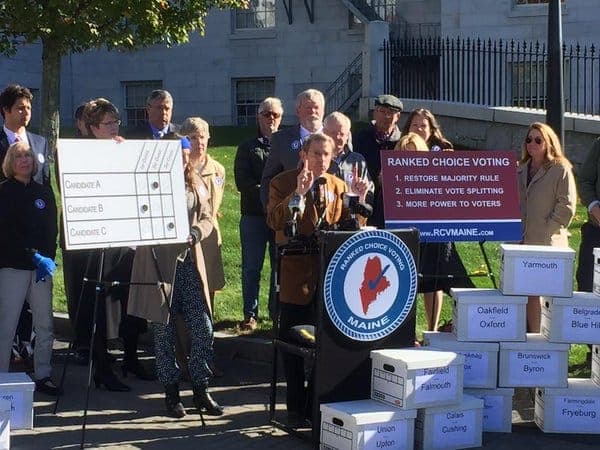
Measure 5 puts ranked choice voting (RCV) on the ballot to be used statewide. RCV is worthwhile to support because it’s better than Maine’s current plurality voting system. But if you dress up RCV and say it can do things that it can’t, then you’ll set yourself up for disappointment. And that false praise may very well set up Maine to add itself to the list of places that have repealed RCV. We’d rather not see that downslide, so this article is to prepare you.
Believe it or not, this is a pro R...
27 Oct, 2016
-
11 min read