
 Jeremy Gruber
Editor's Note: The following is an exclusive series on IVN from the better elections group Open Primaries. The content originated from the group's weekly newsletter, "Primary Buzz."
The campaign to repeal Alaska's ranked-choice voting and nonpartisan top 4 primaries is doing something quite dishonest. They are running ads saying that overturning Alaska’s nonpartisan system would “bring back the days of open primaries.”
Get rid of an open system to bring back…open primaries?
 Shawn Griffiths
The current system guarantees every voter can participate. Repeal would return Alaska to partisan primaries, where parties can decide whether or not independent voters are allowed to participate.
But the dishonesty points to something important: the repeal campaign knows Alaska voters like open primaries. They know voters want to participate without first choosing a political party.
They have good reason to know it. Independents make up roughly two-thirds of Alaska’s voters.
That is the real story: even the campaign fighting to repeal Alaska’s open system understands that independent voters expect—and want—a voice.
What We’re Talking About
A New Chapter for the Open Primaries Movement
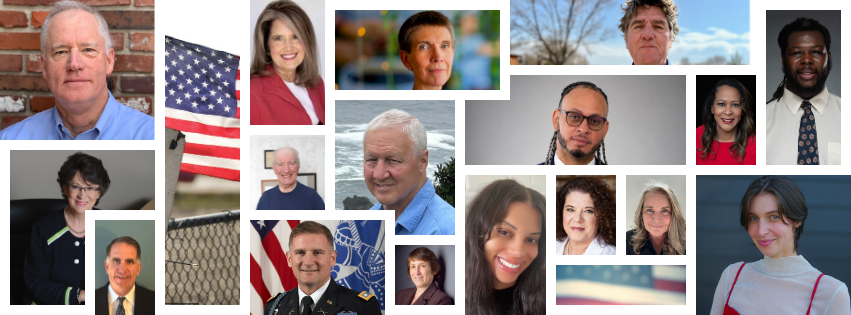
For years, leaders and activists across the country have been fighting for open primaries—often without a formal structure connecting their work. That’s changing.
We’ve launched a nationwide network of State Leaders and Spokespeople, bringing together 11 state leaders and 29 spokespeople across more than half the states in the country.
These are people who have been in the fight for years, alongside new activists joining the movement. Together, they’re helping build the foundation for a 50-state network.
This is an exciting new chapter for Open Primaries: expanding our organization, creating new structures, and bringing more voices into the fight for independent voters.
The movement is growing. Now our organization is growing with it.
Meet the State Leaders and Spokespeople building the movement nationwide.
Delaware’s Primary Puts The Spotlight on Independent Voters
On Tuesday, Delaware held the final state legislative primary of the 2026 midterm season and over 31% of the state’s registered voters who are independents were locked out.
Delaware is one of only 14 states with closed primaries. As I told Delaware Public Media ahead of the election: “There is no context where that isn’t a crisis…. That’s particularly because Delaware is in such poor company.”
Bethany Beach independent Rich Clair made a related point to the Delaware State News: many of the decisions that shape who ultimately holds office are made in the primaries. By the time the general election arrives, he said, “it can be a done deal….“I should have the same ability as anybody else that has an R or a D or a G or an L next to their name to participate in our democracy.”
This year underscored just how consequential Delaware’s primaries can be. Twenty-four state legislative primaries were contested — the most since at least 2010 — and 18 incumbent legislators faced primary challengers.
Across the state on Primary Day, independent voters participating in Operation Independent 2026 shared memes on social media alerting fellow Delawareans about this democracy crisis and several went to polling locations to call attention to Delaware’s closed-primary rules.
Jamie Kegerise from Wilmington and Bruce Mann from Millsboro talked with voters outside their polling places.
Check Out Their Videos:
JAMIE KEGERISE
BRUCE MANN
Di Pine, a veteran, sent us this report from her polling place:
“I went to vote today, and I was told I could not. I was registered. I was informed. I was ready to participate. But because I am registered as an independent, Delaware law does not permit me to vote in either major party’s primary….There are so many beautiful things about Delaware, and I care deeply about the community I have built here. That is precisely why this exclusion hurts."
What happens next?
The pressure and momentum to open the primaries grows.
This past legislative session, a bill to open the primaries, HB 188, sponsored by Rep. Michael Smith, passed the Delaware House 22–17, but did not receive final Senate approval before the session ended.
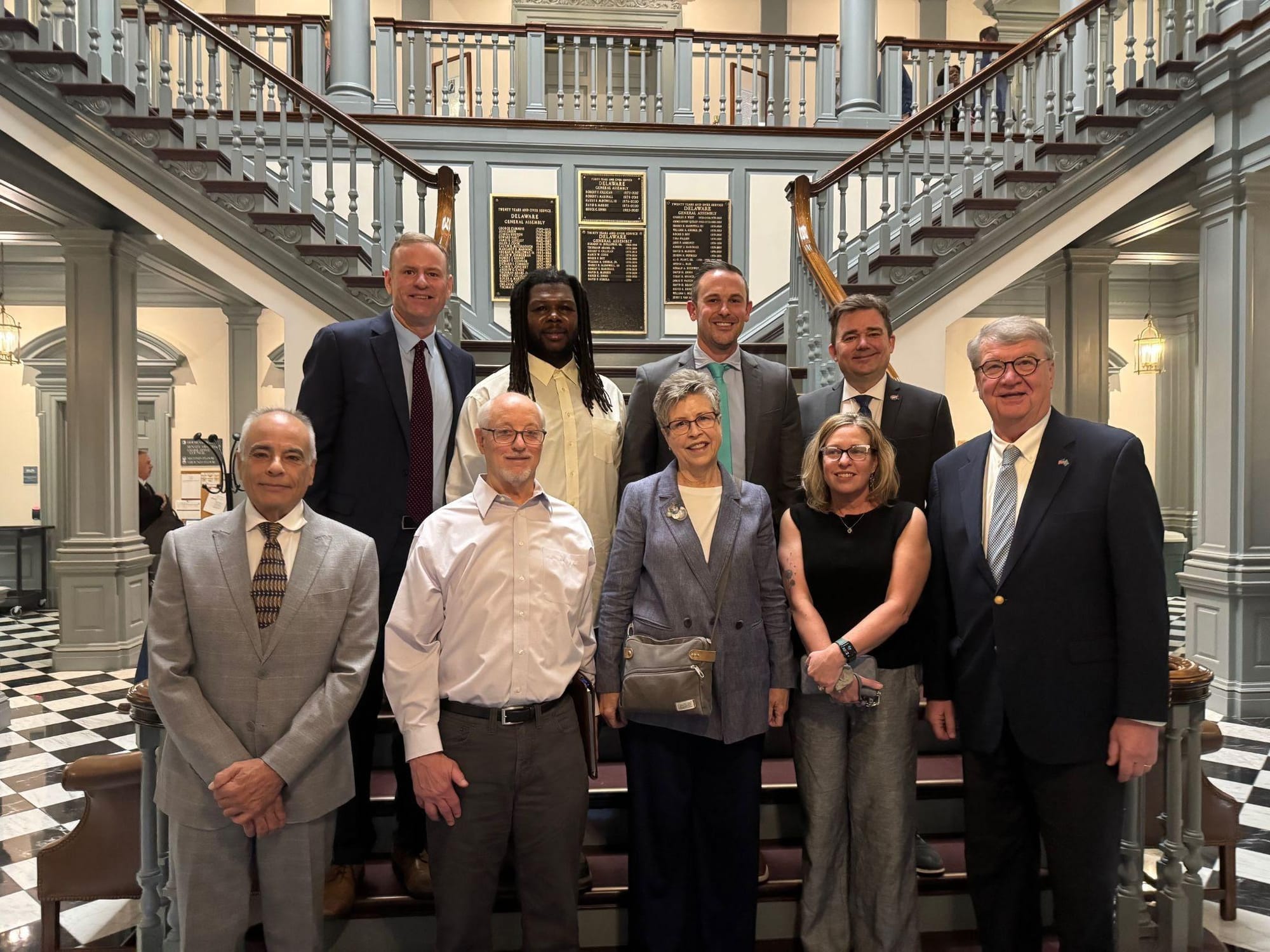
Rep. Smith, who is running for reelection to House District 22 this November, plans to re-introduce an open primary bill in the next session. As Smith told the Delaware State News:
“Every election is a taxpayer election. So, if that’s going to be the case, everyone should have access. Or, if not, why aren’t parties paying for it themselves?”
Stay tuned.
What We’re Reading
Perot 2.0 Is Coming — Without Perot
Ross Perot won 20 million votes in 1992. Now, John Opdycke argues, the independent movement is back—and bigger than any one candidate.
Independent voters are surging. Open primaries are spreading. The two-party system is facing a new challenge.
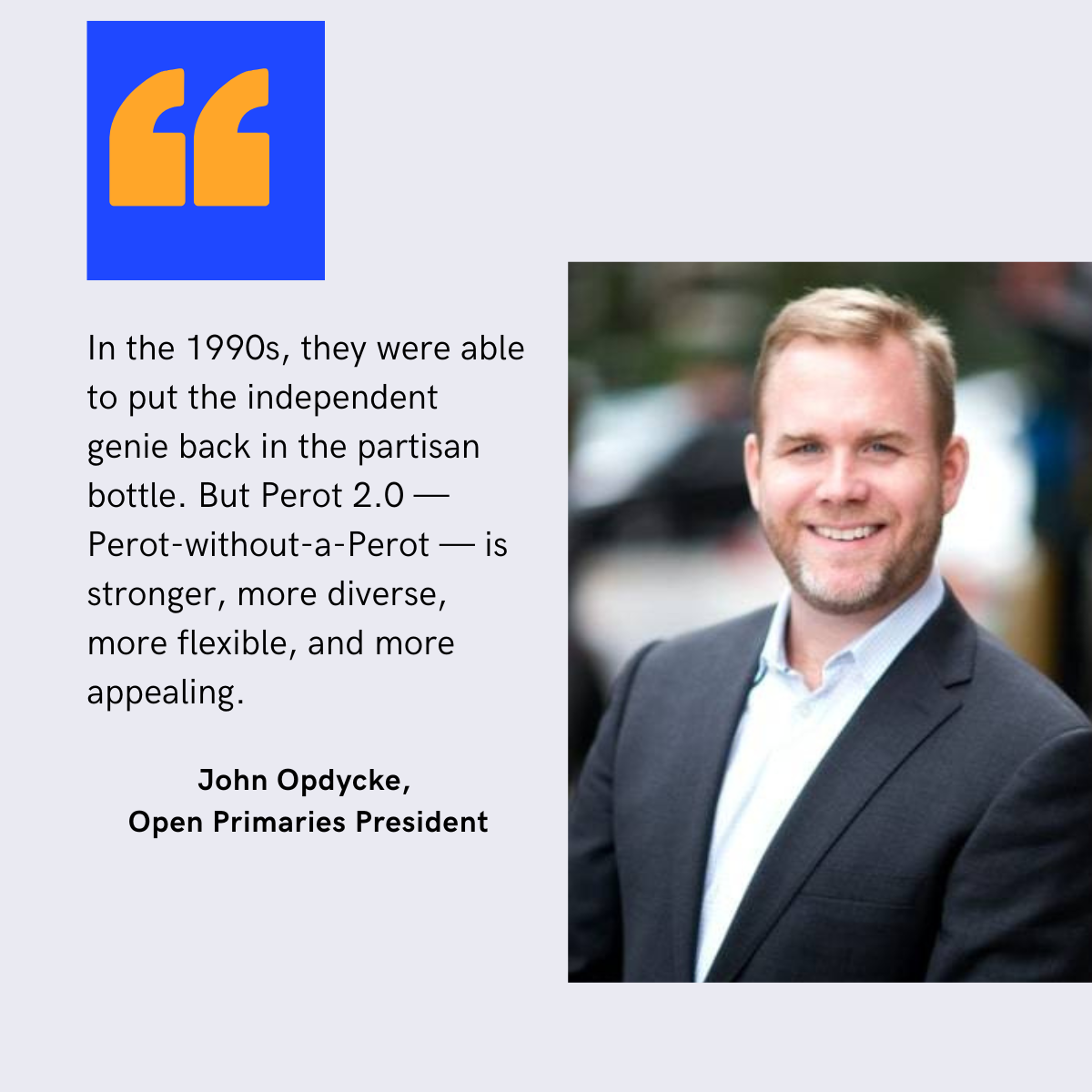
Read John Opdycke’s full piece on the independent surge of 2026.
Campaign Updates
NYC’s Open Primary Movement Is Starting To Look Like A Movement
A few weeks ago, we asked: Will New York City ever get open primaries?
The answer may depend less on finding the perfect campaign strategy—and more on whether the 1.2 million independent voters shut out of New York City’s primaries begin organizing as a political force.
That is already starting to happen.
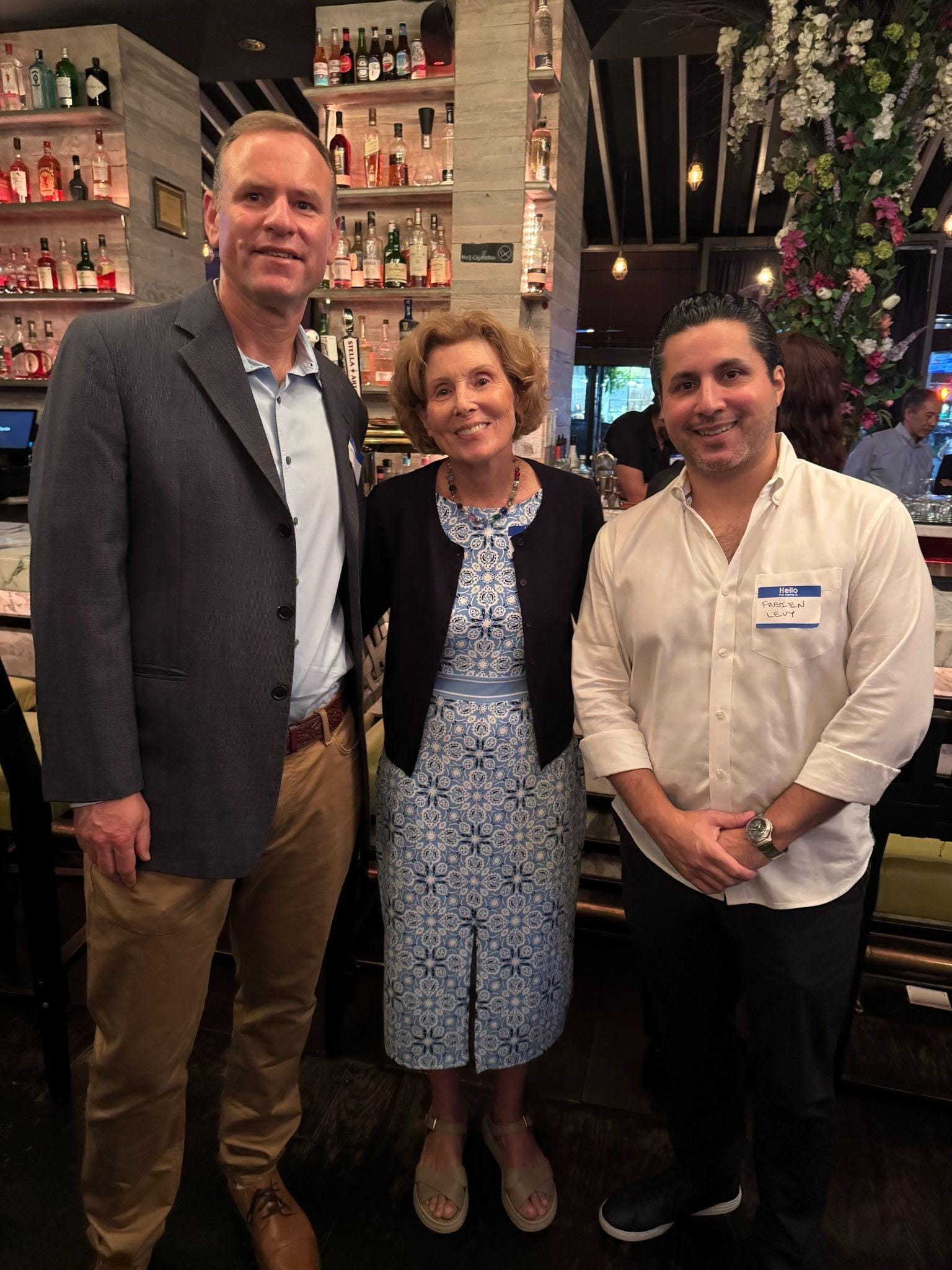
This week, I joined former Deputy Mayor Fabien Levy and One CIty Rising founder Maria Danzilo for a conversation about bringing open primaries to New York City. The event brought together New Yorkers who have been testifying at Charter Revision Commission hearings, sending emails, organizing their communities and making the case that excluding independent voters from taxpayer-funded elections makes no sense.
That’s the important development in New York City. The fight is no longer just about a proposal or a ballot question. It is about building the civic power of the people who have been excluded from the system.
As I wrote in Vital City, the next chapter cannot simply be another campaign. It has to be a movement.
And in New York City, that movement is beginning to take shape.
NYC Independents Take It to the Streets of Brooklyn
Open Primaries and Let Us Vote will be hosting a booth at Brooklyn’s historic street festival – The Atlantic Antic – on Sunday, Sept. 27th. We’ll be talking with voters about the unfairness of the NYC primary system that bars 1.2 million voters from participating in the primaries. We’ll be getting signature on the Open Letter to Mayor Mamdani, asking him to meet with independents at a Town Hall.
If you are in the NYC area on the 27th come volunteer or stop by and say hello. We’ll be there rain or shine from 12 noon - 6 pm. To register to volunteer, email cstewart@openprimaries.org.
Did You Know?
Independents Are Rising—and Even Bill Maher Is Noticing
On Real Time, Bill Maher pointed out what the parties would rather ignore: independents are now the biggest bloc in many states.
Voters aren’t checked out. They’re checking out of the partisan food fight—and demanding a say in elections that matter.
Activities and Events
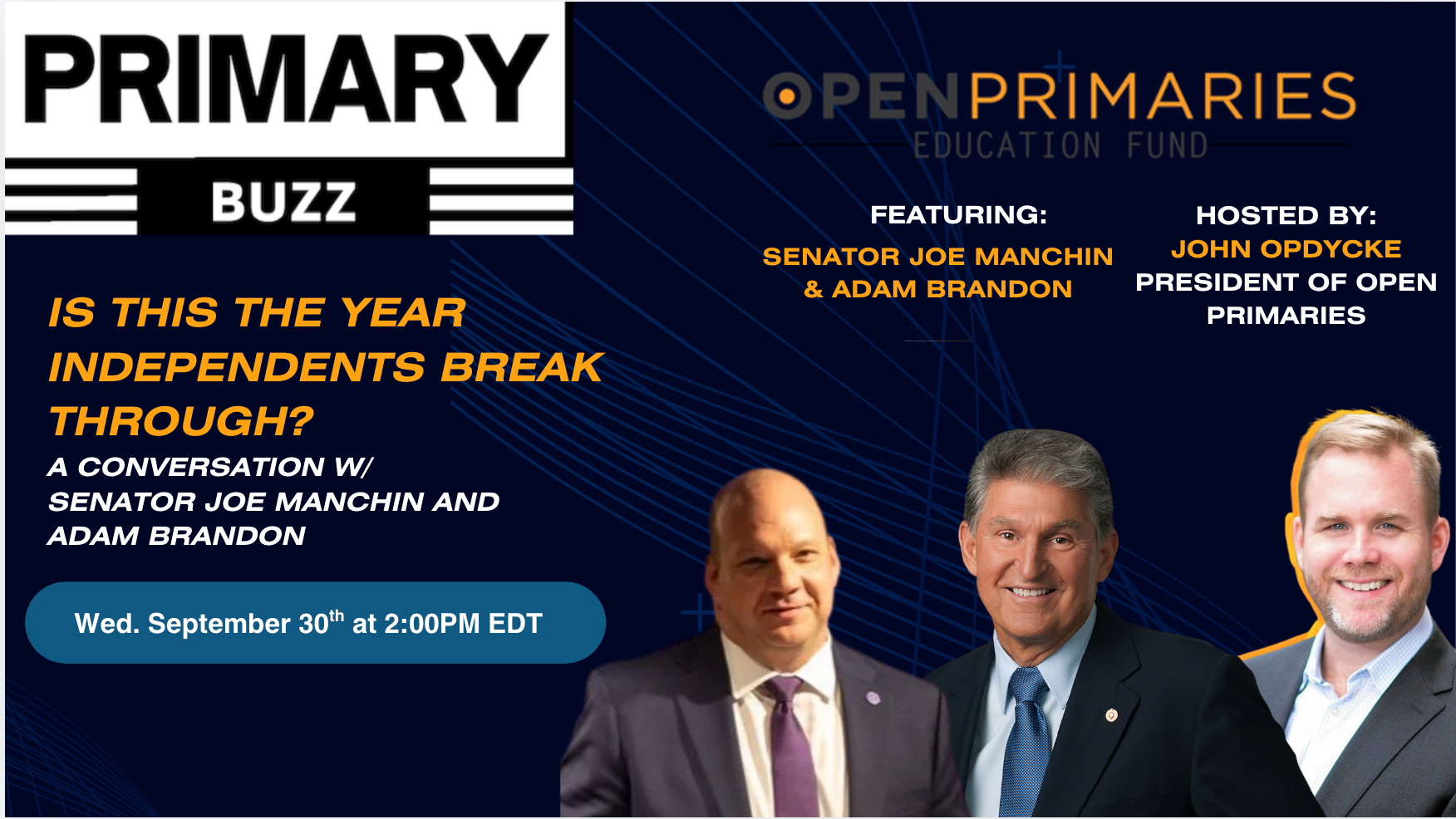
Is This The Year Independents Break Through? A Conversation with Joe Manchin and Adam Brandon
Hosted by Open Primaries President John Opdycke
Wednesday, September 30 | 2:00 PM EDT | Virtual
Independent voters are the largest force in American politics. But when it comes to who holds power in Washington, Republicans and Democrats still have a near-total monopoly.
Could 2026 be the year that begins to change?
Join Open Primaries President John Opdycke for a timely conversation with former U.S. Senator Joe Manchin and Adam Brandon, senior adviser to the Independent Center and former president of FreedomWorks, about their ambitious new effort to elect independent candidates to Congress while challenging the two-party system from the outside.
Their goal is to build the infrastructure independent candidates have long lacked and prove that candidates can run and win without a D or R next to their name.
The stakes go beyond electing a handful of candidates. Their effort raises a much bigger question: Why should two private political parties have so much control over who gets elected, how Congress operates and whether independent voices have a seat at the table?
With closely divided chambers, growing dissatisfaction with the two-party system and millions of Americans identifying as independents, even a small number of truly independent members of Congress could have an outsized impact potentially influencing congressional leadership, committee rules and how Washington does business.
Can independents finally translate their numbers into political power? Can candidates compete without the machinery of the two major parties? And could 2026 be the beginning of a fundamentally different kind of Congress?