Skip to content
Subscribe

50 Days Ahead of Election, Trust in Congress Hits Historic-Low

Published:

With less than 50 days before Election Day, Gallup published a report on Monday that shows that public trust in the federal government continues to decline. According to the most recent survey, 28 percent of respondents said they trust the Legislative Branch a "great deal" or "fair amount."

Additionally, 43 percent said they trust the Executive Branch, and the Judiciary Branch remains the most trusted branch of the government at 61 percent.

Historically, respondents have been more likely to say they don't trust the Legislative Branch than the other two branches of government. However, trust in Congress dropped to historic lows in 2011 when it fell to 31 percent, picked up a little bit in 2012 and 2013, and has since dropped to a new record-low.

According to Gallup, since 2005, respondents who claim no affiliation to either major party have been least likely to trust Congress and as partisanship has gotten worse, trust among this demographic has declined even more. Twenty-three percent of independent respondents said they trust the Legislative Branch a "great deal" or a "fair amount."
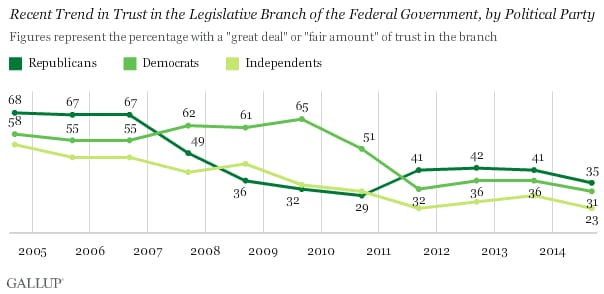
trust-in-congress

Republicans and Democrats, on the other hand, tend to shift their opinion of how trustworthy the Legislative Branch is depending on which party has control -- a predictable trend that is even more noticeable with the Executive Branch. However, the hyper-polarized political environment in the last couple of years has been toxic to everyone .

The survey-takers who identify as independent tend not to care which party is in control, because Congress has become less and less representative of the American public. Partisan gridlock has prevented meaningful legislation from being passed and when bipartisan compromise is reached, it is more for grandstanding than solving problems.

The lack of adequate representation in the Legislative Branch is a result of over 200 years of gerrymandering, as well as election laws designed to limit competition in elections and prevent millions of voters from having equal access to all integral stages of the voting process.

Given the latest data on the public opinion of Congress, most independent voters will likely agree that not much will change after the 2014 elections.

Adhere to the IVN etiquette

By posting a comment, you agree to adhere to our etiquette rules: No partisan attacks, no personal attacks, substantiate your sources, no self-promotion.

Contact IVN

Questions about this article or our coverage? Send us a message. A free IVN member account is required.

Message sent

Thanks, we’ll review it and get back to you if needed.

Message not sent

Sorry, something went wrong. Please try again.

Sign in to send a message

Messages are tied to your IVN member account. Signing in is free and takes a few seconds.

Republish this article

Republishing guidelines

Republish IVN articles for free. Independent Voter News articles may be republished online or in print under a Creative Commons BY-NC-ND 4.0 license, on these terms:

  1. Credit the author and IVN. Keep the byline ("By Author Name, Independent Voter News") and the attribution note at the end, which links to the original.
  2. Keep the meaning. You may update time and place references and apply your house style. You may trim for length, as long as the cuts don't change the meaning or misrepresent the author. Keep the headline. Mark any additions as your own (for example "Additional reporting by ...").
  3. Translations are welcome. Translate faithfully, add "Translated from English by [your outlet]", and tell us at editor@ivn.us.
  4. Keep the links, including the link to the original article.
  5. Keep the tracking image. The HTML includes a 1-pixel image that counts readers on your page. It collects no personal information.
  6. Photos and illustrations. Images credited to IVN may be used with this article only. Images credited to others (AP, Getty, Unsplash, Wikimedia and so on) stay under their owners' terms. Secure the rights or switch "Include images" off.
  7. Don't sell it. You can't sell our articles or sell ads specifically against them. Your normal site advertising is fine.
  8. No implied endorsement. Don't suggest that IVN or the author endorses you, your candidates or your causes, or that donations to you support IVN.
  9. Keep labels. Opinion or analysis pieces keep that label.
  10. Point search engines to the original. Where your CMS allows, set the canonical URL to the original IVN article.
  11. No bulk or automated republishing, and don't submit our articles to aggregators (Apple News, Google News, MSN) as your own.
  12. Corrections and removals. Update your copy when we correct it, and remove it promptly if we ask. We'll contact you at the email you give us.
  13. Questions or print republication: editor@ivn.us.

IVN staff: fill in who you're inviting above, then create the invite.

Preparing the article

50 Days Ahead of Election, Trust in Congress Hits Historic-Low

Choose a format
  • HTML
  • Email HTML
  • Markdown
  • Formatted (.docx)
  • Plain text
  • WordPress blocks
  • PDF
Choose a platform

Photos credited to others need their owners' permission.

To for

Republishing somewhere else? Questions? editor@ivn.us