
 Shawn Griffiths
Photo Credit: Getty Images on Unsplash
A new study analyzing all single-winner ranked choice voting (RCV) elections since 2004 reveals a significant increase in meaningful votes and representation in elections under RCV. The study, conducted by FairVote, shows that RCV caused 17% more votes (equivalent to 2.5 million votes) to count for candidates who had a chance at winning.
The percentage increases to 30% when looking at RCV elections with multiple rounds of counting. This highlights the effectiveness of RCV in amplifying voter choice and ensuring that a broader spectrum of voices is heard in the electoral process.
“This report puts on a number on what we already know – RCV makes more votes count meaningfully. If your favorite candidate performs poorly, your vote can count for a backup choice, and you can still make a difference. Millions of voters are doing just that,” said Deb Otis, Director of Research and Policy at FairVote.
“More voters than ever feel dispirited and disillusioned by our democracy. These findings point a better way forward with ranked choice voting – one where every vote matters as much as possible.”
FairVote is a nonpartisan organization that advocates for better elections. It is the nation's foremost advocate and supporter of ranked choice voting in cities and states across the country.
The group's report provides a compelling example of how RCV operates in practice, using the 2018 Santa Fe mayoral race as a case study.
Five candidates ran in the election. Many were city council members or had other government experience. However, without strong public polling, voters had no way of knowing who the frontrunners were in the race.
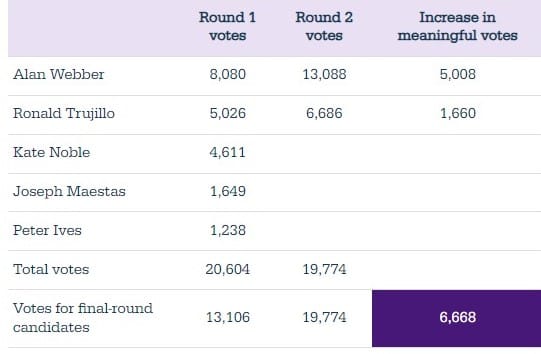
Chart by FairVote
By allowing voters to rank candidates in order of preference, RCV enabled individuals to express their support for multiple candidates without fear of wasting their vote.
In the Santa Fe mayoral race, the vote totals for Alan Webber and Ronald Trujillo increased by 51% compared to their first-choice totals. This 51% represents 6,000 voters whose top pick wasn't a finalist, but they were still able to have a say in the outcome because of RCV.
The implications of this study extend far beyond individual elections. In an era marked by growing disillusionment with traditional electoral systems, RCV offers a promising alternative that prioritizes inclusivity, fairness, and voter engagement.
By eliminating the spoiler effect and promoting consensus-building, RCV fosters a more vibrant and representative democracy.
RCV is the fastest growing nonpartisan voting reform in the US. Today, 50 US jurisdictions use RCV elections, including 2 states, 3 counties, and 45 cities. The reform reaches approximately 13 million voters.