 Cara Brown McCormick

Independent and No Party Preference voters turned out at record levels in California's June 2 top-two primary. Now they are poised to decide 16 competitive Southern California legislative races on November 3, 2026, and the direction of the state legislature.
California's top-two primary sends the top two finishers to the general election, regardless of party. In parts of Southern California, that means two Democrats advance and no Republican appears on the November ballot. Where that happens, voters registered with neither party will decide the winner. Several of these matchups pit a Democratic Socialists of America (DSA)-recommended candidate against a moderate Democrat, and independents will settle which wing of the party takes the seat.
1. Assembly District 68
David Penaloza (D) vs. Jessie Lopez (D)
Independents and Republicans May Decide Whether Jessie Lopez Can Lead the Socialist Wing of the Democratic Party to Victory in Orange County over Moderate Dem David Penaloza.
No Republican is on the ballot, so the 68,000 independent voters in AD68 will be the deciders in this general election matchup between the DSA-recommended Jessie Lopez and David Penaloza, a moderate Democrat.
The pair finished the June 2 primary fewer than a thousand votes apart, Penaloza at 33 percent and Lopez at 31 percent.
 Cara Brown McCormick
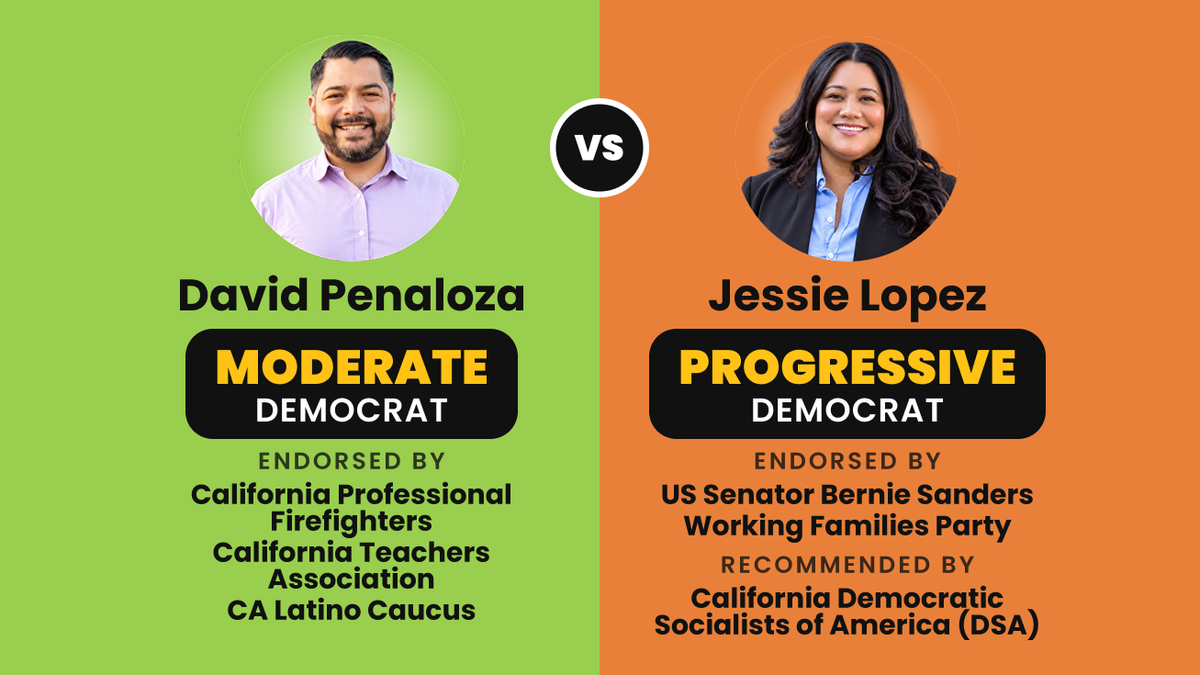
Lopez is recommended by the Orange County Democratic Socialists of America and backed with money and organizers from SEIU California, the Working Families Party, and Bernie Sanders.
This election pits two Santa Ana councilmembers against one another. As council members, Lopez and Penaloza have voted on different sides of economic and voting bills for the past 6 years.
In her first year on the council, Lopez cast the deciding vote on the rent stabilization and just cause eviction ordinance, which passed 4-3 and made Santa Ana the first city in Orange County with its own rent control law. The DSA advocates for universal rent control and strong tenant protections as part of its platform, treating housing as a human right rather than a for-profit commodity.
Penaloza voted against the 2021 rent control ordinance, calling it rushed and saying its $300,000 allocation came from one-time money that would deepen city debt.
Lopez supported Measure DD, which would have allowed noncitizens to vote in Santa Ana local elections. The DSA’s platform, unveiled in 2026, supports noncitizen voting. Penaloza opposed Measure DD.
“Shall the City of Santa Ana City Charter be amended to allow, by the November 2028 general municipal election, noncitizen City residents to vote in all City of Santa Ana municipal elections?” (Measure DD, Failed 40-60)
Lopez was harshly criticized before the June 2 primary for supporting a 556 percent council pay raise for herself and other elected officials in Santa Ana. Penaloza voted against raising his own pay.
Lopez created Santa Ana’s Police Oversight Commission to investigate police misconduct. In late 2023, California DSA chapters actively campaigned to help her survive a highly contentious recall election. The DSA celebrated the successful defense of her seat as a major win in Southern California. Voters rejected the recall 56-44.
Penaloza is supported by the California Democratic Party, California Assembly Speaker Robert Rivas, retiring Assemblymember Avelino Valencia, former Representative Katie Porter, the California Teachers Association, and nearly all of California’s public safety unions.
Lopez is 37 and was born and raised in Santa Ana. She is the daughter of immigrants and worked two jobs to put herself through school. She earned an associate's degree from Santa Ana College and a bachelor's in sociology from Cal State Long Beach. In 2020, she won the Ward 3 seat on the Santa Ana City Council and was elected to the Orange County Central Committee the same year. She was reelected to the council in 2024.
The Orange County chapter of the Democratic Socialists of America recommends her. SEIU California, UFCW 324, NUHW, the Working Families Party, and US Senator Bernie Sanders endorse her.
David Penaloza was born January 6, 1988, and has lived in Orange County his entire life. His father was tragically killed by a drunk driver when he was three, and he credits his mother and the surrounding community with holding the family together. His website says he learned to swim and played baseball at the Memorial Park Community Pool, and swam and played water polo for Saddleback High. He earned a bachelor's degree in English language and literature from Cal State Los Angeles in 2011.
While still a student, Penaloza started working part-time in the office for Color Science, Inc., an Orange County manufacturer. He worked at the company for 16 years, moving through shipping and receiving, sales, payroll, project quality, and regulatory compliance, and became director of regulatory affairs in 2019.
Penaloza won a seat on the Santa Ana City Council in 2018 and won again in 2022. His current term ends on December 8, 2026.
He is president of the League of California Cities Orange County Division and chair of the Transportation Corridor Agencies.
He previously served as the large city representative for the Orange County Housing Finance Trust.
His campaign credits him with more than 2,000 new housing units, five new parks, street and infrastructure repairs, the city's first new library in 60 years, and a refinancing of the city's pension debt. He worked to restore the Memorial Park pool where he learned to swim, which hadn't been renovated since 1965.
He is a member of Elks Lodge #794 and has volunteered with the Children's Resource Center through the Illumination Foundation. He lives in Santa Ana with his wife, former Garden Grove councilmember Kim Nguyen-Penaloza, who ran for Congress in 2024, and their two children, Penelope and Lucas.
Democrats hold 48 percent of the district's registration and Republicans 22 percent, leaving 68,000 voters, or 30 percent, registered with neither party, of whom 54,000 are No Party Preference.
The district lies entirely within Orange County: half in Santa Ana, roughly 30 percent in Anaheim, and 20 percent in the city of Orange. It is majority Latino, with Latinos comprising 56 percent of voting-age citizens. Fifty-seven percent of households rent at a median of $2,050, while the median home value is $709,000, which is why rent control has been an issue; 36 percent of residents are foreign-born, and 20 percent are noncitizens, which is why the voting measure reached the ballot. Angel Stadium, the Honda Center, Chapman University, Santa Ana College, and the Bowers Museum fall inside its lines.
2. Assembly District 66
Paul Seo (D) vs. Sara Deen (D)
Independents and Republicans May Decide Whether Sara Deen Can Lead the Socialist Wing of the Democratic Party to Victory in the South Bay Over Moderate Dem Paul Seo.
It’s a moderate democrat vs. a DSA-recommended democrat in this assembly race. With no Republican on the ballot, 75,000 NPP voters in AD66 will decide who wins if they turn out.
 Cara Brown McCormick
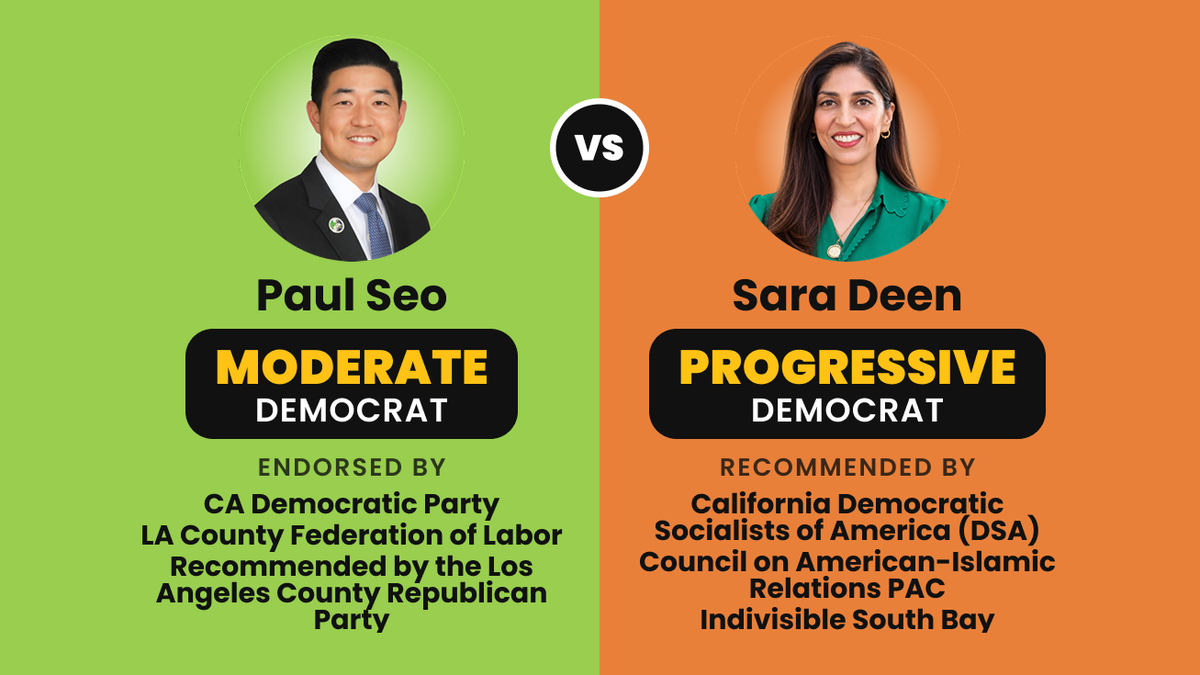
The two Democrats who emerged from the primary finished two points apart, Seo at 27 percent and Deen at 25 percent.
Seo, the popular mayor of Rancho Palos Verdes, is a deputy state attorney general and an Army veteran who spent seven years prosecuting serious and violent felonies for the Los Angeles County District Attorney.
Seo has assembled a coalition of organized labor and law enforcement endorsements: the Los Angeles County Federation of Labor, IAM District 947, and USW Local 675, along with the Association of Deputy District Attorneys, the Association for Los Angeles Deputy Sheriffs, and the Los Angeles Police Protective League. He has pledged to increase funding for police, sheriff's deputies, prosecutors, and the Highway Patrol.
Deen is a Pakistani-American dentist and presides over the Palos Verdes Peninsula Unified School District board.
The California Democratic Socialists of America voter guide says, “Sara Deen is clearly positioned as the progressive candidate in this not-very-progressive district, so we recommend that you should vote for her.”
Deen asked DSA-LA to remove its recommendation from its voter guide. "We asked for it to be removed because it misrepresents my values and equates Muslim Americans with socialism - giving opponents a safer way to attack my identity instead of my record," she said. Later, she said that she "did not intend to say that DSA-LA itself equates Muslim-Americans with socialism."
"What I meant to say is that political opportunists took DSA-LA's recommendation, which I never sought, and used it to feed a false narrative - painting Muslim-American leaders as secret socialists, communists, or dangerous outsiders."
Deen is also endorsed by the California Teachers Association, the California Dental Association, the California Women's List, the National Women's Political Caucus, and Indivisible South Bay also endorsed Deen.
Initiate Justice Action, a criminal justice reform group, recommended Deen as its “harm reduction” candidate, citing the law enforcement backing of Seo as a negative.
Deen is 47 and lives in a $4 million house in Rancho Palos Verdes with her partner, who is also a doctor. CAIR-CA PAC, a political action committee associated with Hussam Ayloush. She has faced calls for her resignation from the Palos Verdes Peninsula Unified School District board over her social media posts about the Israel-Hamas war.
In October 2023, Deen spoke from the main stage at the California Democratic Party's convention in Sacramento, calling for a cease-fire in Gaza as delegates cheered and chanted "cease-fire now."
Rabbi Steven Jacobs & Dr. Sara Deen stand in solidarity to condemn islamophobia and antisemitism during the 2023 November Endorsing Convention. #Organize2Win pic.twitter.com/sIoAPsJqVh
— California Democratic Party (@CA_Dem) November 18, 2023
She was joined at the podium by Rabbi Steven B. Jacobs, who condemned abuses by both Hamas and the Israeli government, and the convention later drew scrutiny over the safety of Jewish delegates. Deen said she has facilitated New Ground Muslim Jewish Partnership for Change, a program pairing Jewish and Muslim high schoolers for a year of dialogue, and described the rise in antisemitism and anti-Muslim hate as "two sides of the same coin."
Democrats hold 43 percent of the district and Republicans 27 percent, leaving 97,000 voters, or 30 percent, registered with neither party, of whom 75,000 are No Party Preference.
The district takes in the heart of the South Bay: Torrance, Redondo Beach, Manhattan Beach, Hermosa Beach, El Segundo, Gardena, Lomita, San Pedro, and the Palos Verdes Peninsula.
Suburban and affluent, this district voted for Joe Biden by a whopping 63 percent in 2020. Its population of roughly 474,000 is 44 percent non-Hispanic white, 23 percent Asian, 21 percent Latino, and 4 percent Black. It’s one of the most Asian-American districts in the Assembly.
3. Senate District 24
John Erickson (D) vs. Brian Goldsmith (D)
Independents and Republicans May Decide Whether John Erickson Can Lead the Socialist Wing of the Democratic Party to Victory on the Westside of LA Over Moderate Dem Brian Goldsmith.
The top two candidates are both Democrats, separated by 2 points in the June 2 primary: Erickson at 21 percent and Goldsmith at 19 percent. Erickson ran third on election night and climbed to first as late ballots were counted.
The California Democratic Socialists of America recommended Erickson as the field's leading progressive.
Whether that recommendation helps or hurts Erickson depends on whether 162,000 No Party Preference voters from the Westside of LA turn out and pick a side.
 Cara Brown McCormick
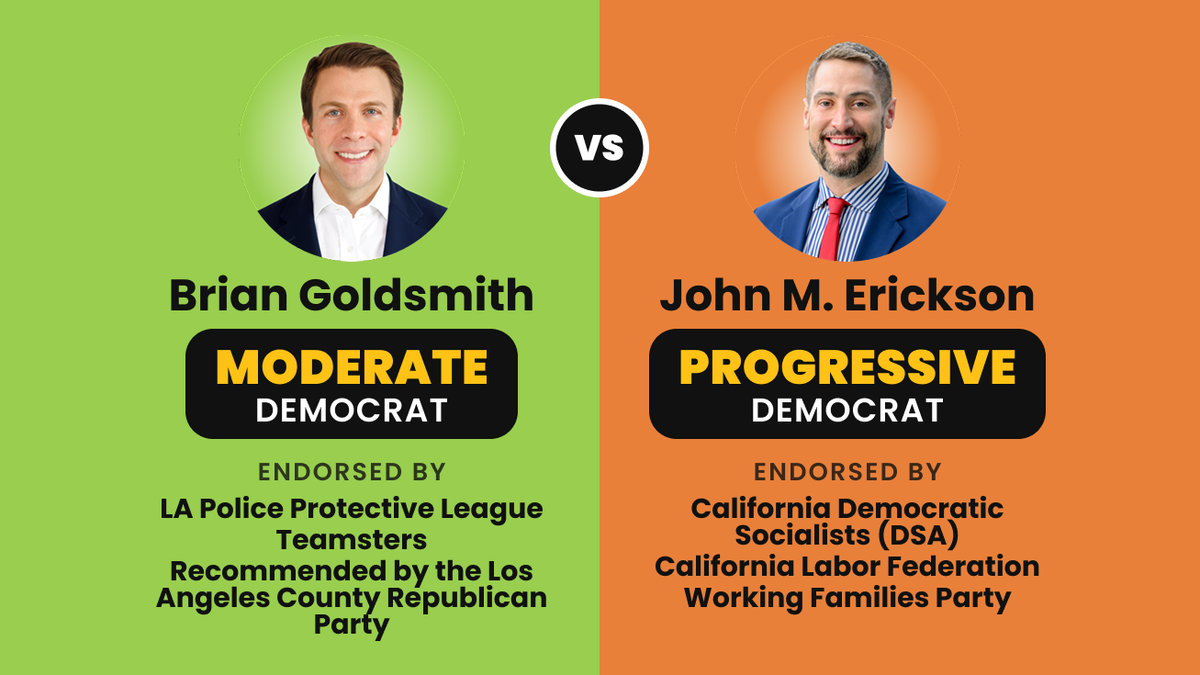
Erickson, 40, a West Hollywood councilmember and former mayor who came to California from Wisconsin, spent his career at Planned Parenthood Los Angeles, where he was a vice president, and at the Alliance for a Better Community. The California Labor Federation, the Working Families Party, and the California Teachers Association endorse him. At the California Democratic Party's February endorsing convention, Erickson took just 8 percent.
Goldsmith is endorsed by voters from across the political spectrum.
He is a Beverly Hills media consultant, journalist, and first-time candidate, raised more than $2 million (more than anyone else in the primary) and assembled a roster of national support from across the political spectrum that includes Nancy Pelosi, Hillary Clinton, Pete Buttigieg, Antonio Villaraigosa, Rick Caruso, and Katie Couric, along with CAL FIRE Local 2881, ILWU and the Teamsters.
Democrats make up 49 percent of this Senate district with Republicans at just 21 percent, leaving 209,000 voters, or 30 percent, registered with neither party.
California Senate District 24 includes the cities of Agoura Hills, Beverly Hills, Calabasas, El Segundo, Gardena, Hermosa Beach, Hidden Hills, Lomita, Malibu, Manhattan Beach, Palos Verdes Estates, Rancho Palos Verdes, Redondo Beach, Rolling Hills, Rolling Hills Estates, Santa Monica, Torrance, West Hollywood, and Westlake Village, and the Los Angeles neighborhoods of Bel Air, Beverly Grove, Brentwood, Fairfax, Holmby Hills, Hollywood, Hollywood Hills, Little Holmby, Mid City West, Pacific Palisades, Playa del Rey, Sunset Hills, Venice, Westwood, Westwood Village, and the unincorporated Los Angeles County communities of Santa Monica Mountains and Marina Del Rey.
Affluent, heavily Democratic, and expensive to campaign in, the race for SD24 could be the most costly legislative contest in California this year.
4. Senate District 26
Sara Hernandez (D) vs. Sarah Rascón (D)
Independents and Republicans May Decide Whether Sarah Rascón Can Lead the Socialist Wing of the Democratic Party to Victory in East LA over Moderate Dem Sara Hernandez.
This could be a DSA pickup seat. State Senate District 26 in East LA contains the highest concentration of DSA-LA members in Southern California, and Rascón carries the DSA endorsement.
 Cara Brown McCormick
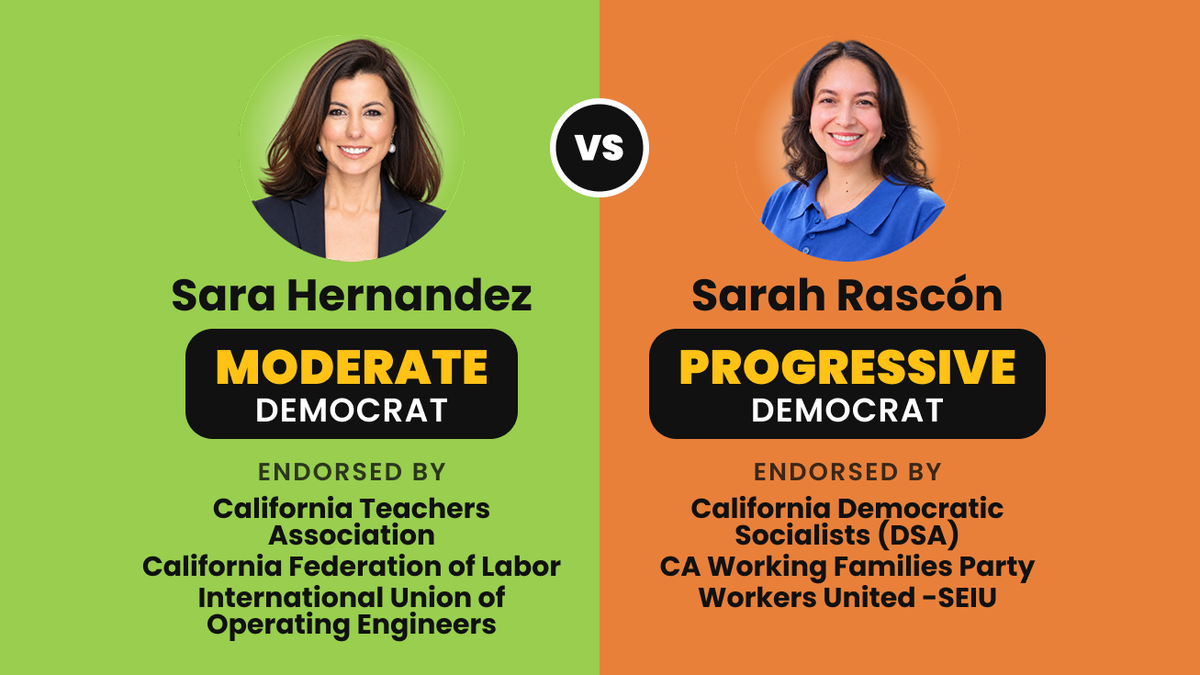
The 116,000 No Party Preference voters here outnumber the entire Republican electorate nearly three-to-one. If independents and NPP voters turn out, they will decide it.
In the June 2 primary, Hernandez emerged with a commanding 34 percent to Rascón's 21.
Hernandez, a trustee of the Los Angeles Community College District and a housing, immigration, and environmental attorney who began her career teaching middle school for the Los Angeles Unified School District, holds degrees from Duke, Loyola Marymount, and Loyola Law School and lives in Eagle Rock. She has the endorsements of the California Teachers Association, the California Federation of Labor, IUOE Local 12, and much of the elected Democratic establishment, including sitting state senators who would become her colleagues.
Rascón, who grew up in El Sereno and lives in Glassell Park, comes out of sustainability and environmental justice work: she served as director of county and regional affairs for Mayor Karen Bass, worked for then-Assemblymember Jimmy Gomez and the Mountains Recreation and Conservation Authority, sat on the East Los Angeles Planning Commission, and served on the board of CicLAvia. The Democratic Socialists of America, the California Working Families Party, and the New Deal Democrats recommend her.
The California DSA voting guide recommended Rascón because “she supports Single Payer healthcare via CalCare, repealing the Ellis and Costa-Hawkins Acts and reforming Proposition 13.”
Rascón also supports the “full liberation of Palestine.”
Democrats hold 60 percent of registration and Republicans just 11 percent, leaving 147,000 voters, or 29 percent, registered with neither party, of whom 116,000 are No Party Preference. The unaffiliated bloc here is nearly three times the size of the Republican electorate. With no Republican on the ballot and two Democrats offering sharply different politics, those voters are the swing.
The district runs through central and eastern Los Angeles: Boyle Heights, East Los Angeles, Highland Park, Los Feliz, Koreatown, and the industrial city of Vernon. It is heavily Latino and immigrant, and at candidate forums this spring, residents' questions centered on immigration enforcement, public health, and the environment.
5. Senate District 40
Mara Elliott (D) vs. Kristie Bruce-Lane (R)
Independents May Decide Whether Mara Elliott Can Flip This Senate Seat from Red to Blue Over Pro-Voter ID Activist Kristie Bruce-Lane.
Elliott took 48 percent of the primary vote to Bruce-Lane's 28 percent in the race to succeed Senate Minority Leader Brian Jones, a Republican who is termed out.
Elliott served two terms as San Diego City Attorney, the first woman and first Latina to hold the office. She created the office's first affirmative civil enforcement unit, sued opioid manufacturers and distributors in a case that returned tens of millions of dollars to the region, and established a conservatorship unit to handle unhoused residents with severe mental illness.
“Nobody's ever had the experience I would bring to the table, and everything we're talking about right now that really impacts people has to do with how government runs,” she said.
Bruce-Lane, a businesswoman, nonprofit founder, and former Olivenhain Municipal Water District board member, is backed by Carl DeMaio and Reform California and campaigns on border security, repealing the state's sanctuary laws, and overhauling housing-first homelessness policy.
Bruce-Lane served as regional co-chair of the California Voter ID Initiative.
Bruce-Lane has run for the Assembly twice and lost both times, by three points in 2022 and by eight in 2024.
This is one of the most evenly divided districts in the California state Senate. Democrats hold 35 percent of registration and Republicans 34 percent, a gap of less than a point. Some 189,000 voters, or 31 percent, are registered with neither party, including 142,000 No Party Preference voters. The independent bloc is nearly as large as either party's and more than thirty times the size of the registration gap between them. No serious path to victory exists here without it.
The district covers inland San Diego County: Santee, Lakeside, Alpine, Ramona, Poway, Escondido, San Marcos, Valley Center, Fallbrook, and the northeastern edge of the city of San Diego. It has flipped between the parties repeatedly, and the Republican registration advantage, which stood at more than fourteen points in 2014, has since collapsed to nothing.
Will Elliot pick up enough independents to ride a blue wave in November? Bruce-Lane starts twenty points down in a district with no registration edge for either party. The 142,000 No Party Preference voters here are more than thirty times the gap separating Democrats and Republicans. If independents and NPP voters turn out, they will decide it.
6. Assembly District 34
Randall Putz (D) vs. Charles Hughes (R)
Independents May Decide Whether Lifelong Republican-turned-Democrat Randall Putz Can Beat Navy Veteran Charles Hughes in Conservative Big Bear.
The Republican Party holds an 8-point registration edge, but party-switching Democrat Randall Putz was able to come close to Republican Charles Hughes in the primary. Whether Hughes’ edge holds in November depends on the 30 percent of voters in this sprawling district who have registered with neither party. If independents and NPP voters turn out, they will decide it.
This is an open seat, and on June 2, just 90 votes separated the top two finalists: Putz at 37.7 percent and Hughes at 37.6, with a third Republican, Steve Fox, taking 19.5 percent.
Putz is a lifelong Republican who changed his registration to Democrat before running for this Assembly seat. He campaigns openly on that history, calling his platform purple and arguing that rural California feeds, waters, and recreates the rest of the state while going unnoticed in Sacramento. He has the California Democratic Party endorsement.
Putz has served Big Bear Lake for more than fifteen years as a school board member, councilmember, and three-time mayor, and he chairs both the Mountain Area Regional Transit Authority and the Big Bear Fire Authority. He is a small business owner and co-founded the Big Bear Valley Trails Foundation.
Hughes, a Navy veteran and retired law enforcement lieutenant who owns a small business and serves as a trustee and two-term president of the Antelope Valley Union High School District board, campaigns on cutting regulations and middle-class taxes, backing law enforcement, expanding school choice, and parental rights in education. He raised more than $250,000 before the primary, a sum Putz has publicly described as difficult to match.
Republicans hold 39 percent of registration here and Democrats 31, an 8-point Republican advantage. Yet the primary finished within ninety votes. The reason is the 30 percent registered with neither party. Lackey won this district by 24 points in 2024 against a Democrat with no such crossover appeal. A party-switching Democrat running as a moderate has erased that margin, and he did it with independents.
The district is vast, covering 18,000 square miles across San Bernardino, Los Angeles, and Kern counties, taking in Big Bear and the Bear Valley communities, the Antelope Valley, Mojave and California City, and the Morongo Basin towns of Twentynine Palms and Landers. It is rural, dispersed, and historically Republican, and neither candidate begins with meaningful name recognition across all three counties.
7. Assembly District 74
Sergio Farias (D) vs. Laurie Davies (R, incumbent)
Independents May Decide Whether Incumbent Laurie Davies Keeps Her Seat As Sergio Farias Tries to Ride A Blue Wave in Southern California.
Davies led the primary with 52 percent to Farias's 48 percent in a district split evenly between Democrats, Republicans and independents.
Republican incumbent Assemblywoman Davies is seeking a fourth term after narrowly holding the seat in 2024.
Davies, 64, came to politics from event and wedding planning and served on the Laguna Niguel City Council from 2012 to 2020, twice as mayor, before unseating fellow Republican Bill Brough in the 2020 primary.
She campaigns on what she calls the largest middle-class tax cut in California history, defense of Proposition 13, and repealing laws she says lowered penalties for property and violent crime and released felons early.
My office is aware of the Emergency Rail Repairs happening in San Clemente, and we’re actively working with @OCTAnews on ways to best support this issue. More information to come. https://t.co/jSgKqeXts3
— Assemblywoman Laurie Davies (@AsmLaurieDavies) September 9, 2026
Davies is a member of the California Problem Solvers Caucus. “Partisanship slows us down; partnership moves us forward,” she said in a post.
Less friction, more function.
— Assemblywoman Laurie Davies (@AsmLaurieDavies) April 10, 2026
Proud to be apart of @CAProblemSolver with members of both parties who choose partnership over partisanship.
Partisanship slows us down; partnership moves us forward. 🤝 #CALeg https://t.co/FsWPp6YC5a
Democrat Farias, the son of immigrants and a lifelong San Juan Capistrano resident, served two terms on the city council, including a term as mayor, and is a local businessman.
He argues the California Dream has moved out of reach for his neighbors and points to his record on affordable housing, homelessness reduction, public safety, and balanced budgets, all achieved with a mixed council.
Equality California, Planned Parenthood of Orange and San Bernardino Counties, and several labor groups endorse him, and he has taken no law enforcement contributions. State Democrats have named the seat a top target.
Republicans hold 35 percent of registration here and Democrats 34.5, a half-point gap.
About 95,000 voters, or 31 percent, are independents, including 69,000 No Party Preference voters.
The district straddles the Orange and San Diego county line, covering Laguna Niguel, Dana Point, San Juan Capistrano, and San Clemente to the north and Oceanside, Vista, Camp Pendleton, and part of Fallbrook to the south. Coastal, suburban, and heavily military, it has stayed Republican since 2022, but it's never been safe.
Will this moderate Republican incumbent survive a blue wave? Davies leads by four points in a district where a half-percentage-point registration gap separates the two parties. If independents and NPP voters turn out, they will decide it.
8. Assembly District 72
Chris Kluwe (D) vs. Gracey Van Der Mark (R)
Independents May Decide Whether Chris Kluwe Can Lead the Socialist Wing of the Democratic Party to Victory in Newport and Huntington Beach over Latina Republican Gracey Van Der Mark.
Democrat Kluwe led the June 2 primary with 44 percent to Van Der Mark's 38 percent, but a third candidate, former Assemblyman Matt Harper, pulled another 13 percent of the Republican vote in the primary.
If more moderate Harper Republicans vote for Van Der Mark, Kluwe will struggle to beat the math. Independents will hold all the cards in deciding if the DSA-backed or the MAGA-backed candidate wins this district, which covers some of Orange County's most beautiful coastal cities, including Huntington Beach and Newport Beach.
Kluwe is a former NFL punter who was arrested for civil disobedience at a Huntington Beach City Council meeting in February 2025 after telling the council during public comment that the MAGA movement is explicitly a Nazi movement. Kluwe’s arrest drew national coverage, and he announced his Assembly campaign roughly three months later. He has since come out for government-owned grocery stores and public utilities.
The California Democratic Socialists of America gave Kluwe its most enthusiastic recommendation of the cycle, writing that he extols the virtues of democratic socialism and would be among the Assembly's most progressive members if elected.
The California Democratic Party, the Working Families Party, and the California Labor Federation also endorse Kluwe.
According to the California DSA Voter Guide, “Kluwe is in an extremely good position to flip this seat.”
Kluwe was charged with a misdemeanor for disrupting an assembly and spent about four hours in jail before being released.
Van Der Mark, a Huntington Beach councilmember and former mayor, is the Republican contender in a city that has become a MAGA local government beachhead.
Van Der Mark counted herself among the "MAGA-nificent 7" after the 2024 local elections; she and her fellow Republicans formed an all-conservative supermajority on the Huntington Beach City Council.
In June 2024, the Los Angeles Times’ Gustavo Arellano profiled Van Der Mark calling her career “short but chaotic,” and pointing out that she had been called antisemetic, racist and homophobic.
Republicans make up 39 percent of the registered voters in this district, and Democrats make up 32 percent, a 7-point Republican edge, with 29 percent independent.
The California DSA Voter Guide describes AD72 as “MAGA flags over boardwalks and old-money stucco malls,” but even so, they think that 2026 is their first real chance since 1992 for this seat to swing socialist.
Does Kluwe, a socialist-backed candidate, have the chance to defeat a MAGA Republican in this Orange County seat representing these traditionally Republican beach communities? Kluwe’s only route to becoming the Assembly's most progressive member depends on the 1 in 3 voters registered with neither political party. If independents and NPP voters turn out, they will decide it.
9. Assembly District 70
Paula Swift (D) vs. Tri Ta (R, incumbent)
Independents May Decide Whether Tri Ta Can Keep His Seat
Republican incumbent Tri Ta led the June 2 primary, 54 percent to Paula Swift's 46 percent.
Ta flipped this seat from blue to red in 2022, and he is the first Republican to hold it in a decade. Ta won reelection by 9 points in 2024.
A special thank you to Assemblywoman Alexandra Macedo, our new Assembly Minority Leader, for visiting Little Saigon and taking the time to meet with local community leaders. It was great to welcome her to Little Saigon! @AsmwomanMacedo pic.twitter.com/7o2OcMdJES
— Assemblyman Tri Ta (@TriTa4CA) September 8, 2026
Ta, 53, was born in Saigon and served as mayor of Westminster from 2012 to 2022, the first Vietnamese American mayor of a U.S. city. His years on the Westminster City Council were at times turbulent, and he survived a 2020 recall attempt. In the Assembly, he serves on Appropriations and as vice chair of Local Government and Revenue and Taxation.
Ta was described in the California DSA voter guide as an “extreme anti-communist.”
His comments about Hasan Piker went viral in April 2026.
“Opposing communism is personal. It is why so many families came to America,” Ta said.
Hasan Piker’s remarks about Vietnamese refugees are deeply offensive and cannot go unanswered.
— Assemblyman Tri Ta (@TriTa4CA) April 17, 2026
Those who have chosen to campaign alongside him, and anyone on the political left who has remained silent, are enabling this kind of rhetoric. They have a responsibility to speak out… pic.twitter.com/9fxwq8A2qM
Swift, a small business owner, educator, and advocate for foster youth and domestic violence survivors, moved into this race from a congressional campaign after Proposition 50 redrew the lines.
She put herself through college while raising a family and lost a nonprofit job to pandemic budget cuts. She had raised $36,000 by April and says she will take no police, fossil fuel, real estate, or corporate PAC money. The California Democratic Party, Representative Dave Min, Senator Bob Archuleta, the California School Employees Association, UDW/AFSCME Local 3930, and Planned Parenthood of Orange and San Bernardino Counties endorse her.
Democrats hold 36 percent of registration here and Republicans 33 percent. Some 85,000 voters, or 31 percent, are registered with neither party; of those, 68,000 are No Party Preference, the highest No Party Preference share of any Assembly district in this guide, at nearly 25 percent. Democrats have led registration here throughout Ta's tenure. Independents are why he holds it anyway.
The district covers northwestern Orange County: all of Westminster, Stanton, Los Alamitos, Fountain Valley, and Garden Grove, with parts of Seal Beach, Santa Ana, and Huntington Beach. It includes Little Saigon and is 39 percent Asian and 34 percent Latino, making it one of the most Asian-American districts in the state.
Will this moderate incumbent Republican survive a blue wave in November? Ta has held this seat through three elections despite a Democratic registration edge, thanks to the 68,000 No Party Preference voters who make up nearly a quarter of the electorate. If independents and NPP voters turn out, they will decide it.
10. Senate District 36
Chris Duncan (D) vs. Tony Strickland (R, incumbent)
In the June 2 primary, incumbent Senator Tony Strickland brought home 53 percent of the vote to Democrat Chris Duncan's 47 percent, a majority for a sitting senator but a narrow one. Strickland first won the seat outright in a March 2025 special election.
Strickland has a storied career in California politics. He’s a former Assemblyman, former state senator, and Huntington Beach councilmember.
He’s campaigning for reelection on public safety, lower taxes, and cutting wasteful spending.
Strickland says “regulations and unaccountable boards and agencies” are partly responsible for the affordability crisis and gas prices.
He also supports Prop 36 in all 58 counties in 2024. “The most essential role of government is public safety,” he said.
Strickland supported nonpartisan redistricting commissions and opposed Proposition 50. “Two wrongs don’t make a right…It’s authoritarianism to say we’ll have predetermined elections…and that’s not good for Democrats, Republicans or independents.”
“We’re the gold model for the rest of the country. People want competitive elections.” He says he didn't believe Prop 50 would be temporary.
Strickland has supported efforts by the California Problem Solvers Caucus.
I signed on to the @CAProblemSolver letter because it’s important to find common sense solutions promoting affordability & protecting jobs to the Cap-and-Invest program. #caleg https://t.co/bzOfwPAddl
— Senator Tony Strickland (@SenStricklandCA) April 21, 2026
Duncan, a San Clemente councilmember and former mayor, spent more than sixteen years as a federal prosecutor under both parties, working on political corruption, corporate wrongdoing, child exploitation, and drug smuggling cases, and later served as a senior assistant chief counsel at US Customs and Border Protection.
He ran for the Assembly in 2020 and lost.
Duncan says he’s proud to be the first Democrat ever elected in San Clemente. As mayor, he added two fire helicopters, deployed officers to high-risk areas, established social worker outreach teams, and claims to have cut homelessness by 23 percent.
Duncan holds law degrees from Georgetown and the University of Hawaii.
He is running on a platform opposing tariffs.
“As an attorney fighting Trump's disastrous tariffs and a member of the Assessment Appeals Board, I see firsthand how our tax system too often burdens those who can least afford it while letting corporate tax cheats off the hook,” Duncan said.
Republicans hold 37 percent of registration and Democrats 33 percent. About 191,000 voters, or 30 percent, are registered with neither party, including 149,000 No Party Preference voters.
The district runs along the Orange County coast from San Clemente to Seal Beach. It is coastal and suburban, 63 percent white, and has been held by Republicans since 2022.
Will the moderate incumbent Strickland survive a blue wave? Strickland cleared a bare majority against a challenger who raised an eighth of his money, in a district where the 149,000 No Party Preference voters outnumber the registration gap eight times over. If independents and NPP voters turn out, they will decide it.
11. Assembly District 58
Clarissa Cervantes (D) vs. Leticia Castillo (R, incumbent)
This is a rematch in the closest Assembly race of the last cycle.
Democrat Clarissa Cervantes led the June 2 primary contest with 55 percent to incumbent Leticia Castillo's 45, a reversal of 2024, when Castillo won the seat by 596 votes out of nearly 156,000 cast.
 Cara Brown McCormick

Castillo, 55, is a Riverside-born psychotherapist from Corona who ran and lost in 2022 before flipping the seat in 2024, giving Republicans their only foothold in western Riverside County.
Cervantes, a Riverside councilmember and businesswoman, was the first woman and second Latina and LGBTQ person elected to represent Ward 2. She is the sister of state Senator Sabrina Cervantes, who held this Assembly seat before her, and she has backing from organized labor, progressive groups, and the Working Families Party.
Democrats hold 42 percent of registration here and Republicans 28. Some 83,000 voters, or 31 percent, are registered with neither party, including 62,000 No Party Preference voters. Castillo won this district in 2024 despite a fourteen-point Democratic registration disadvantage.
AD 58 includes the entire cities of Jurupa Valley and Grand Terrace, plus portions of Corona, Eastvale, and Riverside. It includes the Mission Inn, a grand hotel that has hosted ten presidents, and Mount Rubidoux Memorial Park.
According to the California Target Book, the district was redrawn to comply with the Voting Rights Act, anchored in northwest Riverside County.
Once a safely Democratic seat, it has become one of Southern California's most competitive districts, with independent voters now holding significant sway.
Will moderate Republican Leticia Castillo survive a blue wave? Castillo won this seat by 596 votes in 2024 despite a fourteen-point Democratic registration deficit. The same 62,000 No Party Preference voters who elected her once will decide whether she keeps the seat. If independents and NPP voters turn out, they will decide it.
12. Assembly District 38
Steve Bennett (D, incumbent) vs. Michael MacDonald (D)
Bennett took 69 percent of the primary to MacDonald's 31. Only two candidates filed.
Bennett, 75, has been in Ventura County politics for three decades: two terms on the Ventura City Council beginning in 1993, twenty years on the county Board of Supervisors, and the Assembly seat since 2020.
He was a linebacker and team captain at Brown and holds a master's in education from Butler. In the Assembly, he has focused on limiting environmentally damaging water use. He and his wife have shared their home with an immigrant family from Mexico for fourteen years. The California Labor Federation and the California Teachers Association endorsed him.
MacDonald has served as Ventura's city clerk since 2022 and previously served as assistant city clerk in Berkeley and as chair of the Oakland Public Ethics Commission.
Democrats hold 47 percent of this district and Republicans 24 percent, leaving 80,000 voters, or 29 percent, registered with neither party, of whom 58,000 are No Party Preference.
The district covers western Ventura County and roughly 485,700 residents, including Oxnard, Ventura, Santa Paula, Port Hueneme, Fillmore, Ojai, and part of Camarillo.
Bennett's 38-point primary lead makes an upset unlikely, but the 58,000 No Party Preference voters still have no candidate speaking directly to them. If independents and NPP voters turn out in numbers large enough to matter, they will decide it.
13. Senate District 38
Catherine Blakespear (D, incumbent) vs. Laura Bassett (R)
Democrat incumbent Blakespear took 55 percent in the primary, while Bassett took 45 percent. She flipped this seat from red to blue in 2022 and is defending it for the first time.
Blakespear, 50, is an estate planning attorney and former journalist whose family has lived around Encinitas for nearly a century. She served two years on the Encinitas City Council and six as mayor, during which she made the city the county's first to deliver fully renewable power, banned ghost guns, and passed safe storage requirements.
In the Senate, Blakespear chairs the Environmental Quality Committee and the Transportation Subcommittee on the LOSSAN rail corridor. She has authored 24 bills signed into law, including the ban on plastic bags at grocery checkouts and legislation requiring people in mental health crisis to surrender firearms. She is widely described as a moderate.
Bassett is a small businesswoman running her first campaign for the seat. She runs two local small businesses and has been a licensed real estate broker since 2003 and a licensed professional fiduciary since 2011. Bassett is a lifelong resident of Oceanside, California.
She currently serves as a San Diego County Civil Service Commissioner.
She earned her Bachelor of Science in Accounting from the University of Southern California (USC) in 1989. She and her husband homeschooled their six children, and the whole family has been active in local community theater.
California Republicans have named the district among those they hope to flip as they try to block a Democratic supermajority.
Democrats hold 37 percent of registration here and Republicans 32 percent. Some 196,000 voters, or 31 percent, are registered with neither party, including 146,000 No Party Preference voters.
The district covers northern San Diego County and southern Orange County, including Encinitas, Carlsbad, Mission Viejo, and La Jolla. Historically a toss-up, it has trended Democratic because the San Diego portion outweighs the Orange County portion.
Bassett trails by ten points against a Democratic incumbent widely described as a moderate herself, in a district Republicans have named a top target. The 146,000 No Party Preference voters here outnumber Republicans outright. If independents and NPP voters turn out, they will decide it.
14. Assembly District 69
Josh Lowenthal (D, incumbent) vs. Carolyn Essex (D)
Lowenthal took 69 percent of the primary to Essex's 29 percent, and the two Democrats advance together in a district where no Republican mounted a serious campaign.
Lowenthal, 56, is a Long Beach native and former business owner, the son of former Representative Alan Lowenthal and former Assemblymember Bonnie Lowenthal. He won this seat in 2022 and now serves as Assembly Speaker Pro Tempore. He has authored bills holding social media platforms accountable for harm to minors and legislation creating resentencing opportunities for incarcerated people serving in fire camps.
The California Labor Federation endorsed him; the California Teachers Association issued no recommendation. Initiate Justice Action supports him.
Essex spent 18 years in civil service with the City of Los Angeles before moving into hotel operations and then politics, and has worked as a community organizer and civil rights advocate.
She approaches public safety through public health, calling for CPR and first aid training in schools, neighborhood mental wellness centers, and expanded harm reduction services.
Democrats make up 51 percent of this district, Republicans 18 percent, and 30 percent are registered with neither party, including 66,000 No Party Preference voters.
The district covers Long Beach and Signal Hill.
15. Assembly District 47
Leila Namvar (D) vs. Greg Wallis (R, incumbent)
Independents and Republicans May Decide Whether Namvar Can Lead the Socialist Wing of the Democratic Party to Victory in the Coachella Valley.
Incumbent Republican Greg Wallis led the June primary with 48 percent to Leila Namvar's 32 percent in a four-candidate field where three Democrats split the opposition. She emerged ahead of software engineer Jason Byors and Lucas Pinon, a director of special projects for Representative Raul Ruiz, both of whom ran serious campaigns.
 Cara Brown McCormick
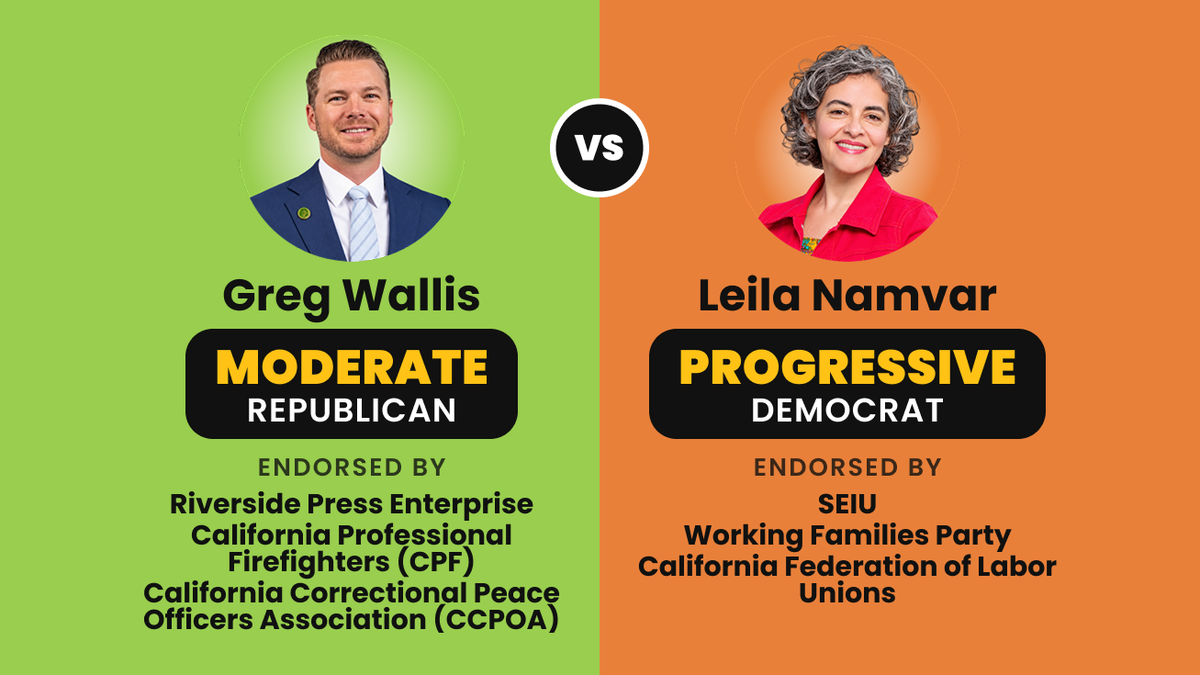
Wallis, 36, a third-generation Californian from Bermuda Dunes, was district director for Assemblymember Chad Mayes before winning this seat in 2022 out of a four-way field containing two Democrats and two Republicans. He introduced 37 bills in the 2023 to 2024 session and saw five signed into law, among them a prohibition on altering license plates to defeat identification.
More than half of California’s legislators joined Wallis’s call to urge Interior Secretary Doug Burgum to halt and reject the proposed Yosemite land exchange benefiting a private developer.
61 of California's 118 legislators joined my call to urge Interior Secretary Doug Burgum to halt and reject the proposed Yosemite land exchange benefiting a private developer.
— Assemblymember Greg Wallis (@AsmWallis) September 2, 2026
Swipe to read the full letter. pic.twitter.com/KsA5Zb60Vb
CalMatters classifies Wallis as one of the Legislature's most moderate Republicans, and his record supports the label in both directions. He was the only Republican to vote for Governor Newsom's $180 million wildfire prevention package. He signed a bipartisan letter urging expedited work permits for undocumented essential workers. He backed placing same-sex marriage rights in the state constitution. He helped secure funding to rebuild a Palm Springs fertility clinic damaged in a bombing.
🚨 BREAKING 🚨#PalmSprings / #California
— OC Scanner 🇺🇸 🇺🇸 (@OC_Scanner) May 17, 2025
NEW UPDATE: This was an explosion at “American Reproductive Centers” which is an IVF and fertility center serving the Coachella Valley area. Reports say the explosion was felt as far as 3+ miles away. Some have stated this may have… https://t.co/6XPb3uaMk1 pic.twitter.com/jyIWlfOJbq
Planned Parenthood scores him at 100 percent and NARAL at 75. Organized labor and environmental groups do not: 28 percent from the California Labor Federation, zero from UFCW, zero from Sierra Club California and the California Environmental Justice Alliance. His coalition includes business groups, law enforcement organizations, and the Western States Carpenters.
Wallis belongs to the Bipartisan Problem Solvers Caucus and describes his district as a mix of Republicans, Democrats, and independents who value results over party.
The California Problem Solvers Caucus is a new voice – and a unique venue – to address complex state challenges. Our bipartisan, bicameral caucus is both a convener and a catalyst, bringing together innovative ideas and diverse stakeholders to advance pragmatic policymaking.… pic.twitter.com/wjYtFlQ2Om
— California Problem Solvers Caucus (@CAProblemSolver) April 10, 2026
Namvar, 54, was born and educated in Iran and worked in Tehran on urban planning. She applied to immigrate in 1983 and waited nearly two decades, arriving in 2002. With degrees including one in architecture, she worked as a movie theater cashier, a Red Cross lab assistant, and a planning technician for Indio, sometimes working three jobs while studying English at night. She naturalized in 2008, earned a master's in public administration, and now runs Indio's public arts programming after helping shape the city's general plan and downtown housing density framework.
Namvar is the DSA-recommended candidate.
“We recommend Leila Namvar for Assembly District 47.” - California DSA Voter Guide, 2026
She served as president of SEIU Local 721 for Indio city employees and led contract negotiations three times. She campaigns on affordable housing, environmental justice, healthcare, and education, and says the American dream she believed in is slipping away from too many.
Democrats make up 38.7 percent of registered voters here, and Republicans 33.5 percent, an advantage of about five points. Some 93,000 voters, or 28 percent, are registered with neither party, of whom 65,000, nearly one in five voters, are No Party Preference.
Biden carried the district by 6.6 points in 2020, and Harris won it by 4 points in 2024. Adam Schiff carried it by a single point. Newsom lost it narrowly in 2018 and won it by 2 points in 2022.
Through it all, Wallis has held the Assembly seat, beating Christy Holstege by 85 votes in 2022 and by 5,534 in 2024 on the same ballots where Harris and Schiff won. Turnout in November 2024 reached 72 percent. Independent expenditures topped $2.5 million that cycle, and the California Target Book again expects this to be among the state's most competitive legislative races.
The district stretches across Riverside and San Bernardino counties, including Banning, Beaumont, Calimesa, Cathedral City, Desert Hot Springs, Indian Wells, La Quinta, Yucaipa, Palm Springs, Palm Desert, Rancho Mirage, and Yucca Valley, plus portions of Redlands, Highland, and San Jacinto.
Much of it lies in the Coachella Valley, where tourism, housing costs, infrastructure strain, and seasonal population swings drive local politics, and Joshua Tree National Park anchors its eastern end. Its population of 523,318 is 48.5 percent white and 39.3 percent Latino, with a median household income of $78,451, homeownership at 70.7 percent, and 29,537 civilian veterans, 7.1 percent of residents.
Will this moderate Republican survive a DSA challenge? CalMatters calls Wallis one of the most moderate Republicans in the Legislature, and he has held this seat on ballots where Biden, Harris, and Schiff all won. The 65,000 No Party Preference voters here, nearly one in five of the electorate, are the reason. If independents and NPP voters turn out, they will decide it.
16. Assembly District 36
Ida Obeso-Martinez (D) vs. Jeff Gonzalez (R, incumbent)
Incumbent Jeff Gonzalez took first place in the June 2 primary with 45 percent to Ida Obeso-Martinez's 24 percent in a four-candidate field.
Gonzalez is a member of the bipartisan California Problem Solvers Caucus.
Obeso-Martinez entered the campaign as the least funded of three Democrats and finished ahead of Indio councilmember Oscar Ortiz, who had raised twice as much and had the California Federation of Labor Unions, SEIU California, the California Teachers Association, the California Federation of Teachers, the Inland Empire Labor Council, and the Legislative Progressive Caucus.
 Cara Brown McCormick

Press-Enterprise Columnist Rafael Perez interviewed Obeso-Martinez recently and concluded that she “demonstrated a disturbing lack of knowledge of important matters that she should know about as a prospective state legislator.” Obeso-Martinez said she was unprepared to answer several of his questions about how to make California’s budget more fiscally responsible, and she would not take a position on Prop 40. “Her lack of preparation for office is disqualifying,” Perez wrote.
Gonzalez, 52, is a Marine veteran, former pastor, and small business owner who won the seat in 2024, becoming the first Republican to hold it in years. Born in New Jersey and raised in Southern California, he enlisted at 19, served in counterintelligence and as an operations manager on deployments to Iraq and Afghanistan, and left as a chief warrant officer.
He holds a bachelor's in domestic security management and a master's in theology, spent a decade in ministry at Saddleback Church and Southwest Church in Indian Wells, and now owns a Spherion staffing franchise. He lost a 2018 Assembly bid to Eduardo Garcia and won when Garcia retired.
In June 2024, he announced a coalition of Democrats backing him against Democrat Joey Acuña, a five-term Coachella Valley Unified School District trustee. Among them was Tony Gallegos, the former chair of the Imperial County Democratic Central Committee and a former Imperial Irrigation District director, who said Gonzalez was the kind of person who would set politics aside to solve problems. Gonzalez ran that year on cost of living, education, and bipartisanship, with support from farmers, law enforcement, and business organizations, and he beat Acuña by 3.6 points.
 Dan Schnur
In office, he has authored a bill to suspend the state's 61-cent gas tax for a year, arguing that in desert communities a car is a lifeline rather than a luxury; the Rural Farmworker Women's Health Act, requiring free menstrual products to be distributed in remote agricultural areas; and legislation to expedite environmental review for the $1.5 billion Coachella Valley Rail project, co-authored with a Democrat and a Republican.
He joined the California Hispanic Legislative Caucus, formed by Republicans after the Democratic Latino Caucus declined to admit them, writing that Californians want legislators exchanging ideas across the aisle.
Obeso-Martinez will appeal to healthcare-focused voters and those seeking practical medical expertise. The Imperial Mayor (formerly Mayor Pro Tem) is a cardiovascular nurse practitioner with a doctorate in nursing practice and more than 20 years of emergency room and ICU nursing at local Imperial Valley hospitals.
Speaker Robert Rivas, the California Legislative Women's Caucus, the California Nurses Association, and Representative Raul Ruiz endorse her. She focuses on affordable healthcare, local job creation through career technical education and workforce training, and improved hospital funding. Her campaign is at idaforassembly.com.
Born May 6, 1979, Obeso-Martinez grew up in Imperial County, graduated from Imperial High School, and earned her associate's in nursing from Imperial Valley College, a bachelor's from the University of Phoenix, and a doctorate in nursing practice from the University of Arizona. She was elected to the Imperial City Council in 2022 and has served as mayor pro tem and mayor.
In March 2025, Representative Ruiz brought her to Washington as his guest for President Trump's Joint Address to Congress, where she advocated against Medicaid cuts.
"As a lifelong advocate for expanding health care access in the Imperial Valley, I am here to stand against Medicaid cuts that would limit the care our health facilities can provide to patients," Obeso-Martinez has said.
Democrats make up 41 percent of registered voters here and Republicans just 29 percent. Some 78,000 voters, or 30 percent, are independents and NPP.
The Democratic registration advantage peaked at 17.3 points in 2022, fell to 13.6 points by the 2024 general, and stands at 12 percent today.
No Party Preference registration has nearly tripled since 2008, from about 22,000 voters to 60,000, and from 15 percent of the electorate to 23 percent.
In 2024, with Democrats still holding a thirteen-point registration edge, Trump carried the district 49.5 to 48.2; Republican Steve Garvey beat Democrat Adam Schiff by 1.9 points, and Republican Gonzalez won the seat by 3.6 points. He won by openly courting Democrats and independents rather than turning out Republicans, who make up less than three in ten registered voters here. The question this cycle is whether that coalition holds.
This district sits along the border, where families have ties on both sides and immigrant labor sustains the agricultural economy, and Gonzalez must keep independents uneasy with the Trump administration's direction while running as a Republican.
The district covers all of Imperial County, a large share of Riverside County, and a sliver of San Bernardino, touching the Mexican border to the south, Arizona to the east, and Nevada to the northeast. It includes Indio, Coachella, Blythe, Needles, part of Hemet, and the Imperial Valley cities of Calexico, Brawley, El Centro, Imperial, Calipatria, Holtville, and Westmorland, along with tribal lands of the Quechan, Chemehuevi, and Twenty-Nine Palms Band of Mission Indians. Drawn as a Voting Rights Act seat, it is 69.7 percent Latino, one of the most heavily Latino districts in the state, with a median household income of $66,802, 14.9 percent below the poverty line, and 20.9 percent of households on food assistance. Summer temperatures routinely exceed 110 degrees, while mild winters make the Imperial Valley one of the country's most productive winter vegetable regions, and its farms hold some of the most senior water rights in the United States. The Salton Sea sits entirely within its lines, atop one of the world's largest known lithium deposits, and whoever holds this seat is a central figure in Western water politics. Riverside County casts 62.4 percent of the district's votes and leans Democratic by 8.1 points; Imperial County casts 36.4 percent and leans Democratic by 19.1 points.
Will moderate Republican Jeff Gonzalez survive a blue wave? Gonzalez won his race in 2024 by openly courting Democrats and independents directly rather than relying on the district's shrinking Republican base. No-Party-Preference registration has nearly doubled here since 2008. Whether his coalition holds depends on 60,000 voters; if independents and NPP voters turn out, they will decide it.