.
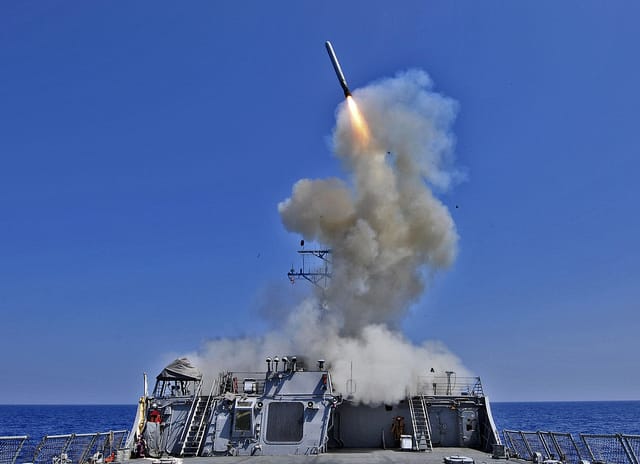
A U.S. Navy Destroyer fires a Tomahawk Cruise Missile. Image Source: Flickr
The much-publicized “generation gap” in U.S. politics is generally thought to apply primarily to domestic policy, and to social issues — like gay rights, religion, and immigration — in particular. But today, as American warships assemble in the Eastern Mediterranean and Congress debates whether to authorize a military strike against Syria, it’s worth considering a different dimension of the generational divide: Foreign policy.
A 2011 Pew Survey found that young Americans, much more than their parents and grandparents, are likely to favor multilateralism over unilateralism, non-intervention over activism, and diplomacy over force. Two-thirds of Millennials, compared to less than half of Baby Boomers, believe that over-reliance on military power creates hatred that leads to more terrorism. More than six-in-ten Millennials believe that the U.S. should make compromises in foreign policy to accommodate the interests of its allies; just four in ten Americans over 65 share that view. On social issues, Millennials might align with Barack Obama, but on foreign policy, we look more like Rand Paul.
Naturally, these broad preferences inform the way Millennials view the prospect of military intervention in Syria. A Washington Post/ABC News poll released Tuesday found that “opposition to unilateral air strikes peaks among young adults, at 68 percent among those younger than 30.”
You could partially explain this demographic disparity in enthusiasm for foreign interventions by pointing to the individualistic mood that undergirds many of young peoples’ political preferences. But it’s also rooted, I think, in the way the America’s global challenges have been transformed over the last several generations. Millennials’ generational memory of World War II and its aftermath — the moment when America stood “at the summit of the world” — is fading. We came of age after the end of the Cold War, so America no longer had as urgent a need to promote its values abroad. Most of us were not yet politically conscious during the first Gulf War or Bill Clinton’s Kosovo intervention — two largely successful deployments of American power to preserve fundamental international norms.
Meanwhile, our formative experience in American foreign policy was the swaggering neoconservatism of the Bush presidency and the quagmire in Iraq. This was soon followed, of course, by the Great Recession, an era of austerity that made expensive wars of choice seem even more nonsensical.
As Ross Douthat and Nicholas Kristof have pointed out, the reason the Obama administration is looking to punish Assad for his use of chemical weapons is not to protect American national security per se (the Obama administration's argument that the use of Sarin gas against Syrians threatens Americans is strained at best), but to try to ensure that Pax Americana — the post-1945 era of relative global stability largely underwritten by U.S. military power — is sustained. However, America’s great achievements as a superpower — the rebuilding of Europe and Japan, the defeat of international Communism, the steady growth of the global economy — seem increasingly distant to Millennials as we suffer through mass unemployment and watch the Middle East continue to burn.
In the unlikely event that Congress turns down President Obama’s request to open fire on the Assad regime, he might ironically have his most loyal constituency — young voters — to blame.
I invite you to follow me on Twitter or email me at jawillick at gmail dot com.