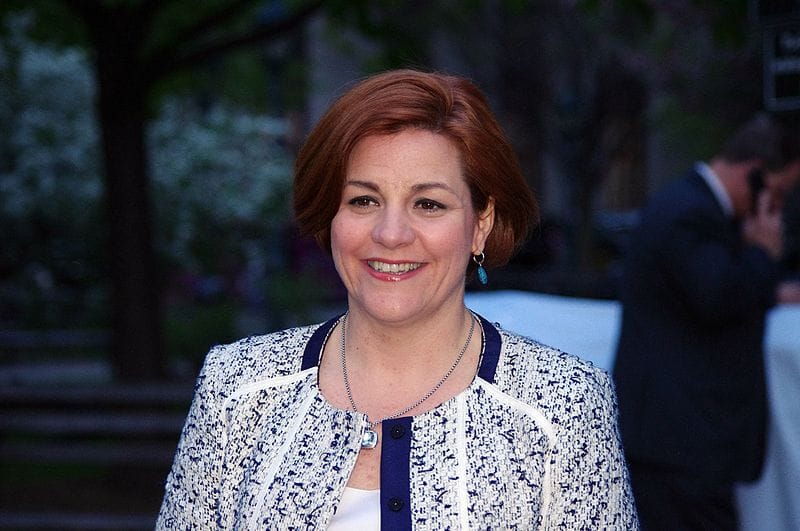
Christine Quinn in 2012 // Credit: David Shankbone
It’s not hard to find politicians with bad records on First Amendment issues. But I’m not aware of any prominent American political figure who has been as consistently in favor of silencing political views with which he or she disagrees than Christine M. Quinn, the Speaker of New York’s City Council and a leading candidate to be its next mayor.
Last summer, Quinn made headlines by writing to the President of NYU — in her official capacity as a government official — demanding that he kick Chick-Fil-A off his campus because Quinn is offended by the Chick-Fil-A CEO’s position on same-sex marriage.
Usually, people calling for censorship pretend to be in favor of the First Amendment. (“I support free speech but...”). Refreshingly, Quinn made her opposition to freedom of speech quite explicit when she wrote, “join me in ensuring that our city does not become a place where those who do not share our commitment have any place to espouse those views.” People who hope to speak publicly during a Quinn administration would be wise to make sure their “commitments” are in line with those of the mayor.
Only a few months later, Quinn signed another official letter asking a college president to censor a viewpoint she disliked — in this case, a panel at Brooklyn College about the Israel divestment (“BDS”) movement delivered by UC Berkeley philosopher Judith Butler and Palestinian activist Omar Bargouti.
Quinn and other elected officials — including, unfortunately, her major competitors in the mayoral race, Bill De Blasio and Bill Thompson — demanded that the event be shut down or “balanced” by the University. (This letter was prefaced with a standard empty gesture to the First Amendment: “While students and professors must remain free to express their views…” which was of course contradicted by the content of the letter). The signatories seemed to be suggesting, in the words of CUNY Professor Barbara Bowen, that colleges “support only forums that advocate equally strongly for two ‘sides’.” (Mayor Bloomberg helpfully weighed in: “If you want to go to a university where the government decides what kinds of subjects are fit for discussion, I suggest you apply to a school in North Korea”).
Quinn’s authoritarian impulses became evident once again during the mayoral campaign, when a liberal citizens’ group created an ad critical of Quinn’s record that her campaign claimed was inaccurate. Her campaign threatened to sue the station that aired the ad and then urged her fellow candidates to reject all ads by independent groups. “In other words,” writes ACLU Executive Director Ira Glasser, Quinn’s position is that “only the candidates themselves and established media outlets, like newspapers, can offer their opinions in elections. Citizens should not have a voice.”
At least one civil liberties issue — stop-and-frisk — has been the subject of vigorous and healthy debate during the New York mayoral campaign. But Quinn’s First Amendment record doesn’t seem to interest voters. This is probably in part because Quinn’s attempts to undermine free expression don’t have a particular ideological coherence — her attempt to evict Chick-Fil-A came from the gay rights “left” while her interference with the anti-Israel event came from the pro-Israel “right” — so people who get exercised by the former are less likely to get exercised by the latter, and vice versa.
When it comes to their First Amendment records, New Yorkers unfortunately don’t have any good choices among the three leading candidates, all of whom signed the Brooklyn College letter. But Quinn has three strikes against her since last summer. America's most pro-censorship politician should not be made America's most powerful mayor.
I invite you to follow me on Twitter or email me at jawillick at gmail dot com.